
An enigmatic story is contained in Ibn Khallikan’s biographical summary of the life of the seventh century Basran poet Ibn Mufarrigh. The story is one of the few times that the biographer, speaking of himself in the first person, relates an incident connected with his own life.
Whether the tale may be accepted on its face, or whether it may be a form of allegory, or whether it exemplifies a credulous delusion, we will leave for the reader to decide. Our stalwart biographical compiler, Ibn Khallikan, first dutifully describes the life and influence of the obscure Iraqi poet Ibn Mufarrigh. Then he takes a startling detour to recount a personal anecdote. He says:
Jarud is a village situated in the dependencies of Damascus and lying in the government of Hims [Emessa]. Onagers are extremely abundant in that country. When the division of Egyptian troops entered into Syria [A.H. 660, A.D. 1261-2] and marched against Antioch with the troops of Syria, it halted for a short time at Damascus, where I then was, and from that it returned back. The army entered into Damascus towards the end of the month of Shaabzin of that year [July, 1262]. A person belonging to that army related to me a circumstance so curious that it may very well be mentioned here. [Trans. by M. de Slane, vol. IV.245]
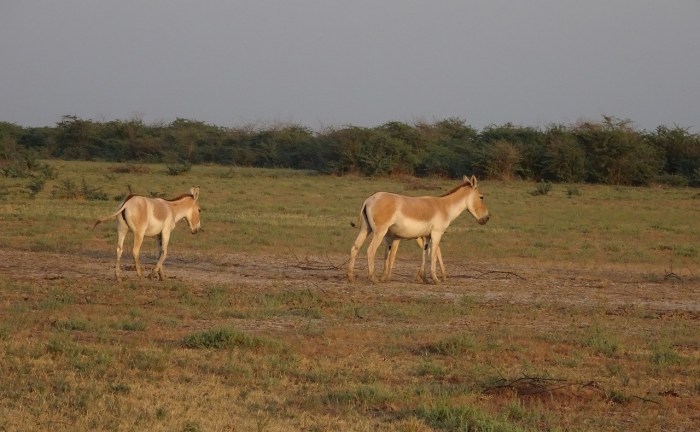
An onager is a species of wild ass that is native to northern Iran. Ibn Khallikan says that the army halted near the village of Jarud to rest and replenish its supplies. A large number of onagers were killed to provide meat for the men. A soldier attempting to prepare the meat of one onager found it strangely resistant to heat; he added wood to the fire, and let the animal roast for a long time, but this seemed to have little effect. Finally another soldier examined the onager’s severed head; in its ear there seemed to be an inscription that read “Bahram Gur.” Bahram Gur (بهرام گور) was Bahram V, a Sasanian Persian king who ruled from A.D. 420 to 438. He acquired the epithet “Bahram the Onager,” apparently for the frequency of his hunts in pursuit of this elusive and swift animal. Ibn Khallikan claims to have personally inspected the onager’s ear, and verifies that there was, in fact, an inscription carved into it:
When they [the soldiers] arrived at Damascus, they brought me the ear. I found the mark to be quite visible, the hair on the ear being as fine as the smallest shreds. The writing was Kufic. This Bahram Gur was one of the ancient kings of the Persians and lived a long time before our prophet. When that prince took more animals at the chase than he required, he would mark some of them and let them go. God knows how old this onager was when Bahram captured it and to what age it would have reached, had they set it at liberty and not killed it. The fact is that the onager is one of the long-lived animals. This individual must have lived upwards of eight hundred years.
What are we to make of this story? Apparently Ibn Khallikan, an educated, well-traveled, and enlightened man, believed it was possible for the onager to have reached this extreme age. Or was his pious credulity deceived by some genetic imperfection in the onager’s ear that only appeared to be an inscription? Or is it possible that our subtle and wily biographer is only using this tale as an allegory about nature’s unfathomable mysteries? It is not clear. While I am not prepared to believe that an onager could have lived for eight hundred years, it is also true that the scientific principles of heredity and genetics contain many oddities of which we are still underinformed.
The Greenland shark is the oldest vertebrate in the world; biologists tell us that it can live for nearly three hundred years. The world’s longest-living animal is the ocean quahog, one example of which attained the age of five hundred and seven years. We are not exactly sure how these animals are able to reach these extreme ages, any more than we can say with certainty why giant redwood trees have longevities that number in the thousands of years.
We see what we wish to see, and comport our observations to suit our predilections. Sense-perception and reason are at times unreliable, and can easily provide false testimony. Sir Thomas Browne, in the sixth book of his Pseudodoxia Epidemica, when discussing the “common opinions cosmographicall and historicall” of mankind, says: “It is evident not only in the general frame of Nature, that things most manifest unto sense, have proved obscure unto the understanding. But even in proper and appropriate objects, wherein we affirm the sense cannot erre, the faculties of reason most often fail us.” But at the same time, the universe remains a repository of unfathomable secrets and surprises. Where scientific explanation of unusual phenomena carry us only so far, intuition and instinct must carry us the rest of the way. When faced with the immensity of what we do not know, compared with what we do know, the proper human sentiment should be a feeling of modesty and humility. As Valerius Maximus says (IV.5),
Could you deny that there is a great reward for modesty?
We do not deny it, and seek to earn that great reward.
.
.
Read more in the collection of essays, Digest:


.
 Quintus Curtius
You must be logged in to post a comment.