

You can find a complete listing of all the articles on this site here. They are listed in reverse chronological order, and are all clickable links. Twenty-five articles are displayed per page, with the publication date included. To find older articles, click on the page numbers at the bottom.
To search the site by subject, topic, or name, you can use the “Search” function on the right sidebar.
_______________________________
-
Wrath And Sloth (Podcast)
In this podcast, we discuss Canto XVII of Dante’s Purgatorio. We examine the three types of wrath, and the legends Dante has used to illustrate this sin. We also briefly point out the sin of sloth, also known as “acedia” or “acedy,” and explain why it is a particularly insidious vice.
-
Anatomy Of The Mole Hunt
A mole is an agent or provocateur secretly embedded within an organization, and whose purpose is to serve the interests of an outside entity. Because moles can be immensely destructive to the interests of their hosts, it is essential that they be identified and neutralized. We will discuss here some very basic techniques that can…
-
We Know When We Have Sufficiently Atoned (Podcast)
Dante’s opening canto of the Purgatorio describes his and Virgil’s emergence from Hell. They find themselves in the southern hemisphere, confronted by Purgatory, which is presented as an immense mountain. Dante’s conception of Purgatory is different from his depiction of Hell, and we discuss one such difference.
-
Gratitude And The Divine Conference
We are all familiar with the fleeting and fickle nature of gratitude. When our services are found to be expedient, or agreeable, we are flattered and fêted; but when the immediate crisis has passed, and there is longer a looming emergency, we are forgotten as quickly as last Sunday’s supper. We are likely to forget…
-
Great B-Movies You’ve Probably Overlooked (Podcast)
There are some fantastic low-budget movies out there. Some of them are so good that they approach the level of “comfort movies”: that is, films you enjoy returning to again and again, and that can improve your mood. This podcast is about some of my favorite B-movies. Some you may already have seen, but many…
-
The Courage Of Mr. Doncaster, Who Saved The Crew Of The “Duke Of Cumberland”
On September 4, 1804, the British packet Duke of Cumberland was wrecked in a ferocious hurricane that pounded the island of Antigua. Readers unfamiliar with nautical classifications may wish to know that the term packet refers to a ship carrying, on schedule, mail, passengers, and other cargoes. The story of the aftermath of the wreck…
-
Mesearch
In a recent conversation with a friend who works as an instructor at a major university, I was amused to learn a new term about which I was previously unaware. It is the portmanteau word mesearch. A fusion of the words me and research, the term is used to describe a feature of modern scholarship…
-
A Patch Of Fog (Podcast)
In this podcast we explore two movies. The first is A Patch of Fog, a British psychological thriller from 2015, and the newly-released film The Dog Stars (2026), a post-apocalypse drama starring Josh Brolin. Both are satisfying movies, and invite useful contemplation. We discuss.
-
The World Will Never Be All That We Wish (Podcast)
I just finished watching the 2021 documentary film Roadrunner: A Film About Anthony Bourdain. It chronicles the life and tragic end of the celebrity chef and traveler Anthony Bourdain. I see his tragedy as a cautionary tale. What was the source of his despair? And what lessons, if any, can be learned from his story?
-
The Wrecker
Some time in the 1840s—the precise year is not certain—a British ship returning from the Mediterranean was obliged to delay its arrival in England for a few days, due to the persistence of stormy weather and thick fog in the Channel. One of the landsmen passengers found it difficult to sleep; and, to pass the…
-
Time, Effort, And Hope (Podcast)
A recent trip to Manaus, Brazil prompted some thoughts about the limited time we have on this earth, and what we can do to make the most of our efforts. What things are within our control? What things are not? And how can we know when we are deceiving ourselves?
-
Divine Retribution In Herodotus
The idea of divine retribution is a current that runs consistently through the pages of Herodotus. Evil deeds, wicked actions, or the manifestation of hubris, will eventually be repaid; and the payment is usually devastating.
-
The Phalaris Controversy
While the power and utility of forensic linguistics is taken for granted today, this was not always the case. The world of scholarship was slow to appreciate the degree to which written language betrays its authorship and pedigree. The “Phalaris Controversy” is a famous, and striking, example of the use of textual analysis in resolving…
-
Christopher Nolan’s Odyssey: A Review
Controversy and mudslinging are not new features of the Homeric tradition. We are told that, in 1715, soon after Alexander Pope published the first volume of his translation of the Iliad, the eminent poet was assailed by Britain’s most fearsomely competent Hellenist, Richard Bentley. Bentley, with the insufferable bluntness that had made him famous (or…
-
On The Conflict Between Artistic License And Fidelity To A Classic Work
The imminent release of Christopher Nolan’s film The Odyssey on July 17 has ignited a vigorous and necessary debate regarding the tension between artistic license and the importance of fidelity to a classic text. It is a question of old date. But while every generation has felt the compulsion to interpret anew the literary monuments…
-
Wealth Cannot Turn Back Time (Podcast)
In this podcast we discuss a short moral essay of Samuel Johnson. In the essay, a narrator, who was once poor but now is rich, desires to return to his hometown and treat with condescension those who once viewed him with disdain. His scheme of petty revenge, however, does not play out as he wishes.…
-
The Climacterics
The word climacteric is not one commonly encountered. The Oxford English Dictionary describes its variegated colors of meaning. A consultation with Volume II of the 1970 edition (covering the letter C) informs us that the word is an adjective “applied to that period of life (usually between the ages of 45 and 60) at which…
-
“I Need Some Advice In My Job Search” (Podcast)
A reader is experiencing some difficulties in his job search. He just graduated from a respected degree program, but he is beginning to realize that opportunities are hard to come by. In fact, his morale is low, and he’s not sure what his next steps should be. We discuss.
-
It Meant More To You Than It Did To Them (Podcast)
There are times when we try to share fond memories of the past with friends, family, or former lovers. Yet, we often find that these nostalgic recollections are not acknowledged or reciprocated as much as we would like. We may feel emotionally spurned, or shut out. Why is this? We discuss.
-
The Availability Of Information Does Not Equate To Its Effective Employment
Dear Sir: Some recent news reports have occasioned me to call attention to a principle of learning which, in our era of existential unease and fracture, often escapes notice. A professor at an institution of higher learning, we have been told, worries that he may not be able to “compete” (as he says) with the…
-
Rise From The Earth, And Fly As A Victor
The progress of duncery is geometric, while knowledge and understanding advance, if at all, with arithmetic slowness. He who demands acute perception from the overwhelming mass of humanity will find himself crushed in disappointments, and immersed in doleful ruminations.
-
“I’m Distraught That She Ended It” (Podcast)
A reader is upset that his girlfriend has broken things off. He believes that his behavior was the cause of it, and has been trying to repair the perceived damage. He wonders if there is something he could have done, or should have done. Nothing is working out, however. We offer some opinions about the…
-
Trivial Characters Never Disparage Themselves
In his treatise on medicine, the Roman writer Celsus digresses to make a shrewd observation on the behavior of personalities of rare distinction. He happened to note, in the writings of Hippocrates, that the great Greek doctor once confessed to having been misled by the presence of sutures in a patient. Such a comment might…
-
The Beautiful Suit (Podcast)
In this podcast we discuss H.G. Wells’s fable The Beautiful Suit. It was originally published in 1909 under the title A Moonlight Fable. You may never have heard of the story, but it imparts a powerful message. What does it mean? What is the author trying to communicate to his readers? And what lesson can…
-
The Icy Tragedy Of The “Mexico”
We have in these pages chronicled many shipwrecks and maritime disasters, each of which is woeful in its own way. The wreck of the barque Mexico in 1836, however, evokes particular pity, not only from the fact that its victims—most of whom were women and children—perished from freezing, but also because the wreck occurred so…
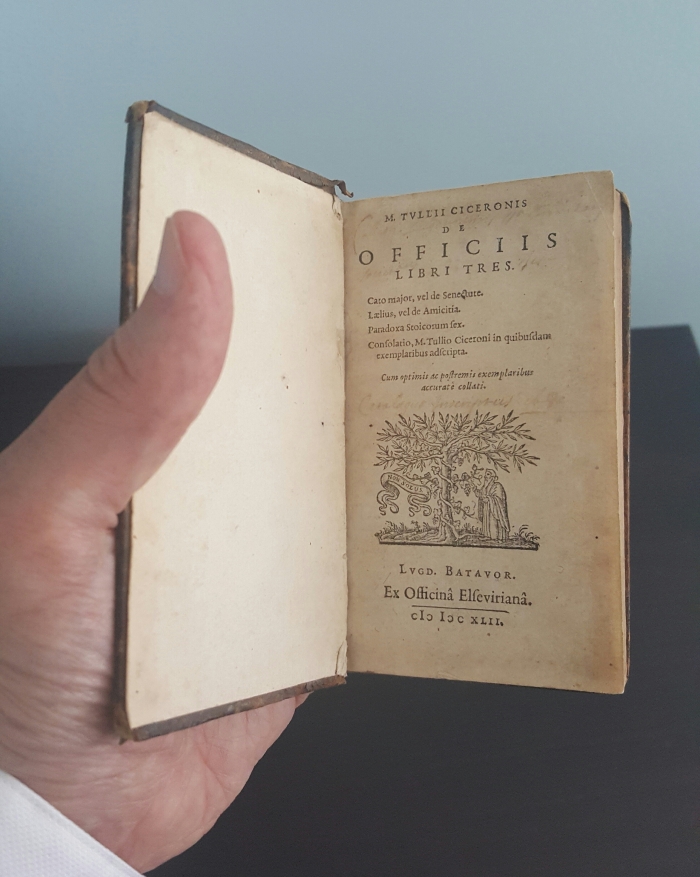
Original copy of Cicero’s De Officiis (On Duties) published in Holland in 1642. From the collection of Fortress of the Mind.


You must be logged in to post a comment.