
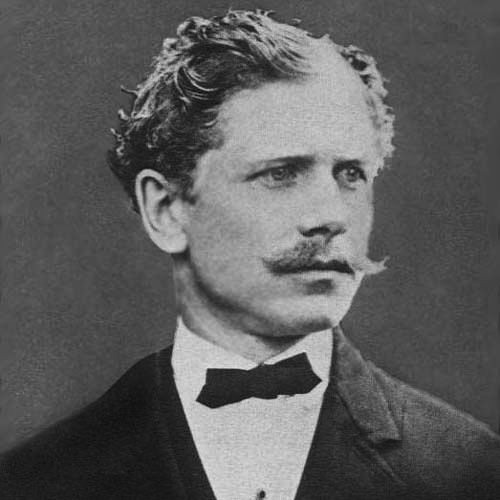
Ambrose Bierce remains the only major writer who actually experienced, and survived, combat in the American Civil War. Henry James and Mark Twain chose to sit out the war. Twain’s actions in particular look very much like the behavior of a deserter. Walt Whitman served as a nurse, but he did not fight.
Only Bierce, whose name remains an obscure one in American letters, marched off to the front lines. He was involved in a number of battles—Philippi, Stones River, and Shiloh, to name a few—and was wounded severely at Kennesaw Mountain. These experiences would remain with him for the rest of his life; only the medicine of writing could help, in some way, to alleviate their grip on his consciousness. His eerie and unsettling Civil War stories have been profound influences on generations of writers who came after him, among them Hemingway and Stephen Crane.
I want to discuss one of his stories that made a deep impression. It is entitled A Resumed Identity. The tale begins by placing an old man, apparently a soldier, on a hillside just before sunrise. He seems disoriented, afraid, and confused. In the distance, and coming closer and closer, the man sees a large contingent of soldiers moving along a road about quarter of a mile away. Bierce describes the scene:
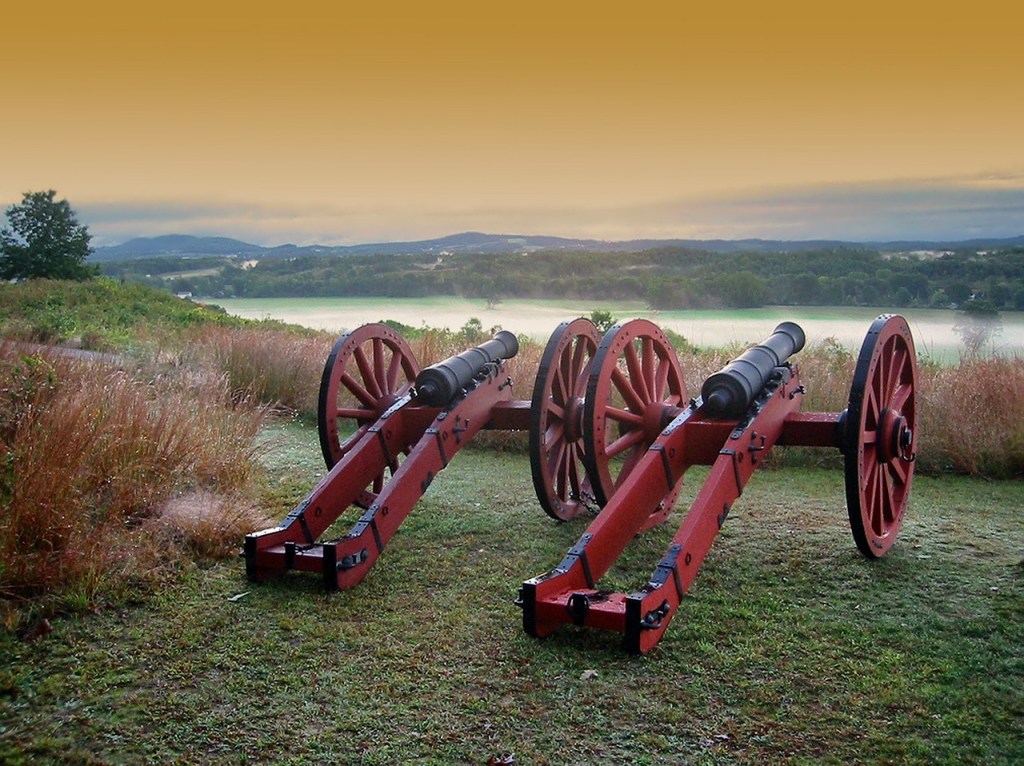
A hundred yards away was a straight road, showing white in the moonlight. Endeavouring to orient himself, as a surveyor or navigator might say, the man moved his eyes slowly along its visible length and at a distance of a quarter-mile to the south of his station saw, dim and grey in the haze, a group of horsemen riding to the north. Behind them were men afoot, marching in column, with dimly gleaming rifles aslant above their shoulders. They moved slowly and in silence. Another group of horsemen, another regiment of infantry, another and another — all in unceasing motion toward the man’s point of view, past it, and beyond. A battery of artillery followed, the cannoneers riding with folded arms on limber and caisson. And still the interminable procession came out of the obscurity to south and passed into the obscurity to north, with never a sound of voice, nor hoof, nor wheel.
The soldiers are a mixed group, and include infantry, cavalry, and artillery. What is odd about the scene is that the man hears no sound at all. At first, he believes he might be deaf; then he hears his own voice, and is startled by its “unfamiliar quality.” Why can nothing be heard? The man believes the answer might have something to do with the phenomenon called “acoustic shadow”:
Then he remembered that there are natural phenomena to which some one has given the name ‘acoustic shadows.’ If you stand in an acoustic shadow there is one direction from which you will hear nothing. At the battle of Gaines’s Mill, one of the fiercest conflicts of the Civil War, with a hundred guns in play, spectators a mile and a half away on the opposite side of the Chickahominy Valley heard nothing of what they clearly saw. The bombardment of Port Royal, heard and felt at St. Augustine, a hundred and fifty miles to the south, was inaudible two miles to the north in a still atmosphere. A few days before the surrender at Appomattox a thunderous engagement between the commands of Sheridan and Pickett was unknown to the latter commander, a mile in the rear of his own line.
The old man is “deeply disquieted” by the moonlight march proceeding before him in total silence. His unease turns into fear, and he takes cover behind some brush, for fear of being seen. He believes he must get away at once, and begins to walk down the road. He eventually encounters a physician from Murfreesboro who has just completed a house call. The doctor finds himself confronted by a disheveled old man, dressed in civilian clothing, walking around near the site of the Stones River battlefield.
The old man stops the doctor and tells him that he is a junior officer on the staff of a General Hazen. The old man presses the doctor to tell him “what had happened here.” Where are the armies? Who has won the battle? The doctor, unsettled by these strange questions, asks the old man if he is wounded. “Not seriously,” says the old man, “I was struck by a bullet and have been unconscious. It must have been a slight, glancing blow: I find no blood and feel no pain.” The doctor points out that the old man is not wearing a military uniform, and then asks him how old he is. When the man tells the doctor he is twenty-three, the doctor disbelieves him. “You don’t look it; I should hardly have guessed you to be just that,” was the doctor’s retort.
The old man begins to feel his face, and indeed senses that there are creases and lines that would not be present in a twenty-three-year-old. The old man asks the doctor if he saw a contingent of soldiers marching down the road a little while earlier; the doctor says he saw nothing. The man then notices that the season is currently summer, and that the Battle of Stones River had been fought in the winter. He assumes from this that he must have been in the hospital for a long time. He now realizes that the doctor must have thought him to be an “escaped lunatic” from an asylum, rather than an escaped patient from a hospital.
Continuing to walk, the man then notices a small war monument placed near a stone wall. The monument is inscribed with the following words:
HAZEN’S BRIGADE
to
The Memory of Its Soldiers
who fell at
Stone River, Dec. 31, 1862
The monument clearly shows the effects of age. It is, in fact, many decades old. He then sees a small pool of water, and peers into it. In his reflection, he is confronted with the visage of a very old man. He suddenly realizes that he has spent many decades in a state of amnesia caused by an ancient war-wound. This realization is too much, and he dies of shock.
There must have been a biographical element to this tale, for the old man in the story has the same rank, age, and unit. The old man was wounded in a long-ago battle, and slipped into a state of forgetfulness. Yet he was not entirely forgetful. There was something at the core of his being which drew him back to the old battleground. Even many decades later, he is pulled back to the traumatic arena of the battle. He sees phantom soldiers where there are none, and is oblivious to the passage of time.
What Bierce wants to tell us with this story, I think, is that the past always remains with us. The more traumatic the past, the more real, urgent, and present it seems to be. We can try to bury it, and we can try to forget it. But every time we appear in front of a reflective surface—a pool or a mirror—we unavoidably see our own creased, aging faces staring back at us.
.
.
Read more on related subjects in Thirty Seven, which is available on audiobook:


.
 Quintus Curtius
Bierce himself toured the old battlefields of his youth before he disappeared so this ending is poignant.
Bierce was wounded in the head, his skull “cracked like a walnut” he said, and one of his brothers claimed that his personality was markedly different after that. I wonder if the protagonist’s amnesia was Bierce contemplating how things might have worked out differently for him.
Bierce was a topographical engineer in the war, and I’ve noticed a fair number of his stories depend on lines of sight for their effect.
Of his Civil War pieces, I particularly like his “What I Saw at Shiloh”.
LikeLiked by 1 person
Yes, good points. There are a lot of possible interpretations here, and I like the psychological one. As you know, the story is very short, so it leaves us a lot of room for interpretation. My feeling is that he was trying to communicate the fact that traumatic experiences, even though they can become dormant, never leave us.
LikeLiked by 1 person
[…] Curtius has a nice piece up on Ambrose Bierce’s “A Resumed Identity”, a story I covered from a different […]
LikeLiked by 1 person