

Ibn Khallikan’s Biographical Dictionary contains an entry (III.68) for one Abu Bakr Al Suli, who is described as an accomplished scholar, biographer, and enthusiast of the game of chess. He was so good at this game, we are told, that his name entered the roll of Arabic proverbs in the saying, “He plays chess like Al Suli.”
This fact leads Ibn Khallikan on another one of his charming and instructive digressions. The game of chess, he tells us, was invented by an Indian named Sissah Ibn Dahir for the amusement of the Persian king Shihram. The game quickly came to be appreciated as superior to the Persian game of nard, a table game similar to backgammon. Shihram was so pleased with it, in fact, that he ordered chess boards to be placed in every temple. The king believed that chess was an excellent instructor of the arts of war and justice, as well as an “honor to religion.”
The king asked Sissah what he would like as a reward for his brilliance in creating such an immortal game. Sissah replied that he would like to have a quantity of wheat calculated in the following way. One grain, he said, should be placed in the first square of the chessboard, two in the second, and four in the third; the number of grains should then be progressively doubled until the last square on the board was reached.

Shihram, unfamiliar with the principle of exponential growth, laughed at what he saw as such a paltry recompense for so great an invention as chess. So he ordered his attendants to give Sissah what he wanted. But the king’s administrators informed him that the request could not be met. Irritated at what he considered to be their waffling, Shihram ordered the administrators to be brought before him. When they performed the necessary multiplications for him, the king was satisfied that he had been the target of Sissah’s subtle sense of mathematical humor. He told Sissah, “Your ingenuity in imagining such a request is yet more admirable than your talent in inventing the game of chess.”
Yet even our biographer Ibn Khallikan could not quite grasp just how immense a number Sissah’s proposal would have called for. With his usual endearing honesty, Ibn Khallikan tells us that he consulted some accountants in Alexandria on the matter:
I was doubtful that the amount could be so great as what is said, but having met one of the accountants employed at Alexandria, I received from him a demonstration which convinced me that their declaration was true. He placed before me a sheet of paper in which he had doubled the numbers up to the sixteenth square, and obtained thirty-two thousand seven hundred and sixty-eight grains.
But this was not all. In order to give Ibn Khallikan a better visual picture of the immensity of the quantity of grain requested, his Alexandrine accountant told him as follows: “Imagine that the quantity reached at the sixteenth square (32,768) is the contents of a pint measure. Then let this pint be doubled at the seventeenth square of the chessboard, and so on progressively. By the twentieth square it will become a peck, and then eventually a bushel. By the fortieth square, we will have 174,762 bushels. Now let us suppose that this amount is the contents of a granary. By the fiftieth square, we will have the contents of 1,024 granaries. Now suppose these are located in one city. By the sixty-fourth and last square of the chessboard, we must have 16,384 cities. In the entire world there are not so many cities.”
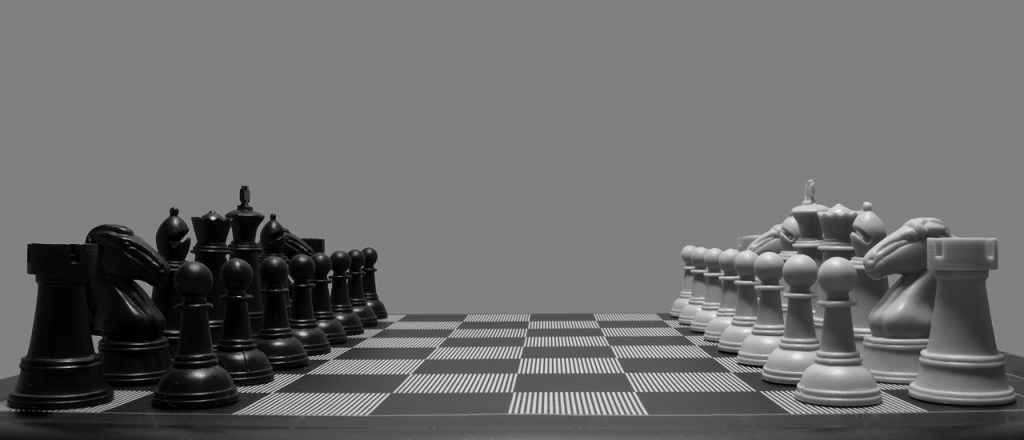
So do we come to appreciate the speed with which doubled numbers can escalate. I am not sure what the lesson of this story is, if in fact there is any lesson at all. I relate it only to marvel at the incapacity of the human brain, without specific demonstration, to appreciate the speed of exponential growth. Why is this? I am not sure. Perhaps our consciousness has evolved to think only in arithmetic terms.
As I was watching the movie Oppenheimer today, the exponential growth aspect in nuclear fission was mentioned: when a uranium nucleus splits apart, neutrons are released, which then crash into other nuclei, causing them to break apart in turn, and so on progressively. The chain reaction proceeds exponentially, and incredible amounts of energy are of course released. As I was sitting in the movie theater, somehow this old story about the wheat grains on the chessboard surfaced in my memory. We may mischievously wonder what would have happened if Dr. Oppenheimer, when President Truman thanked him for his invention and asked him what he wanted in return, had requested (as did Sissah from the Persian king) a reward that was safely impossible to fulfill. Perhaps this would have been a better response than expressing remorse to an irascible sovereign with little patience for such emotional indulgences.
.
.
.
Explore the new translation of Cornelius Nepos’s Lives of the Great Commanders:


.
 Quintus Curtius
You must be logged in to post a comment.