
One of Poe’s lesser-known stories, The Domain of Arnheim, seems to offer his theory of aesthetics. I say “seems to,” because the dream-like quality of the story leaves the reader with more than a residue of ambiguity.
The tale was published in 1847, the same year in which his beloved wife Virginia died after a long struggle with tuberculosis; and in his anguish, he found solace in escape to the aethereal and the divine. The unnamed narrator begins by telling about his fabulously wealthy friend, named only as “Ellison.” Ellison says that there are four conditions of “bliss,” or happiness. These are: (1) the maintenance of good health; (2) the love of a woman; (3) contempt for ambition, which never allows the soul to rest; and (4) an “object of unceasing pursuit.” That is, some sort of transcendent quest. But the object of pursuit should be a spiritual one, our narrator insists:
[H]e held that, other things being equal, the extent of attainable happiness was in proportion to the spirituality of this object.
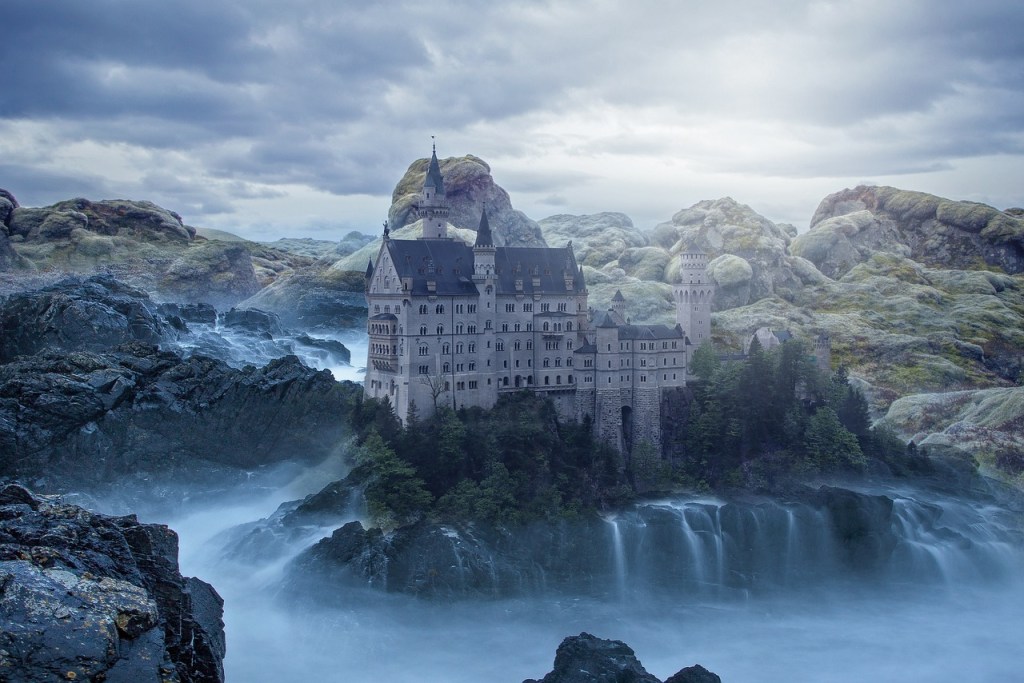
Ellison fortunately has the resources to pursue such lofty objects. He has dedicated his attention to the pursuit of art. Specifically, he has set out to create a landscape-garden and castle of supreme beauty. Ellison, gifted with his vast financial resources, spends four years searching for the perfect site to bring his artistic visions into reality. He wants to create something that would surprise even “the angels that hover between man and God.” Yet Poe does not hesitate to give us other aesthetic theories. While the natural landscapes of the real world may be stunningly beautiful, they always contain some defect. The painter of true genius, on the other hand, is under no such restrictions:
Mr. Ellison did much toward solving what has always seemed to me an enigma:—I mean the fact (which none but the ignorant dispute) that no such combination of scenery exists in nature as the painter of genius may produce. No such paradises are to be found in reality as have glowed on the canvas of Claude. In the most enchanting of natural landscapes, there will always be found a defect or an excess—many excesses and defects. While the component parts may defy, individually, the highest skill of the artist, the arrangement of these parts will always be susceptible of improvement.
Man, therefore, can improve or perfect nature’s gifts. And if he does so, man can create “nature in the sense of the handiwork of the angels that hover between man and God.” There can be little doubt that Poe saw himself as one of these blessed artisans—one of these fashioners of supreme beauty that could rival nature herself. For Poe, the creation of beauty was both a quest and an obligation; and it may be that the nearness of Virginia’s death brought him closer to an apprehension of this mission.
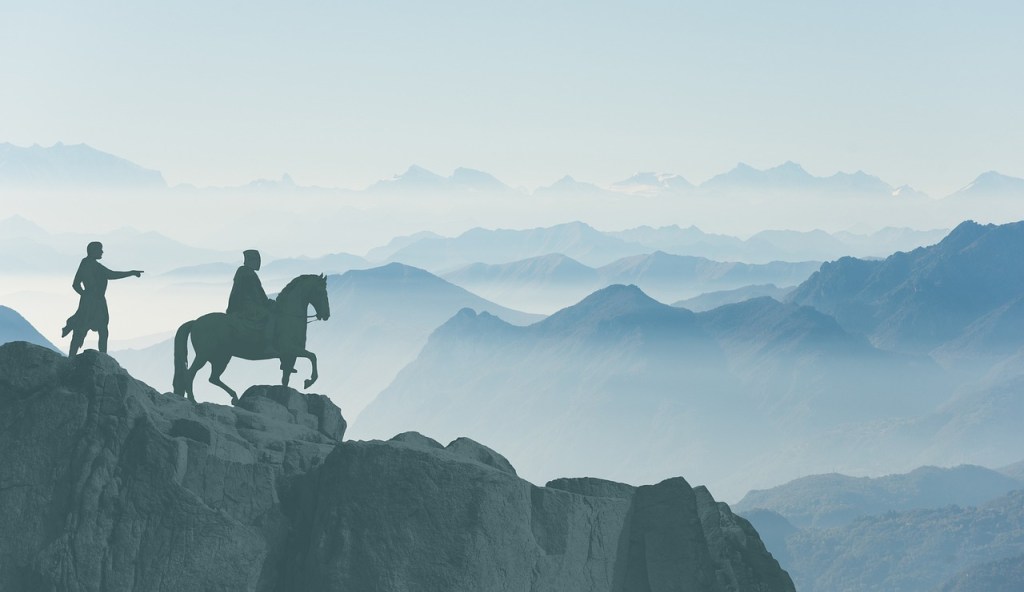
The rest of Poe’s story contains a vivid and beautiful description of a journey to his ideal landscape-garden. Is it a metaphor? Of course it is. But a metaphor of what? It is a mental journey upward, to a higher level of consciousness. This elevated hypostasis of existence—this inner refuge of the mind from guilt and pain—is the product of Ellison’s artistic labors. In the final pages of the story, Poe treats us to a fantastic description of a journey to this paradisical sanctum, represented as a gleaming citadel. It may be read as a real journey, or as a Dante-like allegorical journey of the soul. We must quote him here at length:
The canoe falls into the lesser channel and approaches the gate. Its ponderous wings are slowly and musically expanded. The boat glides between them, and commences a rapid descent into a vast amphitheatre entirely begirt with purple mountains, whose bases are laved by a gleaming river throughout the full extent of their circuit. Meantime the whole Paradise of Arnheim bursts upon the view. There is a gush of entrancing melody; there is an oppressive sense of strange sweet odor;—there is a dream-like intermingling to the eye of tall slender Eastern trees—bosky shrubberies—flocks of golden and crimson birds—lily-fringed lakes—meadows of violets, tulips, poppies, hyacinths, and tuberoses—long intertangled lines of silver streamlets—and, upspringing confusedly from amid all, a mass of semi-Gothic, semi-Saracenic architecture sustaining itself by miracle in mid-air, glittering in the red sunlight with a hundred oriels, minarets, and pinnacles; and seeming the phantom handiwork, conjointly, of the Sylphs, of the Fairies, of the Genii and of the Gnomes.
As Cicero says in On the Nature of the Gods (I.11): “Why might the soul of man not be aware of something, if it is godlike? And if this god is nothing but soul, how is it embedded and infused in our world?” Poe’s Domain of Arnheim describes the soul’s path to a higher spiritual plane. Of Poe’s four requirements for a happy life, noted above, the fourth is the one that enraptures him the most. It is this elemental object of unceasing pursuit: a consuming spiritual quest that guides the sincere seeker through the sinuous waters of verdant gorges to the phantom minarets and pinnacles of a bejeweled citadel, a divine haven, the abode of genii and sylphs.
.
.
Read more on this and related subjects in the new translation of Cicero’s On the Nature of the Gods:


.
 Quintus Curtius
You must be logged in to post a comment.