

There is an anecdote told about the prelude to the Battle of Issus in 333 B.C. This momentous contest, which involved the armies of Alexander the Great and Darius III of Persia, was to decide the fate of Asia.
The historian Quintus Curtius Rufus relates that, on the eve of the battle, Darius made the fatal mistake of putting to death his most competent general, a Greek mercenary named Charidamus. Charidamus knew both the fighting capabilities of the Macedonians, and the unmatched quality of Alexander’s battle leadership; but his attempts to convey this information to Darius in a tactful manner were not successful. When he realized that Alexander was aiming for a decisive battle, Charidamus advised Darius to divide his army in two: one half, led by Charidamus himself, would deal directly with the invading Macedonian king, while the other half would be kept in reserve.
This guidance seems reasonable enough. But Charidamus did not understand that Darius’s emotions had been inflamed by his earlier defeat at the Granicus River. The royal blood was aroused, and he intended to attack Alexander himself with his entire force. There is no doubt that Darius’s legion of court flatterers played their usual role in puffing up the king with unrealistic expectations. Charidamus, aware that Darious would be walking into a disaster, was horrified by this proposal. He spoke these words to the Persian king:
Perhaps you do not want to hear the truth. And if I do not say it now, I will confess it later to no avail…Do not think that [the Macedonians] are animated by a desire for gold and silver; for they have kept their discipline in the school of poverty…What you need is strength equal to theirs. Help must be sought in that land which birthed them. Send your silver and gold to hire professional soldiers. [III.2]
These were some of the words which Charidamus spoke to Darius. The ears of the king, however, were not receptive to this advice, which he perceived as insulting to the fighting abilities of the Persian soldiers. “Darius had an amenable and benign character,” says the historian, “yet in most cases, fortune corrupts even Nature.” And so it was on the eve of this titanic battle. Darius was so incensed at hearing Charidamus’s sound and prescient advice that he ordered him to be immediately seized and carried away from his presence; he was then put to death by Darius’s bodyguards. The words of Charidamus, once spoken, could not be taken back; that they were true was irrelevant. He lost his life, and Darius his kingdom.
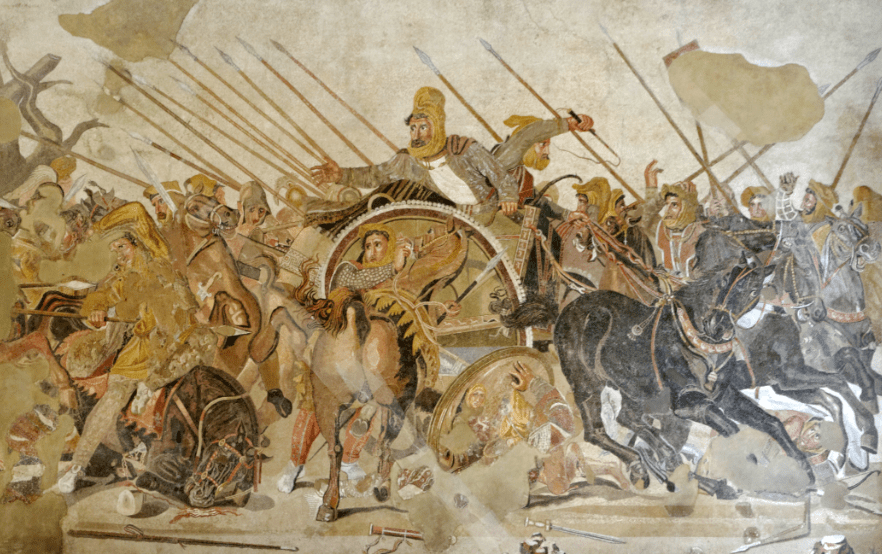
Charidamus did his duty as a responsible advisor and commander; that he was employed by an irascible fool was a tragic accident of Fortune. Yet perhaps he should have found a more tactful way of conveying his message, for a dead advisor is of no use to anyone. The scholar Petrarch, in a letter to the jurist Giovanni d’Andrea, comments on our tragic inability to take back words that have been uttered. This letter, which was probably composed around 1342, contains the following rueful words:
It is as I thought. Outspokenness has given birth to rage, truth has provoked hostility, and counsel has generated scornful contempt. But what will I do? Words do not retreat [Verba non redeunt].
Outspokenness, Petrarch notes, is hostile to friendship: Amicitiae inimica libertas est. But what can one do? We are all faced with certain choices in our professional and personal relationships. Too much truth risks alienating our relations; too little truth places us among the ranks of Darius’s professional court flatterers, those useless sycophants who did nothing but tell the prideful king what he wanted to hear. There must be some delicate balance in the middle, some way of feeding truth wrapped in agreeable layers of sweetened pastry.
As a young lawyer, I quickly realized that there were two types of lawyers. One type was nothing more than an avatar of his client: he would simply sustain and feed his client’s unrealistic delusions, and tell him everything he wanted to hear. Cases would consequently drag on far longer than they should, because the attorney failed to sit his client down and explain to him what was realistic, and what was not. The other type of lawyer is the type who actually does what a counselor is supposed to do: he evaluates the facts and the law, and then offers advice based on his experience and knowledge. I need not tell you that the latter is much rarer than the former.
I myself have had to learn the painful truth of Petrarch’s adage that words do not retreat. Once spoken, they cannot be recalled. There is such a thing as word discipline; it is just as important as fire discipline is to a professional soldier. As a lawyer dealing with clients or prospective clients, every single syllable that leaves an attorney’s lips has import and meaning; every word spoken carries consequences. Whether over the phone, or in person, words spoken by an attorney are going to be parsed out, analyzed, and studied for inflection, tone, and content. This also applies, of course, to written communications.
Young lawyers are often not fully aware of this. It took me some time to appreciate this fact. Words spoken without care and deliberation will often be misinterpreted, or cherry-picked for selective interpretation. The remedy for this problem, I have found, is experience and seasoning. One must learn to relax, calm down, and not let words fly out of one’s mouth without consideration. One must be familiar with a wide variety of factual scenarios, so that advice and counsel will be measured, appropriate, and valid.
Let us learn the discipline of speech and writing. Let us not allow emotion and reckless indiscipline to taint our speech, and permit our meaning to be accidentally or deliberately misunderstood. Let us temper a pungent message with protective layers of pride-saving verbiage. Haste and recklessness in speech is just as dangerous—perhaps even more dangerous—than a lack of fire discipline on the part of a rifleman. In both cases, accidental discharges, whether they be discharges of words or bullets, carry potentially devastating consequences. Words, like projectiles emerging from the barrel of a weapon, do not retreat; once released, they take their own course, either to our benefit or detriment.
.
.
Take a look at the new, annotated translation of Cicero’s On The Nature Of The Gods, now available in paperback, hardcover, audiobook, and Kindle.
 Quintus Curtius
[…] recently discussed some words spoken by the Greek mercenary general Charidamus to the Persian king Darius III on the […]
LikeLike