
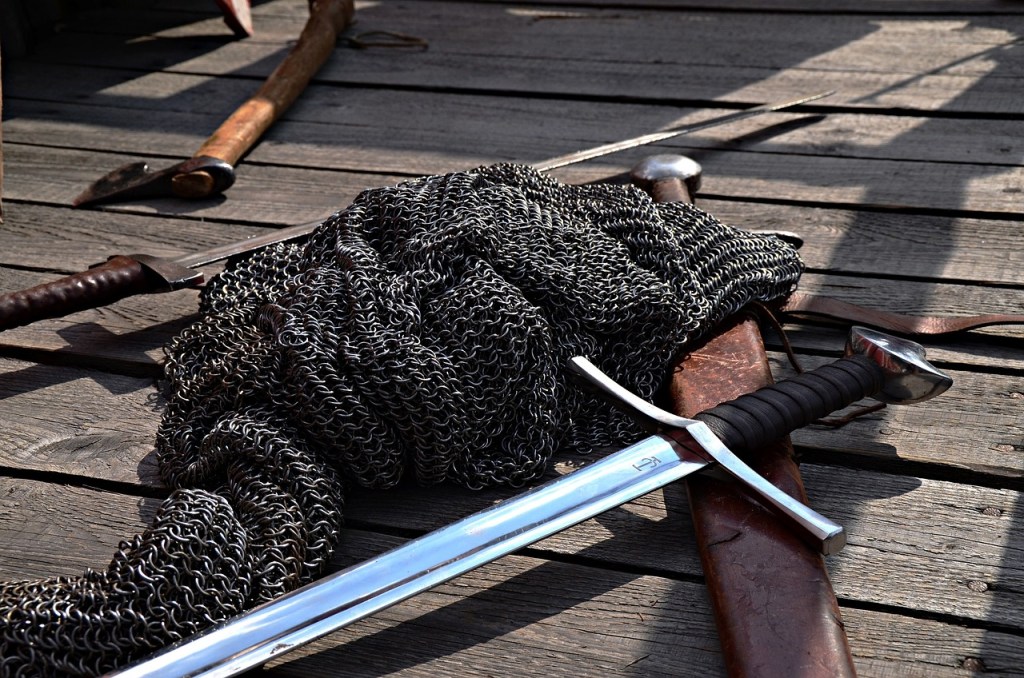
There is an anecdote found in Valerius Maximus (VI.2.10) that calls our attention to the difference between the respective powers of raw force and steady patience. A brutal consul named Cnaeus Carbo was threatening to put the city of Placentia under siege. He ordered a city magistrate named Marcus Castricius to give him hostages as part of his campaign of destruction.
Castricius would not be cowed, and refused Carbo’s demands. “I have many swords,” Carbo told him. Castricius responded, “And I years” (Et ego annos). This answer deprived Carbo of the fear he sought to impose on his victims, and enabled his intended victims to preserve their independence. Superior force will always be defeated by patience, which in time can grind down even mountains of granite into dust. What seems invincible one day will appear very differently with the passage of years and decades. The political philosopher Ibn Zafar, writing in the 12th century, quoted a certain poet’s verses about patience:
Patience is a coat of arms, and he who wears it in adversity puts on an excellent armor…When you see how a man takes courage and endures, then you may know the quality of his mind. [Trans. by J. Kechichian & H. Dekmejian]
But many things can cause us to be deflected from the practice of patience. I tend to think that information pollution ranks as one of the most important causes. We are constantly bombarded with news, chatter, noise, and data of very low informative and communicative quality. The numbing sensation produced by this firehose of noise cannot be underestimated: it causes us to lose our reasoning capacities, to conflate lies with truth, and to mistake fear for prudence. Over time, and with enough concentrated volume, such pollution can indeed cripple our capacity for action. This is why we must carefully ration our exposure to the modern mass media, and learn to judge it with a critical eye. Ibn Zafar says, in this same spirit,
If you so much as bestow a glance on your enemy, you lose your advantage. And if you listen to his words, you submit yourself to him…By demonstrating friendly approval to the enemy, you expose yourself to the risk of being submerged in his world, and of falling into his schemes. [Id.]
There is a similar sentiment found in the letters of Petrarch. Around 1360, he inscribed these words:
Let ignorant mouths ponder their own ineptitude and stupid blather. What does it have to do with you or your goals, whether they are uninformed or are mocking you, people whose praise is an honorary form of dishonor?
I have often found, in my own experience, that he who threatens and roars loudest is he whose position is insecure. He who endures in the face of adversity must eventually arrive at his destination. Force, especially forced based on injustice, cannot compete with patience; time wears down all manifestations of power, reducing them to shadows of what they once were. Do not be distracted or deflected by the meaningless chatter polluting the information space, for the media has more in common with a narcotic than a curative. Seemingly invincible nations and individuals, which once raised standards of victory in diverse parts of the world, will find in patience an adversary with which they cannot contend. They may have the swords, but someone else will always have the years.
.
.
Read more on this and other subjects in the new collection of essays, Centuries.
 Quintus Curtius
You must be logged in to post a comment.