

St. Paul Island is one of those innumerable specks of land in the northeast Atlantic that are perpetually lashed by frigid wind and wave. It is located about fifteen miles northeast of Cape North on Cape Breton Island; it is near the Cabot Strait between the Gulf of St. Lawrence and the Atlantic Ocean. In centuries past it hosted residents, but is now uninhabited.
Measuring only two and three-quarter miles in length and about a mile in width, it is a small and lonely place. The island was once notorious for the sheer number of ships that had been wrecked there. It is not difficult to understand why. The seas surrounding it are rough and treacherous, and become even more so during gales and storms, which are frequent. The island’s sand bars and shoals extend out a great distance—by some estimates, eleven miles—and this fact has proven to be the undoing of even the most experienced Atlantic mariners. Conditions are even worse in winter, when ice packs and freezing winds pound the island’s precarious stony cliffs, two of which rise to a height of four hundred feet. This is a solitary and forbidding place, full of jealously guarded secrets.
In 1950, Boston maritime historian Edward R. Snow visited St. Paul Island to explore its legacy of shipwrecks and tragedy. These were later chronicled in his volume Supernatural Mysteries and Other Tales (1974). In his research, Snow located and interviewed a 75-year-old man named John M. Campbell, who had once been the island’s superintendent. Campbell’s father and grandfather had also been superintendents, and this fact made him a unique repository of the island’s inherited lore since the Age of Sail. Campbell could speak with authority on scores of ancient shipwrecks that St. Paul Island had hosted; every broken bit of timber, every rusted iron mast band, was connected with a tale lost in the cold fog of the northeast Atlantic. Some of these tales were ghost stories. I have always had a keen interest in them, and will relate two here.
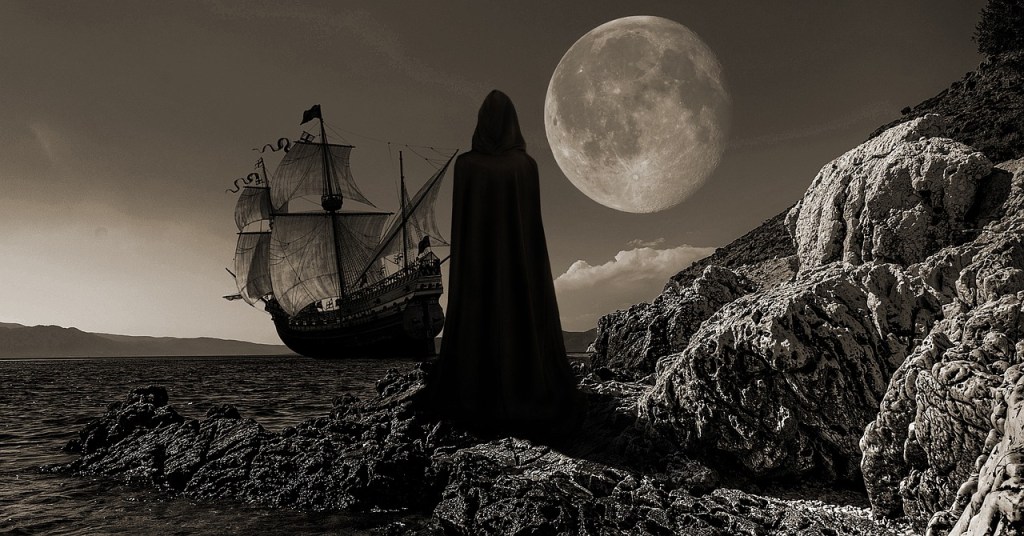
In the 19th century, a beautiful woman was among those who perished of exposure after her ship was wrecked at St. Paul Island. The precise date is uncertain, but the event is said to have occurred in the 1820s. Two salvagers discovered her frozen body, among many others, some time after the event. They noticed that she possessed fine jewelry, which still adorned her corpse. The two salvagers, not trusting each other, agreed to bury her with her jewels; but each secretly coveted her wealth, and plotted to return later, excavate the body, and claim her riches for themselves. One of her fingers held a ring bezeled with a ruby of rare size and quality. The salvagers eventually did return, but by a remarkable coincidence, they arrived at the same time. A vicious fight ensued, one salvager murdered the other, and appropriated the ruby for himself. He immediately fled the island. Other individuals later discovered the bodies of the murdered man and the woman, and reburied them. According to John Campbell, the ghost of the woman thereafter was seen at night walking along the island’s desolate, wind-blasted shores, eternally searching for her stolen ring.
The second ghost story also concerns a shipwreck that took place in the early 19th century. The shipwrecked sailor, a black man, was found on the beach in the morning after a tempest. The body was buried, but reburied in different locations several times by the island’s inhabitants. During one of these transportations, the corpse’s head became detached from its body, and was reburied in a different location. From this moment, the sailor’s spirit could not rest; it scoured the island in a search for its missing head. Campbell told Snow that he heard this dark maritime tale as a boy, but never gave it much credence. Events would later change his opinion of the matter. One night, as he was helping his family prepare a meal, he descended into the cellar to fetch potatoes. He was immediately confronted by the headless sailor’s ghost standing in front of the potato barrel. Terrified, the young Campbell fled back up the stairs and into the kitchen; after ten minutes, he descended again, but saw that the apparition had vanished.
The ghost appeared again in the cellar a few weeks later, and it seemed more insistent this time. The spirit made a point of blocking his access to the potato barrel; it was as if it wanted Campbell to assist it somehow. The young man screwed up his courage and attempted physical contact with the headless form. Campbell moved his hands around the outline of the phantasm, and was able to detect a vague corporeal substance; but when he confirmed the spirit’s decapitated nature, horror overcame him, and he fled upstairs. He did see the ghost again from time to time around the island, but eventually began to accept it as just another feature of the terrain. Campbell left St. Paul Island in 1890; when he returned twelve years later, he saw no sign of the headless spirit.

Whether the reader chooses to subscribe to the veracity of these stories, or consign them to the realm of fancy, I will leave to his or her discretion. There is much about our world that remains unknown, and much that cannot be tested by science or artifice. Our beliefs are dependent on our perspectives; no frame of reference can claim to know all. On this topic of varying interpretations based on perspectives, I am reminded of an anecdote found in Cicero’s On Divination (II.70).
A married woman, Cicero says, wished to conceive a child. After many attempts, she began to doubt whether she was capable of conception. One night, she dreamed that her womb was sealed. Baffled by this haunting vision, she consulted with an interpreter of dreams. The interpreter told her that, since she had dreamed of a sealed womb, she must be incapable of bearing children. Unsatisfied by this counsel, the woman visited a different dream interpreter. This man told her that she was certainly capable of pregnancy, because “it is not customary for something to be sealed to no purpose.” Belief is conditioned on perspective; and what one believes, another may perceive very differently. We must guard against the illusion of omniscience, and the smugness of presumed inerrancy. It remains for the man of reason to evaluate for himself that which his senses, experience, intuition, and intellect may reveal.
.
.
Take a look at the new, annotated translation of Cicero’s Tusculan Disputations.
 Quintus Curtius
You must be logged in to post a comment.