
There is a tendency in conflict situations for inaction to take precedence over action. In his chapter The Suspension of Action in War (III.16), Clausewitz explains why this is so. Three determinants, he says, “function as inherent counterweights” to the impulse for positive action.
The first determinant is “the fear and indecision native to the human mind.” Most human beings are rational actors, and naturally seek to avoid conflicts or other situations where they may be subjected to harm. Danger and responsibility are not things that most men willingly embrace. The second determinant is the sense of unbalance and uncertainty that accompanies conflict. In the midst of chaos, very few things can be known with certitude; and man’s natural timidity will interpose itself between the need for action and the mind of the commander. There will be a certain inclination to watch for further developments, and await the outcome of this feint or that maneuver, believing that the time to act is not yet favorable. But of course such a time almost never comes, because excuses can always be found to justify inaction.
The third and final determinant, according to Clausewitz, is the natural strength which derives from being on the defensive, rather than on the offensive. There is perceived security and safety behind fixed fortifications. But the prudent leader knows that impregnable ramparts and palisades are illusions. The field of conflict is in a state of constant flux; it never lingers or tarries more than a moment in a single vivid manifestation. To settle down behind fixed fortifications with a smug sense of security is a mistake that has repeated itself countless times in history. No doubt it will also be repeated countless times in the future. The human mind strives for what is familiar, and for what brings mental peace; but in conflict, in all of its forms, what appears to be comforting and secure can swiftly become the sides of a coffin.
None of this is to suggest that, in conflict scenarios, we should always seek to be on the offensive. Every situation must be evaluated on its own merits. There are times for aggressive engagement, times for observation and evaluation, times to recoup and recover, times to fight holding actions, and times to draw the enemy into conditions that favor one’s own side. But in each of these scenarios, action is still being affirmatively taken; decisions are still being made based on cold, rational analyses of the situation as it is, not as we wish it to be. In every case, action of some sort must always be implemented. We must stretch our necks, like the tortoise, outside the reassuring safety of our shells.
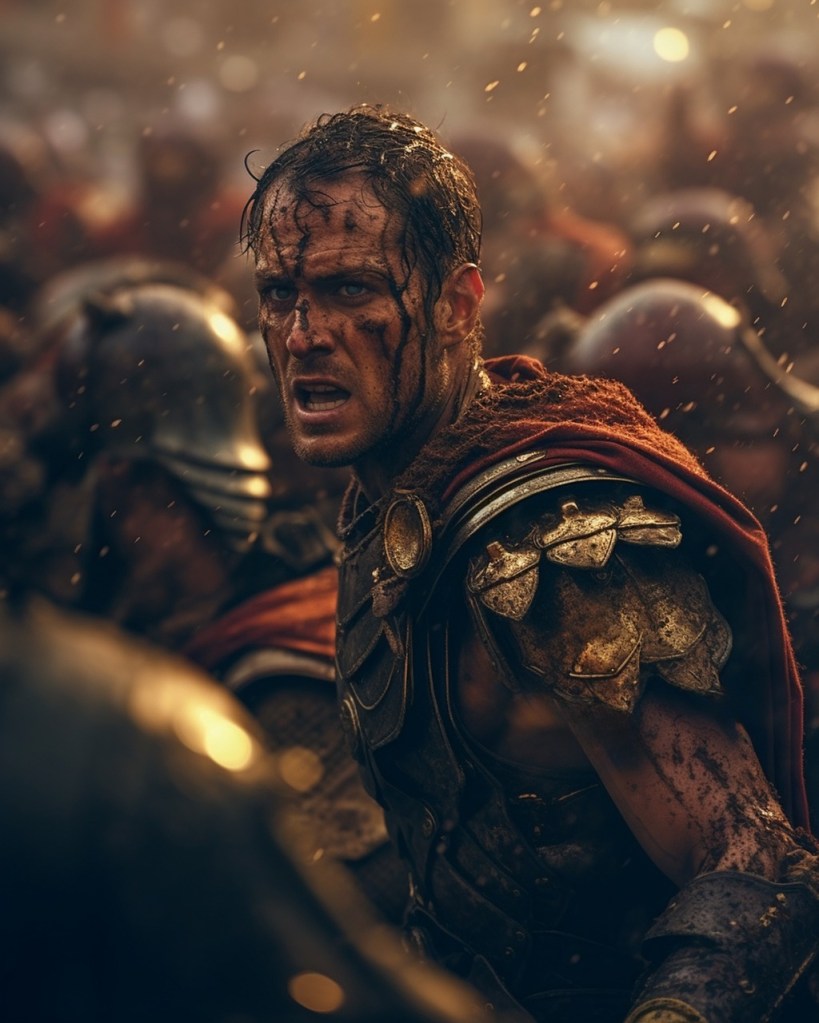
An illustration of this principle can be found in a battle that took place in 66 B.C. during the Third Mithridatic War. The engagement is known as the Battle of the Lycus, and it was fought between the forces of Pompey and King Mithridates VI of Pontus. The Roman commander Pompey was operating in Armenia; he was far from home, he was in mountainous terrain, and his supply lines were stretched thin. He was attempting to subdue an aggressive and canny adversary. Even worse for the Romans, Mithridates was superior to them in the number and quality of their cavalry forces.
Yet Pompey realized that he must take the initiative; he could not wait supinely for the enemy to attack him. To do nothing would have been a death sentence for his men. He had the confidence and conviction to formulate and execute a well-reasoned plan. He secretly positioned three thousand lightly armed men and five hundred cavalrymen at night in shrublands located between the Roman and Pontic camps. Then at first light he told his cavalry to engage the enemy; their orders were to fall back gradually during the fighting while maintaining their unit integrity. The goal was to lure the enemy into a position where Pompey’s hidden force, secluded in the shrublands the previous day, could leap into action and attack the enemy unexpectedly from the rear. Pompey’s forces performed as intended. Mithridates’s forces were lured into a trap, and found themselves suddenly attacked from behind by Romans who seemed to materialize out of thin air.
When this happened, Pompey’s cavalry, which had been pretending to fall back, suddenly moved forward to assault as well. Mithridates’s men found themselves trapped between two battle lines: and the Romans excelled at nothing more than close quarters combat. The final result was a complete Roman victory. It is said that the confidence Mithridates once had in his cavalry was thereafter shattered forever. Pompey’s willingness to take action allowed him not only to save himself and his men, but to achieve a decisive triumph. He did not fret over the uncertainties and complex variables of his situation. He was not intimidated by the formidable reputation of Mithridates’s cavalry. He did not seek refuge in comfortable fantasies, nor was he reduced to paralytic torpor by an overanalysis of his predicament. He grasped, in a way that his enemy did not, that the only way to exert some control over the chaos of conflict was to take decisive action.
.
.
Read more about the importance of decision and command in the new translation of Cornelius Nepos’s Lives of the Great Commanders.
 Quintus Curtius
You must be logged in to post a comment.