
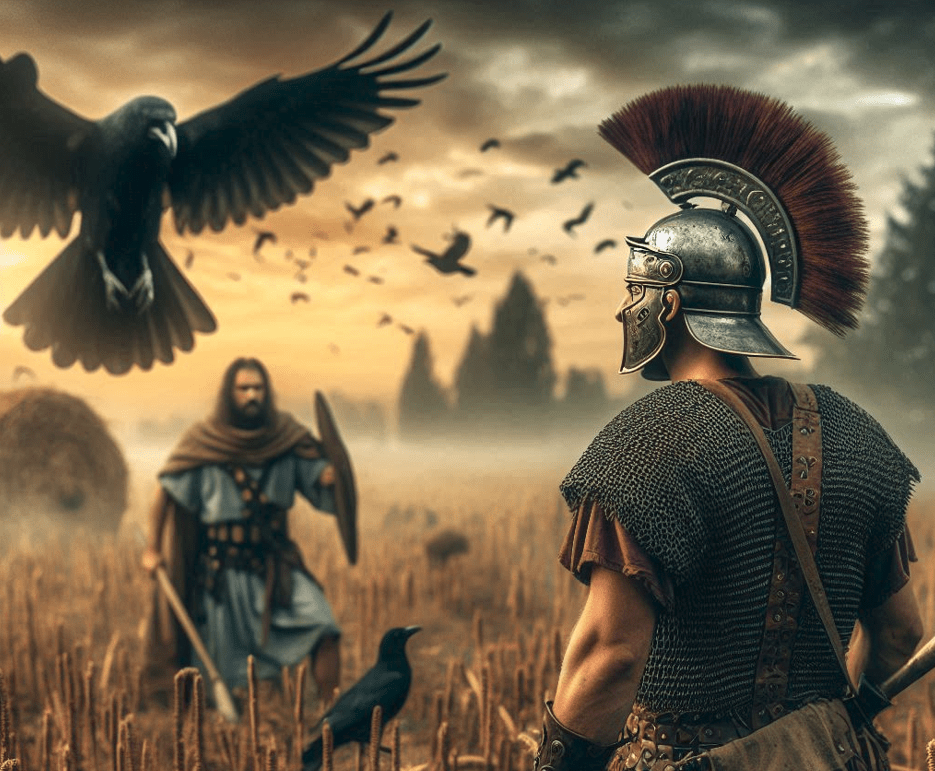
There is a story told in Livy (VII.26) of a raven’s fortuitous intervention on behalf of a Roman soldier engaged in personal combat with a Gaul. This event, if indeed it is not apocryphal, occurred in 348 B.C. during the consulship of Lucius Furius Camillus.
A Roman army had been raised to confront a marauding horde of Gauls who had come down from the Alban Hills and laid waste to regions near Rome. One day, some Roman sentries were approached by a Gaul of intimidating size and gleaming weaponry. An interpreter was found; and the Gaul communicated that he was there to challenge a prominent Roman soldier to personal combat. An opponent was quickly found: his name was Marcus Valerius, and he was a tribune of the soldiers (tribunus militum). Valerius donned his armor and sword and prepared to fight.
But, says Livy, “the fight was less a matter of human determination than an interposition of divine will.” For as Valerius was about to begin the contest, a raven flew at him and settled on his helmet, in such a way that it faced the Gaul. The Roman was at first startled, and then delighted, thinking it a strikingly good omen, and he prayed to his gods for continued good fortune in the commencing struggle. The raven not only remained where it was, but it actually assisted Valerius in his efforts. As he contended with the thrusts and blows from the Gaul, the raven would strike at the Gaul’s face with its beak and talons. Thus distracted, he eventually fell victim to one of Valerius’s gladius-thrusts. Down went the Gaul, mortally wounded; and the raven, we are told, then “flew off to the east and vanished out of sight.”
We should remember that this drama was witnessed by the Gallic and Roman soldiers assembled there. As their champion went down in death, his comrades rushed toward him; the Romans did likewise to attend to Valerius. Fighting between the two sides broke out, for the Gauls were enraged, and the Romans elated. Soon the melee spread, and brought in larger units and legions in the area. Camillus eventually arrived on the scene, and encouraged his men to join the battle in earnest. He pointed to the victorious Marcus Valerius and said, “Follow this example, soldiers! Cut down the Gallic bands around their fallen leader!” Livy says that both divine favor and human will played a role in the outcome of the battle. The result of the single combat had been seen by all, and had foreshadowed the ultimate defeat of the entire Gallic army that day. A large number of them simply turned and fled in undisciplined haste before they came within the throwing range of a Roman javelin.
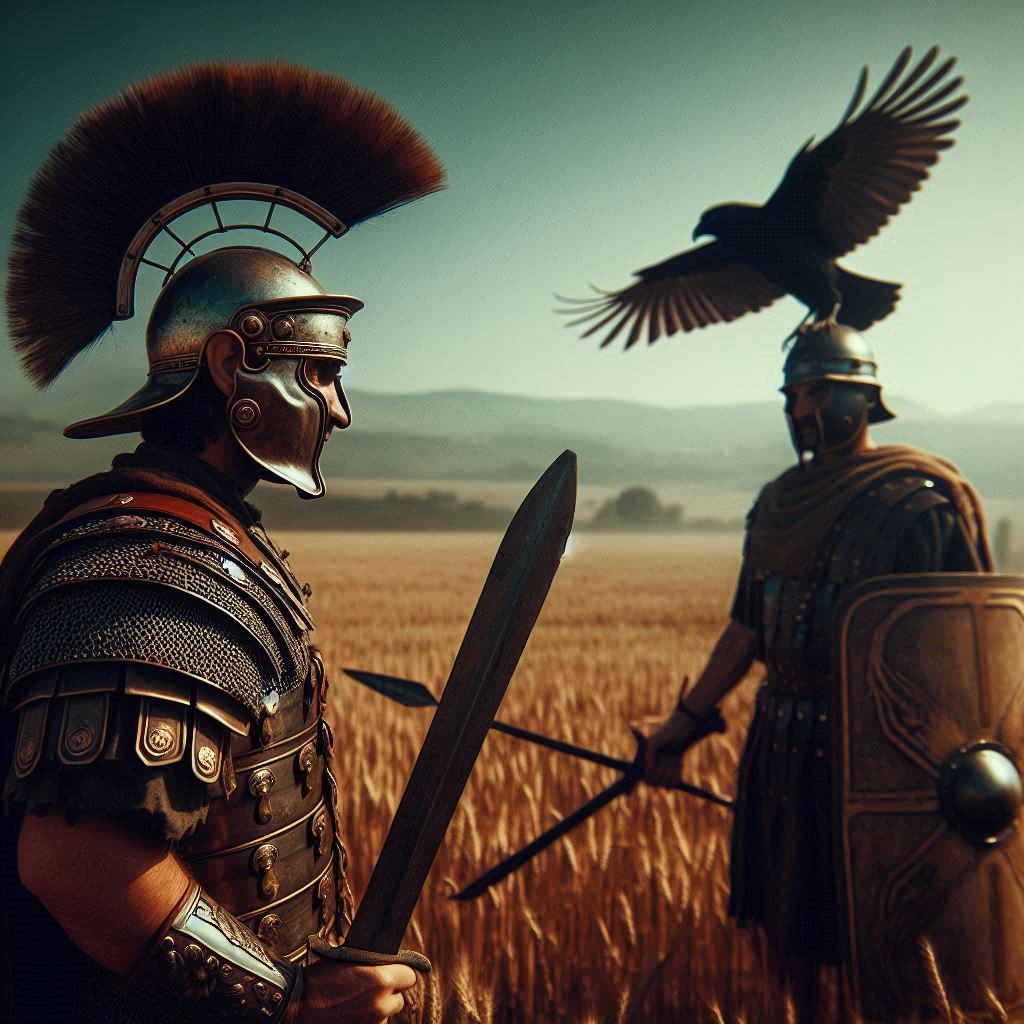
And so concludes Livy’s tale. What matters is not whether this event occurred exactly as he says, but that Livy himself believed the event to have taken place. He was a patriotic man, and as a historian generally scrupulous by the standards of his day. He did not see any harm in mingling history and legend in order to make a point. But what point? Perhaps it is that there are times when certain outcomes are simply fated to happen, and little can be done to prevent them.
R.V. Burgin, in his excellent memoir of World War II in the Pacific Islands of the Damned, makes this same point. Before a landing on a hostile beach, some of his Marine comrades would have dark premonitions of their own deaths. Once a certain degree of certitude settled over them, nothing could dissuade them. The reader may recall Queequeg patiently and silently constructing his own coffin in Moby Dick. No amount of encouragement could convince these Marines otherwise; and in many cases, their forebodings proved to be true. Contrarily, some men have an unshakeable belief in their own inevitable triumphs. This is the feeling impressed on the modern reader of Beowulf, as he works his way through the ominous lines of this great and mystical poem. Its setting and milieu are to us both remote and at the same time possessed of a vague, subconscious familiarity:
Often, for undaunted courage,
Fate spares the man it has not already marked.
However it occurred, my sword had killed
Nine sea-monsters…
But worn out as I was, I survived,
Came through with my own life.
[572—579. Trans. by Seamus Heaney]
The inevitable questions we are left with, of course, involve the boundaries and interplay between divine will and human agency. Where does one end, and the other begin? And to what extent does one influence the other? The only rational response, I think, is to adopt a position suggested near the end of Cicero’s On the Nature of the Gods. We will never know for certain whether a divine will exists; and if it does exist, whether it concerns itself with human affairs, or is even aware of them. These are not questions that should oppress the thoughts of mortals. For us all that matters is that we keep moving forward, that we continue to stand diligently at our posts, that we continue to perform our duties with courageous distinction, and that we continue to struggle valiantly against that Vast Indifferent Unknown which may never take notice of our names. Everything else is out of our hands.
.
.
Take a look at the new, annotated translation of Cicero’s On the Nature of the Gods.
 Quintus Curtius
You must be logged in to post a comment.