
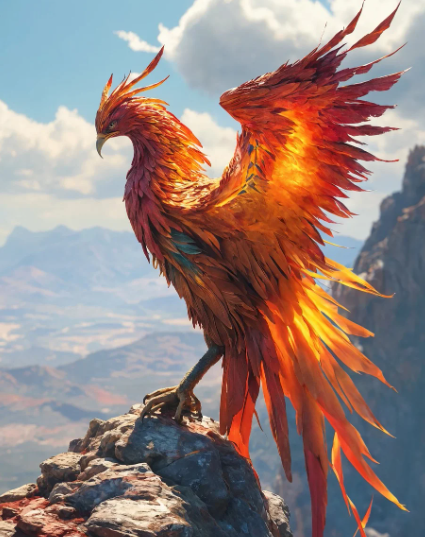
One of Saladin’s advisors was a man known by the honorific title Al-Qadi Al-Fadil (“The Excellent Judge”). We will not try the reader’s patience by recording his protracted real name, but we will note that he lived from 1135 to 1200. Great conquerors in history always seem to be accompanied by wise counsellors; perhaps there is an important lesson to be derived from this fact.
According to his medieval biographer Ibn Khallikan, Al-Qadi believed that the man of destiny should take it upon himself to “pursue the phoenix;” and in support of this idea he would often quote the following verses:
When the eyes of Fortune guard you, sleep without fear, for places of danger are then places of safety. Pursue the phoenix, fortune will serve you as a net; take the constellation of Orion for a steed, fortune will be your bridle. [II.110]
But how exactly does one pursue a phoenix? We recall that the mythological phoenix passes through endless cycles of birth, death, and rebirth. It represents the unrelenting systole and diastole of life. And so we may conclude that Al-Qadi is, in effect, counseling us to embrace life’s eternal rhythm, and make our peace with it. We cannot know when we will die, or when or in what form we may return; and so we must follow the path that the stars in their courses have laid out for us. Yet this does not imply a blind or slavish adherence to external circumstances; on the contrary, we must take action to improve our lot, in order not to be crushed by Fate’s wheel. A man must take pains to educate himself, and become as knowledgeable as possible in his chosen field. He must take decisive action when required. Only then can he hope to shape events in his favor. Readiness is the first prerequisite of good fortune.

Along these lines, there is an amusing anecdote told by the philologist Al-Asma’i (أبو سعيد عبد الملك ابن قريب الأصمعي) (c. 740 A.D.—833 A.D.), a celebrated scholar at the court of the caliph Harun Al-Rashid. This tale appears in the pages of Ibn Khallikan (II.124). Al-Asma’i and another man named Abu Obeida once paid a visit to a senior Abbasid official named Al-Fadl Al-Rabi. The official, seeking to take the measure of the two men, asked Al-Asma’i in how many volumes his work on horses consisted. “One only, sir!” replied Al-Asmai’i. The official then put the same question to the other man, who responded “Fifty volumes, sir!” The skeptical official then conducted both men to another building in which were housed horses, and told Abu Obeida, “Go over to that horse, and put your hands on the different parts of his body, naming them correctly as you do this.” But Abu Obeida balked at this commission. “I am not a farrier!” he cried, unable to complete the assignment. Al-Asma’i took up the challenge, and correctly named all parts of the horse using the precise Arabic terms of the Bedouins. As a reward, Al-Fadl allowed Al-Asma’i to keep the horse; and whenever Al-Asma’i wanted to irritate his friend Abu Obeida, he would visit him with the horse as his mount.
While knowledge is one component of Pursuing the Phoenix, decisive action must be the other. And along these lines, the following dark tale is found in Ibn Khallikan’s biographical sketch of an official named Abd Al-Malik Ibn Omair (II.117). The official was in a fortress with the Umayyad caliph Abd Al-Malik Ibn Marwan when a severed head of a man named Musab Ibn Al-Zubair was brought before the caliph. The caliph saw Ibn Omair shudder, and asked him what was the matter. The shocked official replied:
May God preserve the Commander of the Faithful! I was in this very castle, and in this very room, with Obaid Allah Ibn Ziad when the head of Al-Husain, the son of Ali Ibn Abi Talib was placed before him. I was then here with Al-Mukhtar Ibn Abi Obaid Al-Thakafi when Obaid Allah Ibn Ziad’s head was brought to him. I was here again when Al-Mukhtar’s head was presented to Musab Ibn Al-Zubair, and behold now the head of Musab! [Trans. by M. de Slane]
When he heard these words, the caliph rose from his place and ordered the pavilion in which he and his official were then located to be razed to the ground. Clearly the caliph did not wish to be the next link in the grisly chain of events described in the quote above. By destroying the pavilion, he imposed his own solution to the problem of Fortune. And yet in the end we can only exert so much control over the waters of Fate; the phoenix-like cycle of birth, death, and rebirth will inevitably have its way.
The mystic preacher Ibn Nubata, who died around A.D. 985, revealed the following vision which came to him in a dream. In the dream, Ibn Nubata was standing in a cemetery when an image in the shape of the Prophet Muhammad appeared before him. The spirit pointed to the headstones in the cemetery, then looked at Ibn Nubata and said to him, “You, khatib, what do you say of the deceased?” The mystic pondered for a moment, and then answered:
They tell not of the state to which they are come. And were they able to speak, they would do so. They have drunk the bitter cup of death, and are now as if they had never rejoiced the eyes of their friends—as if they had never been counted among the living. He who gave them speech has brought them to silence; he who created them has caused them to perish. But as he wore them out, so will he renew them; as he scattered their frame, so will he reunite it. [II.110; trans. by M. de Slane]
And as this phoenix spoken of by Al-Qadi Al-Fadl everlastingly is born, flourishes, and passes on, so must we pursue its example.
.
.
Learn more about the cycle of life in the new, annotated translation of Cicero’s On the Nature of the Gods.
 Quintus Curtius
You must be logged in to post a comment.