
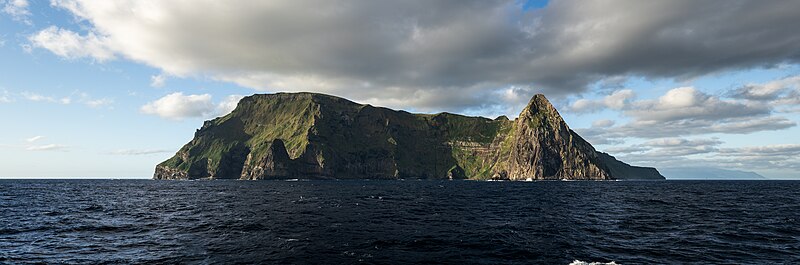
When Napoleon was finally imprisoned on St. Helena, the British government thought it prudent to occupy a small volcanic island named Tristan da Cunha, which was located about twenty degrees south of St. Helena. It was assumed that, if the wily French emperor attempted an escape from his island lodgings, Tristan da Cunha would present an ideal staging area. Occupation of Tristan would forestall such an eventuality. Within a few years a fort and barracks had been constructed, and the island was eventually garrisoned; a few dairy cows completed the island’s fortification.
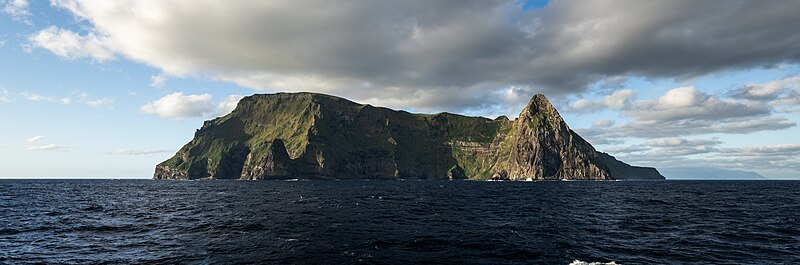
A place on earth more remote and lonely than Tristan da Cunha could hardly be found. But one candidate did exist. About twenty-five miles southwest of Tristan da Cunha lies a desolate speck of land appropriately called Inaccessible Island. The island is uninhabited, and has now been designated a protected wildlife preserve. We are told that it is the sole habitat of the “Inaccessible Island rail,” the world’s smallest flightless bird. The island’s harbor is so forbidding that it can be used only a few days each year. This wind-blasted piece of rock was the scene of a fascinating shipwreck drama in 1821, which we will now relate.
In 1821 the British ship Blenden Hall set sail for Bombay, India with 54 passengers. While sailing through the Atlantic, strong currents and adverse winds caused the ship to drift off course, and Captain Alexander Grieg thought it prudent to land at Tristan da Cunha and reorient himself. As the ship approached the Tristan archipelago in late July, a passenger on deck began to observe large clumps of seaweed floating in the water, which he knew to be an indication that land was near. As it turned out, land was too near. Since the weather did not permit adequate visibility, a man was sent aloft as a look-out. Soon the cry of “Breakers ahead!” sounded, and everyone rushed on deck. Within a few minutes, the look-out sounded more panicked warnings, calling out “Breakers starboard! Breakers larboard! Breakers all around!”
Confusion ensued, but it was too late for the Blenden Hall. The ship struck a reef which tore a huge gash in the hull. The damage was severe, and the ship began to take on water. In the chaos that followed, two sailors perished; they were either drowned or crushed by collapsing rigging. The remainder of the people aboard—officers, crew, and passengers—managed to stay alive by clinging to the floating wreck. At this point Inaccessible Island emerged from the mist. It was about two miles from the shipwreck; but by one of those miracles that on occasion happen during tragedies, the wind and currents were guiding the survivors directly to the island. After about six hours, the wreck ran aground at the only spot on the island where such a landing could be made. The survivors were shocked to see, all around them, granite cliffs extending up to fifty feet in the air.
A raft was fashioned and launched from the floating wreck into Inaccessible Island’s cove. The exhausted and shaken survivors did their best to salvage what they could from the carcass of the Blenden Hall. They removed bales of fabric, cases of wine, boxes of cheese, hams, a seaman’s chest (containing a tinderbox, needles, and thread), even a drowned dairy cow. Soon torrential rains began, drenching the miserable survivors beneath their improvised shelters. In the morning a party of men set out to explore the island. The survivors were horrified to discover that almost nothing to support life could be found; the terrain offered nothing except stones, weeds, ferns, and assorted scrub vegetation.
After a few days, their meager supplies began to run out; if they could not find food quickly, starvation loomed. Yet fate intervened to help the castaways. They discovered that they were able to capture edible birds at night by disorienting the fowls with smoke and light from their campfires. An eighteenth-century account of the shipwreck claims that flocks of birds would fly through the flames, but this seems implausible. In any case, the birds, unaccustomed to interaction with human beings, proved to be relatively easy to harvest, and gave the survivors a new lease on life.
But the island’s birds learned quickly to avoid the hungry humans. After a few days, starvation again loomed. And here again, fate came to their rescue. Vast swarms of penguins began to visit the desolate island to lay eggs everywhere; there were so many eggs that they blanketed the ground like sheets of snow. After about five days, the penguins left, leaving behind a food supply for the castaways. Attempts were made to catch some penguins, but apparently the flesh of the birds proved to be lacking in nourishment.
When the supplies of eggs began to depleted, anxiety again gripped the survivors. One morning, a man came running from the waterline to inform his comrades that he had seen huge numbers of sea-cows on shore. These blubbery manatees proved difficult to eat, but their livers were nourishing, and kept the survivors alive for a bit longer. In the meantime, the ship’s carpenter and five men had constructed a boat which they intended to pilot to Tristan da Cunha. Their location was so remote, so outside the main shipping lanes, that their only chance of deliverance was to try to reach the closest inhabited island. The boat was launched, disappeared over the horizon, and was never heard from again. No doubt the six men died of exposure at sea, or became victims of the strong currents in the Tristan archipelago.

There was no other option but to try again. This second boat did manage to reach Tristan da Cunha, where they were welcomed by one Governor Glass. Multiple trips to Inaccessible Island were made to rescue the survivors. They had remained alive on the barren island for almost three months. What had kept them alive, and out of the maw of despair, was their ability to think clearly, adapt to their circumstances, and capitalize on every chance that presented itself. When food was lacking, they discovered how to capture birds; when this opportunity expired, they found penguin eggs; and when this source ran out, they made use of sea-cows. They then set out to build a boat that would take them to Tristan. The first attempt failed, but the survivors did not give up. They did not surrender themselves to despair; they persisted, and beat Fate at its own merciless game. In the annals of survival, hope is both infectious and imperative.
.
.
Read more inspiring accounts of shipwrecks and survival in my essay collections Digest and Centuries.
 Quintus Curtius
[…] Shipwrecked On Inaccessible Island […]
LikeLike