
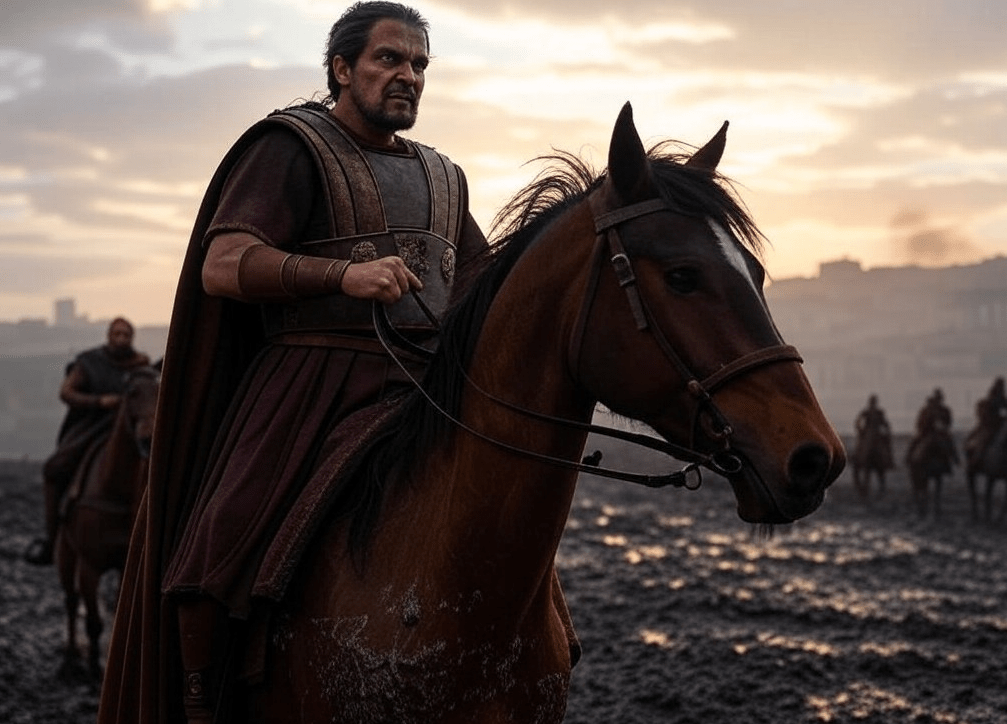
It can often be instructive, in the study of history, to play the intriguing game of “what if?” We are inclined to believe in the inevitability of historical events, simply because things turned out as they did; yet we tend to forget that different decisions might have produced very different outcomes. Thought experiments also help us to review those timeless principles of leadership and morals that may be applicable to our own lives. Let us, then, review Hannibal’s decision not to march on Rome in the immediate wake of his shattering victory at Cannae in August of 216 B.C.
It is difficult to overstate the magnitude of Hannibal’s victory over the Romans at Cannae. Other historians have described the battle in great detail, and we need not repeat their descriptions. We should not quibble too much with the casualty figures provided by Livy and Polybius. They did not invent their numbers from thin air, and the figures they have provided are close enough. Let us accept that approximately 48,000 Romans and their allies perished in one day of carnage. Considering the relatively small size of ancient armies and populations, this was an appalling figure. It deprived the Romans, at one stroke, of a major portion of its military strength. Roman society was in utter panic. Her remaining forces were completely demoralized, and Rome’s allies were horrified. The southern region of Italy—the Magna Graecia provinces that had never been completely Latinized—defected to Hannibal. Sicily, sensing an opportunity, revolted against Rome, and Philip V of Macedon elected to throw in his lot with Hannibal.
In Rome, panic reigned. There are recorded instances of human sacrifice in the city, as the desperate population petitioned a divine power to guide them through the Cannae crisis. Nearly every family member had someone touched by the tragedy. I do not believe it to be an exaggeration to say that, in today’s terms, Rome’s defeat at Cannae would be similar to the effect of a country being hit with a tactical nuclear weapon.
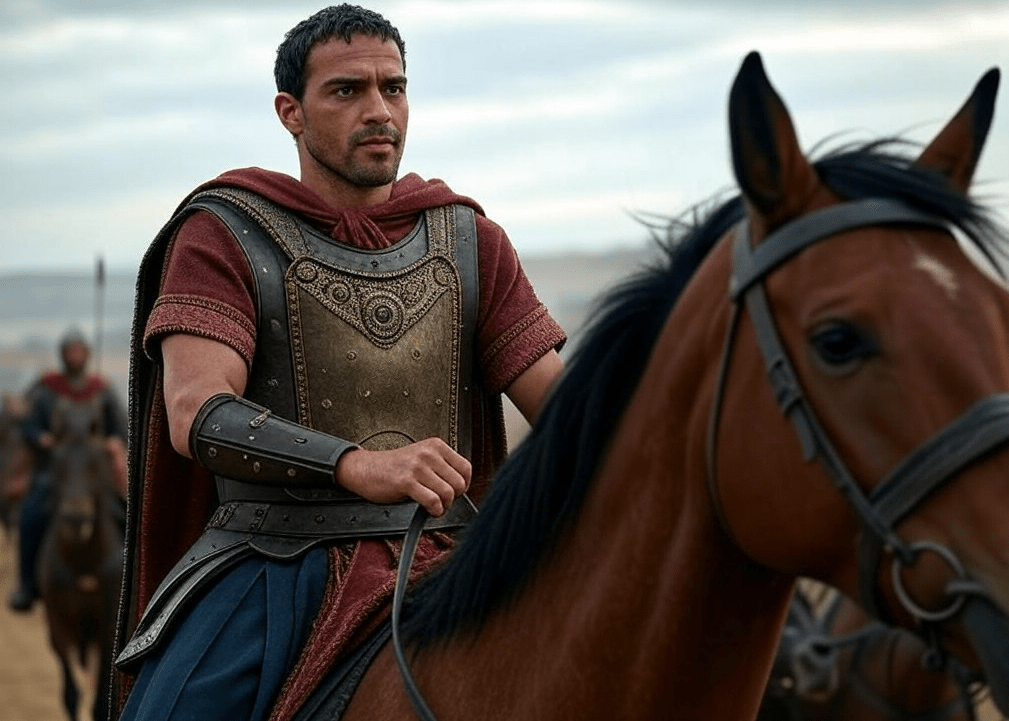
The question for Hannibal after Cannae was, of course, this: what should I do now? Most of his officers advised him to rest the men and savor the moment. But his cavalry commander, Maharbal, pleaded with him to move without delay against Rome itself. Now was the time, he argued, to capitalize on the victory and the paralytic effects of shock. He promised Hannibal that he could be at Rome’s gates in five days. But Hannibal prevaricated, and then demurred. Maharbal famously said, according to Livy (XXII.51), “You know how to win, Hannibal, but you don’t know how to make use of your victory.” Most modern historians, however, do not question Hannibal’s decision. If they do, they do not question it strongly enough. They argue that the Carthaginians were exhausted; that Rome was about 230 miles from Cannae, and would have taken two weeks to reach by forced march; and that Hannibal was without engines or equipment to put Rome to siege.
But is this really true? Are there arguments that can be raised in opposition to this verdict? It is true, of course, that Cannae is about 230 miles from Rome. Rome’s exterior walls were strong; they were about 7 miles long, and Hannibal would have had to contend with additional ramparts and obstacles. The walls enclosed an area of about 1.5 miles. Hannibal probably had about 40,000 men in decent fighting shape after Cannae. There is no doubt that a siege would have been long, difficult, and costly. But this does not mean a successful siege was impossible. Rome herself, in 212 B.C., carried out an arduous but successful siege against the Sicilian city of Syracuse, which had walls 18.6 miles long, and was just as stoutly defended. It was one of the most well-defended cities in the entire Mediterranean. The Romans besieged Syracuse with far fewer men (around 17,000) than Hannibal had after Cannae. The effort took two years, but the city eventually fell. After Cannae, the number of soldiers defending Rome was small, certainly far fewer than Hannibal believed. There were about 8,000 soldiers in Rome, and probably another 5,000 or so in the city’s immediate vicinity. Hannibal would not have faced much armed opposition, at least not initially.
If Maharbal had led his cavalry directly to Rome, he might have been there within a week. Their appearance before Rome’s walls might have induced even more panic among the already traumatized population. Instead of resting, Hannibal could have rallied his men and marched directly to Rome. His presence in central Italy may have caused the wavering Italic city-states to defect to him. Rome might have then found herself under direct siege and surrounded by a network of hostile former allies. Alexander the Great, one of Hannibal’s heroes, did not shrink from sieges that were thought to be impossible. His capture of the Phoenician city of Tyre is a masterpiece of determined creativity. Alexander was willing to spend the time and extreme effort to construct an artificial mole to the island city that both isolated it and brought his soldiers to the base of Tyre’s walls.
But Hannibal opted not to march on Rome. He seems to have been genuinely in doubt as to the magnitude of his victory. He may even have suffered from a crisis of indecision. He had never intended to physically destroy Rome, or to take the city itself. He wanted a peace treaty with Rome that would, in effect, humble Rome’s rising power and cut her down to size. His strategy was to seek alliances among the peoples of the Italic peninsula, and win them over to his side. To this end, he spent the next 13 years tramping around Italy, pursuing his dubious strategy, before being recalled to Carthage in 203 B.C.
The flaws in Hannibal’s master plan were significant. He did not really understand his enemy, or the political conditions in Italy. Under the rules of warfare in his day, an enemy was supposed to sue for peace after suffering the kinds of horrendous defeats that Rome had experienced since Hannibal’s entry into the peninsula. But Rome did not surrender. She absorbed incredible punishment: the battles at the Trebia, Lake Trasimene, and finally Cannae came in rapid and ruinous succession. And yet Rome still would not give in. Hannibal was, in fact, facing an enemy that was unlike any other. Romans were patriotic, disciplined, and possessed extremely resilient political and military institutions. Hannibal’s strategy of winning over useful allies in Italy was also questionable. Many of them had no love of Rome, but Carthage was an alien society that seemed unable to offer them anything better. In the end, the Italian city states preferred to retain the devil they knew, than cast their lots with the devil they did not know.
The truth is that Hannibal was not a master of sieges. His only real experience in this type of warfare was the siege of Saguntum in Spain in 219 B.C. That effort took 8 months. Hannibal saw his small but professional army as a force to fight pitched battles; he was unable to accept the need to change his strategy as the new circumstances in Italy dictated. The First Punic War lasted about 23 years, and ended only when Carthage realized it could not outlast Rome in a war of attrition. Hannibal should have learned from this bitter experience. If he hoped to defeat Rome, he could not let himself be sucked into a contest of attrition. He would have to move with lightning speed, and shatter Rome before she had time to recover. It was an extremely risky strategy, but it was the only one that had a realistic chance of success.
None of this discussion is intended to detract from Hannibal’s supreme talents as a commander. He is rightly ranked as one of the greatest generals in history. Yet our admiration of heroic figures must not blind us from assessing, in honest tones, the consequences of their actions. Hannibal’s strategic failure, I submit, cannot be blamed on his political enemies in the Carthaginian senate, or on unreliable Spanish and Gallic auxiliaries, or on the sullenness of his Italian allies. He failed to capitalize on his crushing tactical victories. He permitted a war of attrition to play out across the western Mediterranean, which is exactly the outcome he should have avoided. Carthage would send reinforcements to other theaters, such as Spain (where it sent 15,000 men in 215 B.C.), or Sardinia (where it sent 17,000 men), or Sicily (where it sent 28,000 men). But these reinforcements could, and should, have been sent to augment Hannibal in Italy, which was the main theater of the Second Punic War.
Stated simply, Hannibal should have gone for Rome’s jugular. He acted with insufficient ruthlessness after Cannae by giving Rome time to recover her composure. A direct march on Rome, and a campaign to besiege the city, would have allowed him to retain and keep the initiative. It might have prompted the Carthaginian senate to send Hannibal everything it had, instead of dissipating its combat power in Spain, Sardinia, and Sicily. Scipio, Carthage’s nemesis, would probably have been forced to remain in Italy to attempt to lift Hannibal’s siege, and the wily Carthaginian might have been able to destroy him. But none of these things happened. Instead, Hannibal was gradually ground down in Italy, after having wasted years in fruitless campaigning. As it turns out, Maharbal’s dismissive comment to Hannibal after Cannae was exactly right: Hannibal did not know how to use his tactical victories. He was unable or unwilling to adjust his strategy, and this proved to be his downfall.
What lessons should we conclude from all this? We must be aware of our circumstances, and retain an absolutely dispassionate objectivity about things. We cannot allow ourselves to be misled or blinded by illusions or by wishful thinking. We must know our enemies, and know ourselves. Strategies and goals should be based on cold, hard calculations. If we are weaker than our opponent, we cannot be drawn into protracted conflicts. Daring, audacity, and confidence are crucial. When given the chance, always go for the direct kill: when you have the opportunity, always march on Rome. Hannibal should have gone for Rome’s throat immediately after Cannae. He never understood that the only way to get the peace treaty he so ardently desired was to do that which he did not want to do: put Rome to siege and threaten her with destruction.
.
.
Read more about the lives and leadership lessons of ancient leaders in the new, annotated translation of Cornelius Nepos’s Lives of the Great Commanders.


[…] Always March On Rome […]
LikeLike