
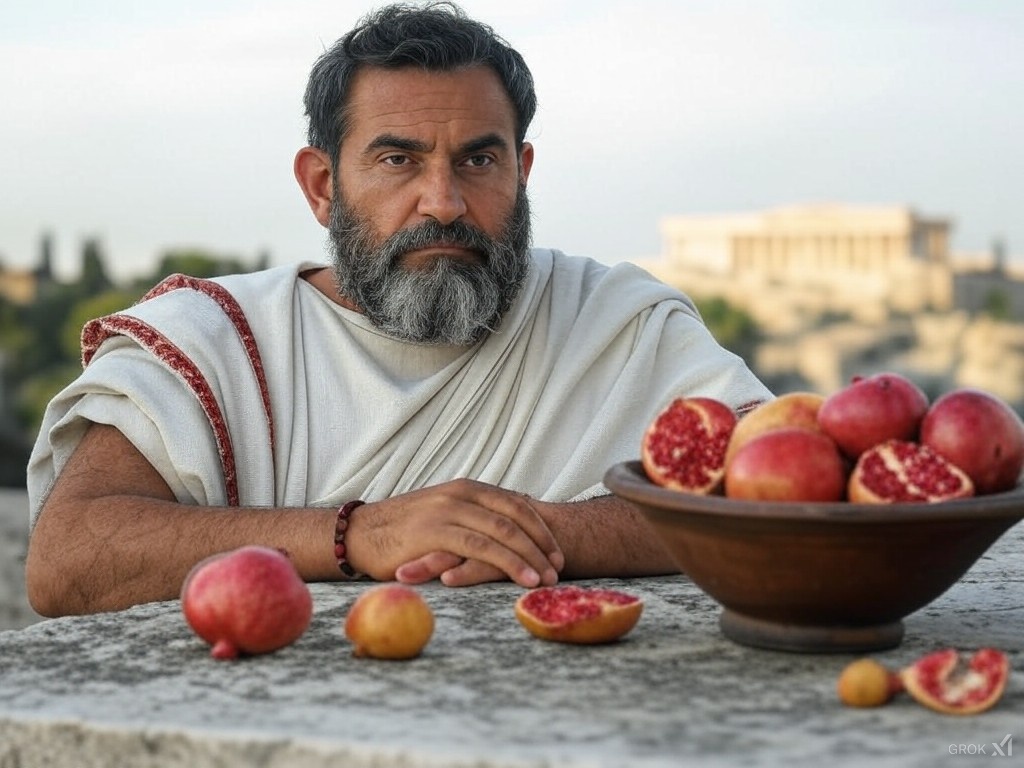
The Stoic philosopher Ariston of Chios was said to have believed strongly that the wise man should avoid making absolute judgments. Certitude, he felt, was neither possible nor desirable.
Yet another thinker, Persaeus of Citium, considered this precept to be an illusion. We make judgments and form opinions of things all the time, he countered; and to prove Ariston wrong, he conceived an amusing experiment, according to the biographer Diogenes Laertius (VII.162). Persaeus arranged for one of two identical twins to deposit a sum of money with Ariston for safekeeping. Then, a short while later, he had the other twin reclaim the money. Ariston was apparently unable to distinguish one twin from the other; he had in effect formed a presumptive judgment that the person who reclaimed the funds was the same person who had deposited them. Despite holding that a man should not form opinions, he himself had been guilty of forming one. Does the result of this experiment refute Ariston?
Another philosopher, Sphaerus of Bosphorus, found an adroit and cunning way out of the “certitude” problem. We find the tale related in the pages, once again, of Diogenes Laertius (VII.177). I consider it particularly amusing because of the lawyerly stratagem Sphaerus employs to wriggle out of the rhetorical trap set for him. Sphaerus was a pupil of the Stoic thinker Cleanthes; after completing his studies with him, he moved to Alexandria, where he became attached to the court of Ptolemy IV Philopater. Sphaerus, we are told, also took the position that a wise man could not be certain of anything. The king found this view obnoxious and evasive, and set out to ensnare the wily philosopher in his own verbal spider webs.
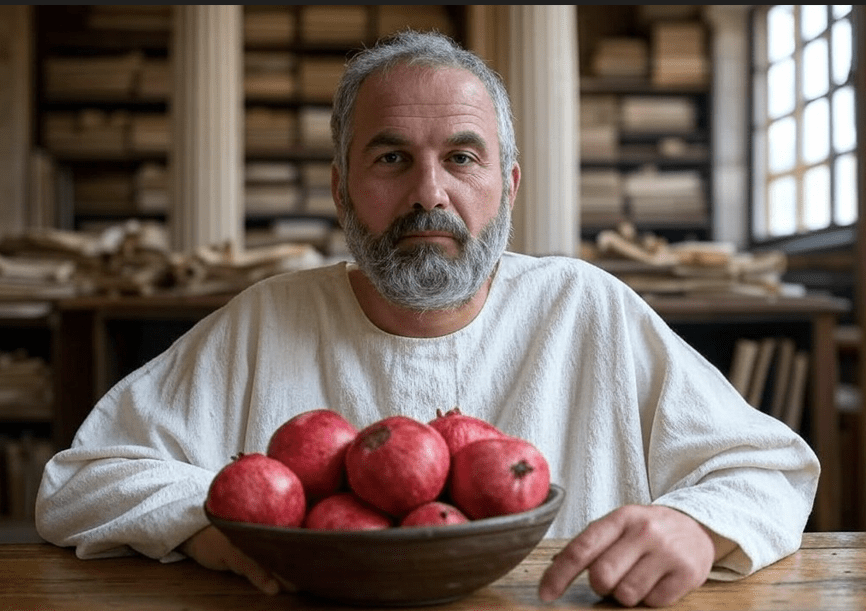
Without informing Sphaerus, Ptolemy had an attendant bring a bowl of pomegranates made of wax to their table. When Sphaerus was deceived into believing in the authenticity of this “fruit,” the king felt he had gotten the better of the philosopher. We form opinions and judgments all the time, he maintained, and to say otherwise is simply wrong. But Sphaerus was not no easily routed. He told the king,
I assented not to the proposition that they are pomegranates, but to another, that there are good grounds for thinking them to be pomegranates. Certainty of presentation and reasonable probability are two totally different things. [Trans. by R.D. Hicks]
Yet Sphaerus is not just using sophistry here; he is making an enduring and valuable point. Reasonable probability, it seems, is the only principle that can stand the test of lived experience. Most things lie outside our ken and comprehension; we can know almost nothing, or at least very few things, with certainty. Our senses are imperfect, lacking in depth, and frequently deceptive. They may say one thing at one time, and another thing at another time. Memory likewise is fleeting, and subject to various mutative factors. The best we can do is assess probabilities, and then act on the results of those assessments.
I should say in closing that Sphaerus’s name also makes an appearance in Cicero’s Tusculan Disputations (IV.24), but with regard to a topic different from the one we have discussed thus far. We find a few of Sphaerus’s definitions cited during a discussion of bravery and courage. Cicero summarizes the philosopher’s ideas on bravery as follows:
Bravery is a condition of the mind in enduring hardships that is in alignment with the highest law; or, it is the preservation of a stable judgment in braving and defeating life’s reversals that appear terrible. It may also be the discriminating awareness of those tribulations in life that are terrible and those that are not terrible, or the knowledge of those hardships that should be ignored completely while keeping a balanced judgment of them. [IV.24]
These definitions offer fascinating insights, and are worthy of our reflection. Bravery, in Sphaerus’s view, becomes a form of discriminating awareness: we must be ready to separate those tribulations in life that are truly terrible from those that are not terrible. And we should learn to identify those hardships that deserve our attention, and those that deserve to be ignored.
.
.
Read more in the new, annotated translation of Cicero’s classic Tusculan Disputations.
 Quintus Curtius
Dear QC,
You encroach here on the domain of quantum physics, namely, that the properties of matter can be understood only in terms of probabilities. Viva Heisenberg, Schrodinger, Bohr, et al.
LikeLike
Yes, sir, I think I did!
QC
LikeLike