
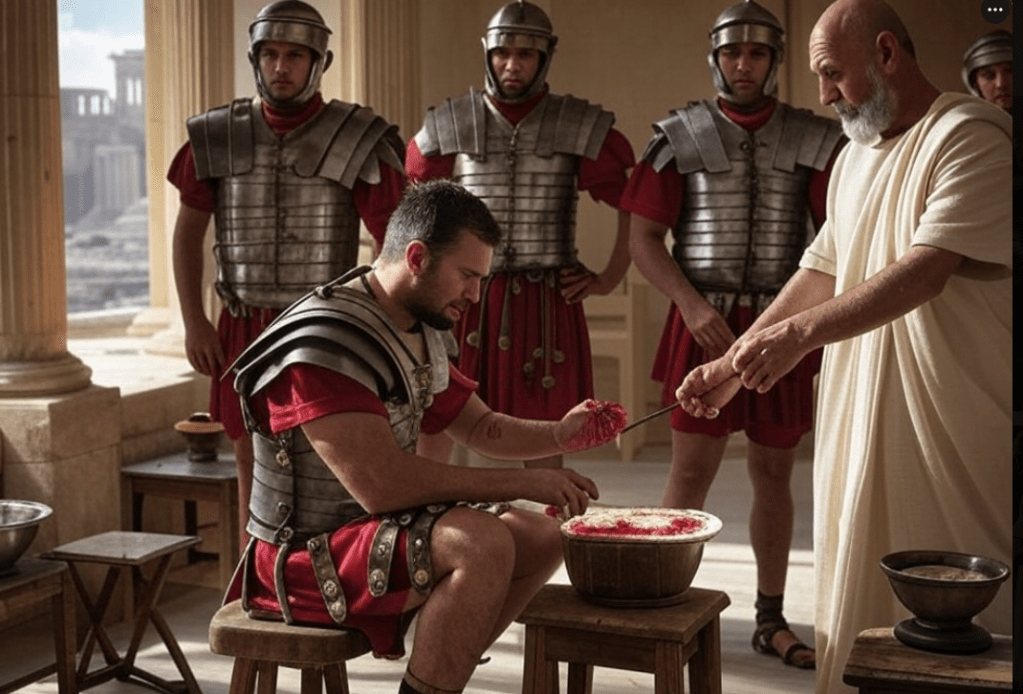
The Roman writer Aulus Gellius (X.8) relates an interesting anecdote about his country’s military punishments in olden times. He says that if a soldier committed some offense, he would be “bled”: that is, he would be subjected to a ritualistic opening of a vein and be forced to lose some blood.
It is not clear what offenses would trigger this punishment, but Frontinus (IV.1.16) says that the letting of blood was an alternative sentence for the crime of stealing. The severest sentence for stealing was the amputation of the offender’s hand. Roman generals knew very well that the cutting off of a soldier’s hand for theft was an impractical and unduly harsh remedy. So we might suppose that the letting of blood would have been far more commonly used. The rite surrounding it at a Roman camp must have inflicted the transgressor with a great deal of shame; and perhaps this was essential to the practice’s purpose.
But the question remains: what was the origin of this odd punishment? What rational basis for this procedure can be proposed? Aulus Gellius ventures to offer an explanation. He says that the punishment was an evolution from the idea that, if a soldier committed an offense, he was not of sound mind. He was, according to this theory, a sick man. Bloodletting would thus have been an attempt to cure a disease of the mind. Over time, Gellius speculates, the original medical purpose of the treatment faded into obscurity, and the practice gradually evolved into a ceremony intended not to cure, but to punish. Readers are no doubt familiar with the fact that the “bleeding” of a patient was in classic times—and even in the early modern era—seen as a medical treatment.
But does this explanation really suffice? I think there is something implausible about it. The Romans were not very keen on seeking medical excuses for criminal behavior; they were, in fact, very keen on using ritual and symbolism to psychologically dominate those they believed needed the lessons of compliance impressed upon them. Compelling a vanquished foe to pass sub iugum (“under the yoke”), the holding of triumphs, the taking of hostages, and a hundred other examples from Roman history: these were carefully calculated mechanisms of intimidation and control. Likewise, it is plausible to speculate that the ritual drawing blood from a soldier was done to inflict some psychological lesson on him. He would be shamed in front of his comrades. He would, perhaps, be made to feel unworthy of a wound incurred in actual battle. Rather than spill his blood against an opponent, he would have it spilled in a shameful way, for the most disreputable reason.
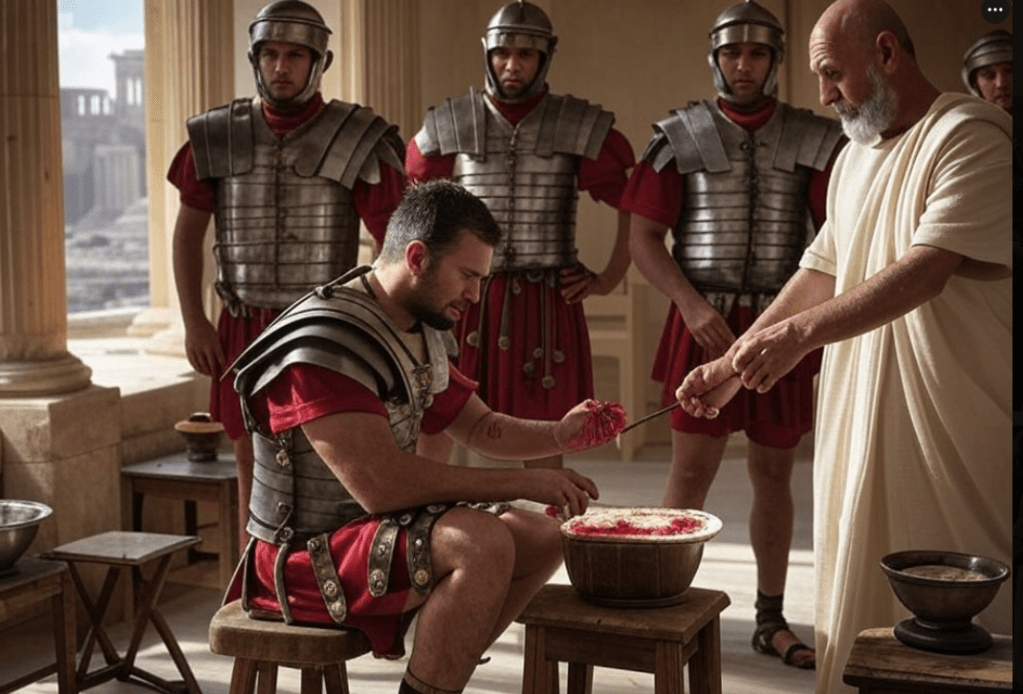
Since reading Sir James Frazer’s influential The Golden Bough, I have gained a greater appreciation of the anthropological and social origins of human rituals. Religions practices, taboos, and social institutions have deep and powerful roots in man’s consciousness. If a seemingly inexplicable tradition is configured in a certain way, we can be assured that there is a rational reason for it, even if that reason is now obscured by the swirling fog of time. With regard to the drawing of an offending Roman soldier’s blood, I think the practice has a purgative purpose. Allied with this purgative purpose is a sacrificial impulse. What do we mean by this?
There is an impulse in the human psyche that requires wrongs to be redressed. Unpunished transgressions threaten to upend nature’s delicate balance. If something is out of balance, it is man’s duty to restore a semblance of balance. This subconscious drive may have its origin in primitive man’s early attempts to control and understand his physical environment. We cannot say from whence exactly it comes: but it is there. So when a soldier in an ancient military organization committed an offense, there would have been a realization that his crime could undermine the morale of the group. It would have been an offense not just against the victim, but against the formation as a whole. Military units in ancient times were extremely cohesive; they trained and fought in close proximity. A problem with one man could adversely affect the morale of the entire group, perhaps more so than with militaries today.
So there would have been this need to restore balance, to show the other soldiers that the offender was willing to sacrifice something. He had to purge himself of his criminal ways and, in so doing, perform a kind of ritual sacrifice. What better method to do this, what more brilliantly symbolic event, than a public drawing of blood? The man would be able physically to purge himself of his moral contaminants, and demonstrate to all his willingness to sacrifice, with his own blood, for the continued harmony of the unit. It is difficult to imagine a more artful exhibition of sanguinary penance.
Aulus Gellius was writing in the first century A.D. The fact that the origin of the blood-drawing punishment of Rome’s ancient soldiery was just as alien to him as it is to us, demonstrates that ritualistic practices eventually, over long periods of time, lose their original meaning. What once possessed practical utility persists as abstract symbol. But we moderns embrace such purgative rituals all the time. We just do not notice them. They become embedded in our psyches as superstitions or inherited folkways.
I was thinking recently about a peculiar habit of mine that may have some bearing on our discussion here. I like to get a haircut before going on a long trip away from home. Where does this impulse come from? Of course it may be just a meaningless, semi-neurotic resolve on my part, signifying nothing. But perhaps there is something deeper: perhaps it is a psychological relic of those instinctive needs, purgative and sacrificial, that have been mentioned above. I may unconsciously feel that to have a successful journey, I must clip off some part of myself and present it as a sacrificial offering to Fate. It is essentially a purgative ceremony, accomplished on a very small scale.
There is, I think, an instinctive understanding in our minds of the idea of purgation. To effect a fresh start, to begin down a new path unencumbered by the baggage of the past, a man must purge himself of something. Guilt, whether real or imagined, must be expunged through some ceremony, in a way that defers to the taboos and totems that haunted the mind of primitive man, the vestiges of which still adhere to our own minds today. Sometimes the sacrifice may be a symbolic one. At other times it may involve something substantial and valuable. But the psychological need nevertheless persists, and must be satiated: for the future cannot be faced without some semblance of restorative equilibrium.
.
.
Read about human mind’s methods of coping with anguish, loss, and perturbation in the new, annotated translation of Cicero’s Tusculan Disputations.
 Quintus Curtius
You must be logged in to post a comment.