Enthusiasts of the history of science are familiar with the ingenious method used by the ancient Greek scientist Eratosthenes to measure the Earth’s circumference. Briefly described, he measured the angle of a shadow cast by a stake driven into the ground at midday in the Egyptian city of Alexandria. He compared this to the fact that, at the same time, a stake located far to the south at Cyene, Egypt cast no shadow at all. Knowing from geometry that alternate interior angels are equal, he was able to calculate the number of degrees on the Earth’s spherical surface between Cyene and Alexandria, and from this, to produce a number for the sphere’s circumference.
It was an elegant and simple demonstration of deductive reasoning. What is far less known is that Eratosthenes’s mathematical results were independently verified by the medieval Arabs around A.D. 820 using an original method derived from astronomy. In so doing, they inaugurated the concepts of latitude and geodesic measurement. As far as I am aware, their experiments are the only medieval scientific confirmation of the Earth’s sphericity.
The so-called Banu Musa brothers flourished in Baghdad in the early ninth century A.D. There were three of them: Muhammad Ibn Musa Ibn Shakir, Ahmad Ibn Musa Ibn Shakir, and Al-Hasan Ibn Musa Ibn Shakir. Since their scientific and engineering advances were made as a unit—as was the case with the Wright Brothers in America many centuries later—they are known collectively in Arabic as the “Banu Musa,” or the “Sons of Musa.” They were the sons of Musa Ibn Shakir, who had been an astronomer of the caliph Al-Ma’mun. When the boys’ father died, Al-Ma’mun recognized their abilities and had them educated at his own expense at the famed “House of Wisdom” in Baghdad. In time the Banu Musa produced a number of scientific treatises, most of which have been lost. A surviving work, known to posterity as The Book of Ingenious Devices (كتاب الحيل), is a stunning achievement for its time; it contains original advances in fluid dynamics and automated machine technology. “They composed on engineering an original and singular work, filled with every sort of curious information,” writes their biographer Ibn Khallikan around 1250. “I met with a copy of it, in one volume, and found it to be an excellent and highly instructive book.”
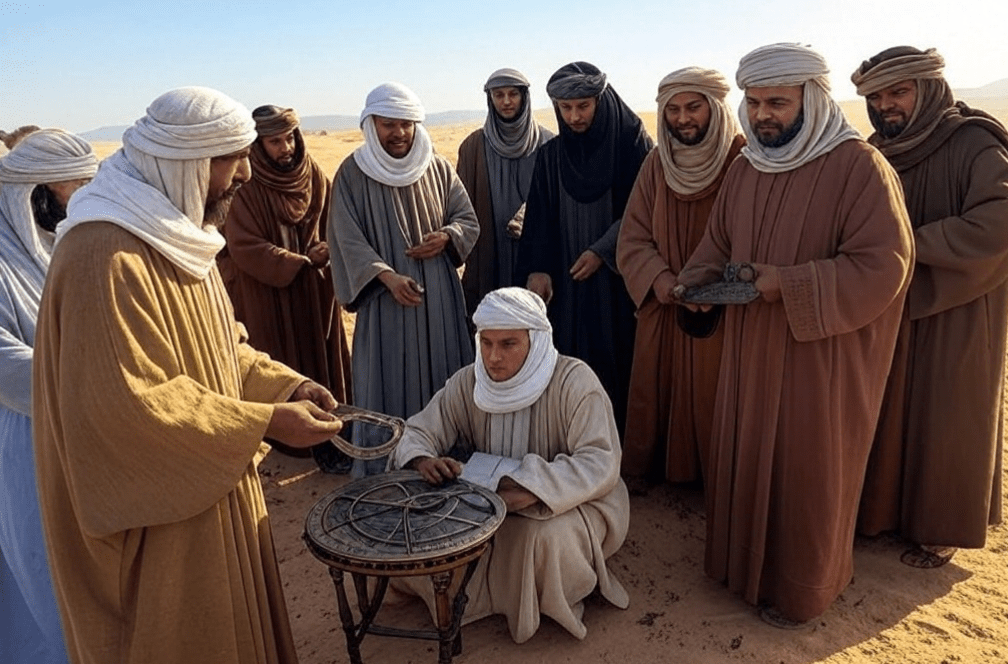
But it is their calculation of the Earth’s circumference that concerns us here. How they accomplished this feat is described by Ibn Khallikan (III.315). The caliph Al-Ma’mun, he tells us, had a strong scientific inclination, and had read about Eratosthenes’s calculation of the Earth’s circumference. Al-Ma’mun challenged the Musa brothers to confirm independently the Greek scientist’s results. The Banu Musa assured the caliph that they could do it, and that they could do it using an original method. It was known that Eratosthenes’s result for the circumference of the Earth was about eight thousand parasangs, or about twenty-four thousand modern miles.
The brothers first needed to locate two places with flat, level ground. They settled on the desert of Sinjar (in the Nineveh governorate in northern Iraq) and the region near the city of Kufa. They then assembled a number of assistants and set out for Sinjar. Upon arriving, they selected a random location and measured “with certain instruments” (presumably astrolabes) the angle of inclination from the horizon to the Pole Star (i.e., the North Star). A durable stake was pounded into the ground where this observation was made. A long cord was affixed to the stake, and the brothers then walked due north, unrolling the cord as they traveled. When the cord ran out, they drove another stake at that spot, attached another cord, and continued to walk north. They continued this procedure for a very long distance, stopping periodically to take readings of the angle of inclination of the North Star. They eventually reached a spot where the angle of inclination was exactly one degree greater than the angle observed at the very first stake.
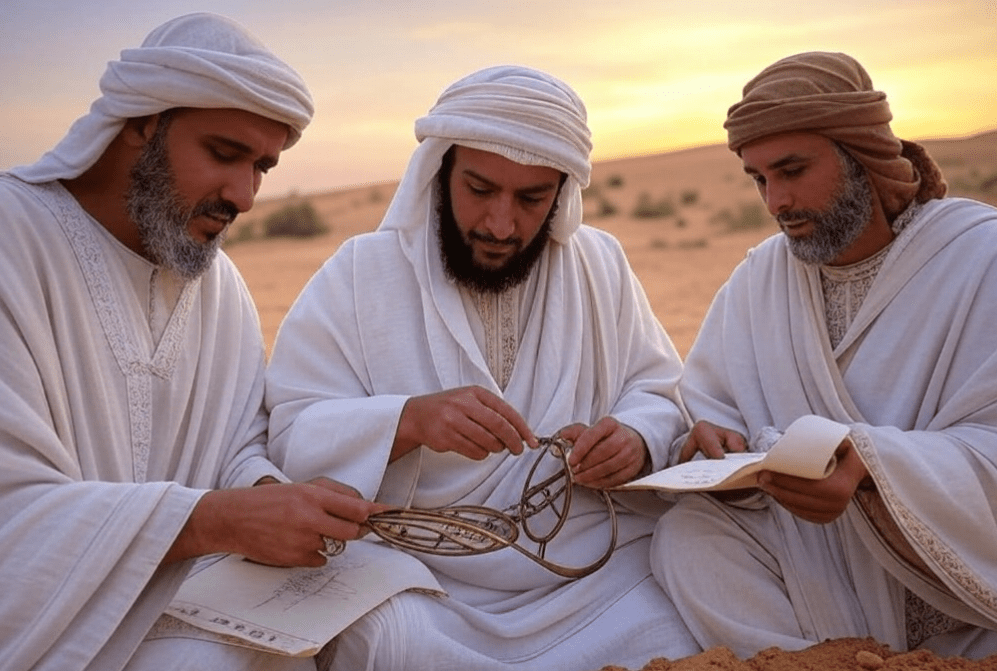
The brothers knew, from measuring the aggregate lengths of the cords, that the distance from the first to their last stake was 66.667 miles. And from this, they could conclude that one degree of the Earth’s spherical surface equated to a distance of 66.667 miles. To confirm this result, the Banu Musa returned to the spot where they had pounded in the very first stake, and this time they walked due south. They repeated the procedure they had done when walking north: they walked long distances, unrolled cord, took periodic measurements, and continued. They must have used reliable compasses to shoot azimuths on a regular basis; it is difficult to see how they could have walked in a straight line otherwise.
Eventually, they reached a point where the measurement of the Pole Star’s angle of inclination was one degree less than the angle first observed. The calculations agreed with each other, and the brothers knew they had succeeded. Knowing, of course, that a circle contained 360 degrees, it was a simple matter to multiply 66.667 by 360 to obtain the same result achieved by Eratosthenes, or 24,000 miles. The Banu Musa reported the results of this experiment to the caliph, who thought that it should be verified at a different location, this time at Kufa. This was done, and the results agreed with each other.
The Banu Musa’s measurement of the Earth’s circumference is a fascinating example of early collaborative science. The experiment is noteworthy for several reasons. First, it involved an original method, derived from astronomy, that took for granted the Earth’s sphericity and its obedience to predictable astronomical laws. Second, the brothers grasped an essential principle of scientific experimentation, namely, the need for independent confirmation of results. They laboriously repeated their experiment in both Sinjar and in Kufa. To us today, this may appear to be an elementary principle; but in the year 820 A.D. it certainly was not. Experimental science in Europe was at that time non-existent. We must remember that the rules of rigorous scientific experimentation would not truly be codified until the advent of Francis Bacon many hundreds of years later. Thirdly, the experiment arguably inaugurated the concept of latitude and, in a larger sense, geodesic measurement. Finally, it is both inspiring and ennobling to learn that a secular ruler like Al-Ma’mun would eagerly serve as a patron of scientific inquiry, and would take such a personal interest in the advancement of knowledge.
.
.
Read more about daring advances in knowledge in the essay collections Digest and Centuries.
 Quintus Curtius
You must be logged in to post a comment.