
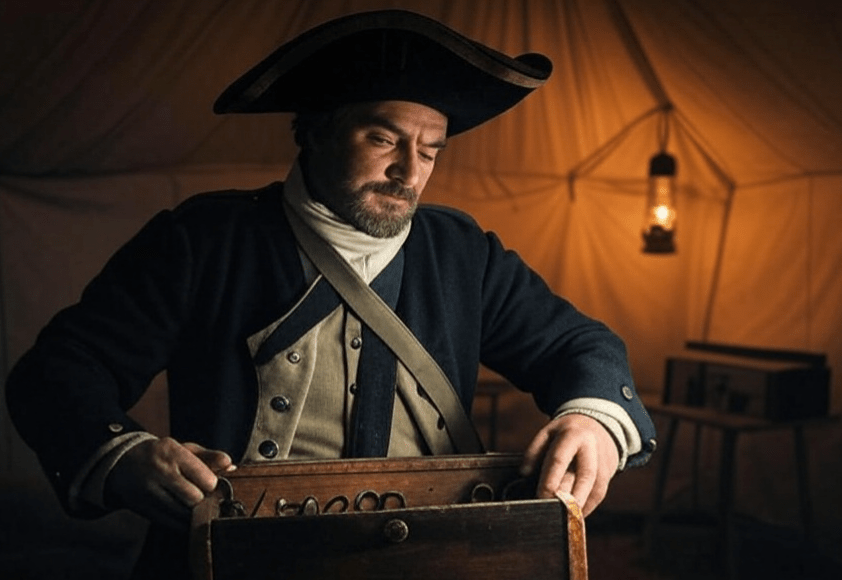
In 1822, Alexander Garden, an aide-de-camp of Major General Nathanael Greene, published a fascinating work titled Anecdotes of the Revolutionary War in America, With Sketches in Character. Some of the stories contained in the volume are based on Garden’s own experiences, or were conveyed to him personally by veterans of the conflict. Out of a great many fascinating and forgotten morsels, I have selected two for the reader’s enjoyment.
The siege of Charleston, South Carolina took place during March and May of 1780, and concluded with a decisive British victory. And yet, as so often happens in war, in the midst of momentous events, there remain occasions for humor and humanity between belligerents. As the siege was winding down, one Colonel Menzies of the Pennsylvania Line (a unit of the Continental Army) received a letter from a Hessian officer in the service of the British. The German had once been a prisoner of the Americans, and during that time had been well-treated by Colonel Menzies. Learning of Menzies’s presence and wanting to return the favor, the gracious Hessian asked his former captor if there was anything he could do to alleviate Menzies’s current condition. It is a remarkable feature of warfare in that era that, amid so much destruction and bloodshed, we nevertheless observe a great many examples of battlefield courtesy and chivalry.
Menzies replied to the Hessian with a letter requesting twelve dozen cigars for his men. But Menzies himself was Germany by birth, and proper English spelling sometimes eluded him. Instead of writing cigars, he penned sizars. The Hessian received Menzies’s letter, and dutifully complied with what he assumed was the request: he sent his old acquaintance without delay twelve dozen pair of scissors. This mishap generated a great deal of hilarity at poor Menzies’s expense, but he was able to turn the blunder into a blessing. The resourceful Menzies bartered the scissors far and wide for food and drink, which at that time were difficult for American troops to acquire. So while other units were forced to scour the countryside for frogs and crayfish, Menzies and his men were able to secure decent provisions.
We have a final tale from the siege of Charleston in 1780. It has often been noted that soldiers in combat will plot creative ways to relieve boredom. Teasing one’s foe has always been a favored pastime. I suppose the impulse dates back to the very earliest days of armed conflict. As the siege of Charleston was drawing to a close, the British became aware of the pronounced dearth of provisions on the rebel side. One British artillery battery filled a thirteen-inch shell with rice and molasses, and lobbed the projectile over American fortifications. It landed with a dull thud in the midst of the rebel camp; attached to it was a note addressed to “The Yankee officers in Charleston.” The message expressed a hope “That in their present state of starvation, they [i.e., the Americans] would accept from a compassionate enemy, a supply of the necessaries they most delighted in.”
Not to be outdone, the spirited Yankees decided to respond in kind. They filled a large shell with hog’s lard and brimstone, attached a note to it, and sent it flying into the British works. The note expressed sincere thanks for the gift received, and suggested that the present offering of lard and brimstone might be of use to the Scotsmen serving with the British forces. We are told that the intended recipients were not amused by this audacious benefaction, probably owing to the fact that the shell’s firing and flight would have turned its sulphurous contents into a reeking, odious mess. Plucky humor and defiance were thus efficiently communicated with one gesture.
.
.
Take a look at the new, annotated translation of Cicero’s On the Nature of the Gods, which is available in all book formats, including audiobook.
 Quintus Curtius
You must be logged in to post a comment.