

Philosophers and theologians have often pondered whether, or to what extent, wicked deeds are punished within the lifetime of a malefactor. Some maintain that the consequences of evil actions can never be avoided, and that, sooner or later, divine retribution will be visited upon him who offends the gods of justice. Others take a different position, and hold that punishment for the commission of foul acts is a purely random occurrence. Some men, they say, arrive at their appointment with Fate, while others seem to lead charmed lives, escaping justice while walking through life’s raindrops. As for which view is correct, no man can know. For my own part I tend to subscribe to the belief that wicked deeds always exact a certain price from their authors. That price may be postponed, or deferred, or placed in arrears, or hidden from the view of others; but the levy nevertheless weighs on the soul of the malefactor, and steadily corrodes it from within.
As Rome’s power expanded throughout the Italian peninsula, she came into conflict with the competing ambitions of nearby regional powers. One of these was Pyrrhus, king of Epirus, who ruled a tract of territory approximately where modern Albania sits today. Recognizing the inevitability of conflict with Pyrrhus in some form, the Roman senate began to install protective garrisons in the major cities of southern Italy (known then as Magna Graecia) in 282 B.C. One of these cities was Rhegium, known today as Reggio Calabria, the largest city in Calabria.
In 281 B.C. the Romans stationed a Campanian legion in Rhegium; this legion was commanded by one Decius Iubellius (or Jubellius). Although Decius and his men were there to protect the city, they had no understanding of the responsibilities of their assignment. Instead of seeing themselves as guardians of a sacred trust, they instead began to plot ways of enriching and aggrandizing themselves. Decius and his officers decided to seize the city, slay the men, and appropriate its women and material wealth for themselves.
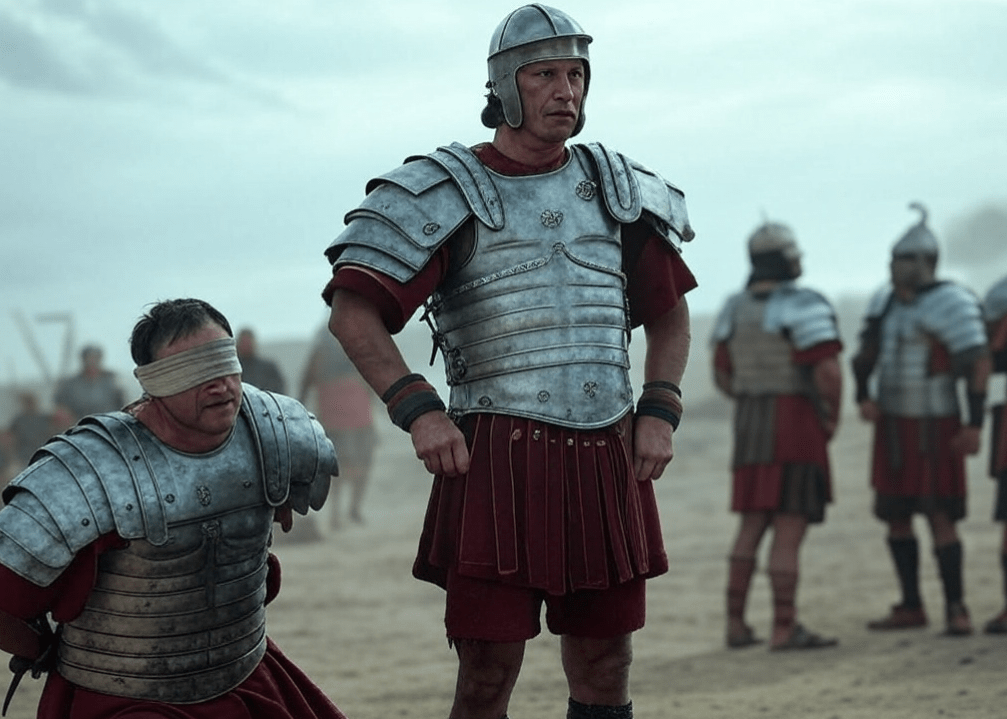
This they did in 280 B.C. Decius’s pretext for this heinous crime was a false claim that the Rhegines were conspiring behind Rome’s back with King Pyrrhus, who had just invaded Italy. The Roman senate was fully absorbed in defending Italy from Pyrrhus, and did not then have the time or resources to deal with the rebel despot. So his atrocities went unpunished for years, or so it seemed; he was even able to forge an alliance with the Mamertines in Sicily. Yet evil has a way of corroding even those who seem to be the recipients of its rewards.
As the potentate of Rhegium, Decius began to suffer from some affliction of the eyes. As he could not trust the Rhegine doctors to treat him, he sent for a physician from the city of Messina. What Decius did not know was that this elderly physician had been born in Rhegium, and secretly sought revenge against the tyrant for the rape and murder of his kinsmen. After examining Decius, the doctor hold him that he should apply a certain ointment to his eyes with regularity; he then slipped out of the city. The patient followed his doctor’s instructions, and soon became permanently blind.
But this was only the beginning. The tyrant’s rendezvous with Fate was approaching ever more swiftly. King Pyrrhus died in 271 B.C., and Rome was freed from the immediate threat of his invasion. The Senate now had the resources to deal with the rebel tyrant decisively; it had neither forgotten nor forgiven him. Rome could be forgiving of many things, but mutiny, betrayal, and dereliction of duty were not among them. The Senate sent an army to Rhegium to retake the city and punish the criminals who had plundered it. The city fell after a siege, and according to Livy (XXVIII.28), around four thousand rebels were brought in chains to Rome, where they were flogged with rods and then beheaded. Their bodies were forbidden to be buried or mourned. The historian Polybius (I.7) reckons the number of executed men at only three hundred, which seems more accurate, considering that most of the rebels would have perished in the siege of the city.
But what of Decius? What was his ultimate fate? The historian Appian, in his Samnite History (IX), says that Decius, now blind and stripped of his power, was flung into a Roman prison cell, where he eventually committed suicide. So ended the life and infamous career of a man who believed he had escaped justice for his crimes. He did not understand that Fortune’s debts may be placed in forbearance or arrears, but must inevitably be repaid. For a long time, ten years in fact, Decius appeared to have been justified in his confidence that he had avoided the verdict of Fate; but in this, as so often happens with the delusional ruminations of criminals, he proved to be entirely mistaken.
.
.
Take a look at the new, annotated translation of Cicero’s Tusculan Disputations, which is available in paperback, hardcover, Kindle, and audiobook.
 Quintus Curtius
You must be logged in to post a comment.