
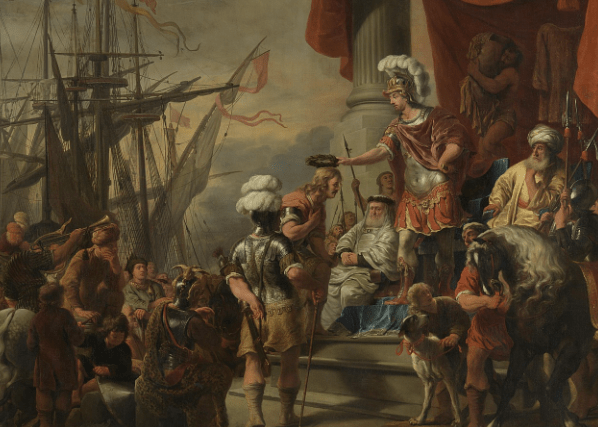
There is a line in Statius’s Thebiad (VIII.320) which reads,
Omne homini natale solum.
This means, “All soil is native to man.” I think it is appropriate to interpret soil in an abstract form, and understand it as signifying land. He does not mean just any land, but terra incognita: the vast expense of the unknown, untamed and hostile. Does this line have any significance, or is it just another poetic garland? To me the poet is trying to communicate the idea that, for the brave man, every piece of ground on this earth may be claimed as his own, and called his own; and that, through his discipline and efforts, the man of virtue may conquer the challenges of his environment, wherever the locale may be.
But how may this conquest be accomplished? The answer can only be found in the masculine virtue of discipline, and its direct heir, perseverance. It is the habit of discipline, inculcated in a thousand ways through a thousand daily actions, that surveys, levels, compacts, and paves the road forward through the inhospitable wilderness. For while the quantity of men in this world is vast, the number of true men is by contrast small. This was what Herodotus meant when he wrote (VII.210) that Xerxes regretted the great disparity between the size of his army, and the tiny number of true men in it. The Persian king heard of the performance of three hundred Lacedaemonians who had defied him at Thermopylae; and he became painfully aware that, for all his superiority in numbers, he could never challenge the Greeks in bravery.
It was discipline, and not numbers, that enabled Rome to conquer a vast empire. Yet discipline rarely maintains an appealing presence; it is of necessity a harsh palliative. But if it were not so, then nothing worthwhile would ever be achieved. This was what Valerius Maximus meant when he said (II.7.14) that
Military discipline demands a severe, blunt type of punishment because strength is dependent on arms; and when these deviate from the correct path, they will subdue, unless they are subdued.
Rarely has the point ever been expressed so well. After the Battle of Cunaxa in 401 B.C., the Greek mercenaries hired by Cyrus the Younger found themselves stranded in a hostile land; they were marooned in the Near East, and surrounded by innumerable enemies. They had no food, no allies, and no clear path to safety. But as men of strict and lifelong discipline, they behaved as if they were standing on their own native ground. All land was natal to them. They conducted themselves as if they had already achieved victory; they knew, in the marrow of their bones, that for the man of virtue, every land may be called his own. And so the Greeks promptly elected one of their own to command them, a soldier named Xenophon the Athenian. It was he who led them on a long, arduous anabasis to safety.
As spectactular as the achievements of discipline can be, so are the consequences of indiscipline unmitigated in foulness and corruption. We sympathize with the anger that emerges from Petrarch’s pen when, in a letter to Peter of Poitou written in 1361, he denounces the selfish, corrupt military leaders of his own day:
Lazy, incompetent, fearful, and big-mouthed [loquaces], they maintain their weapons and horses not to obey their leaders, to protect their country, or for military glory, but for personal gain [quaestum], for decorating their bodies and for enjoyment; they are weighed down with gold, so as to be a more attractive spectacle to a girlfriend, and a more valuable article of loot to an enemy.
Few reading this description will deny that it could apply with equal validity to many of our current military and political leaders. Loaded down with money, titles, and a false sense of superiority, they float from one crisis to the next, comfortable and confident in their own superiority. The reckoning, when it comes, will be unforgiving. Until that time, the man of discipline and virtue will take comfort in the fact that, no matter where Fortune’s fingers may deposit him in the world, he will consider all soil his native soil, since he knows that he possesses the confidence and pertinacity to triumph in every clime and place. For to the man of virtue, all soil is natal.
.
.
Take a look at the new, annotated translation of Cicero’s Tusculan Disputations, and at the essay collection Centuries.
 Quintus Curtius
You must be logged in to post a comment.