
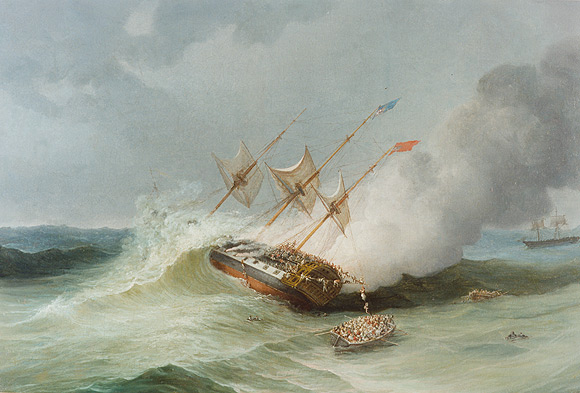
We will relate the terrible loss of the ship Kent, which sailed from the Downs on February 19, 1825. As a so-called East Indiaman (a merchant vessel trading with the East Indies), the Kent was bound for Bengal in India, and then China. She was a ship of 1,350 tons, and aboard her were 344 soldiers, 20 officers, 43 women, 66 children, 20 civilian passengers, and a crew of 148 men. The sum of these numbers comes to a total of 641.
Nine days later, in the Bay of Biscay, disaster struck. The ship encountered a fierce gale, and began to roll violently. Even furniture that had been secured by ropes began were “dashed about with violence.” Around midnight, one of the officers with two sailors ventured into the hold to inspect the security of the cargo, which included large casks of spirits. The officer carried with him a lamp with a lit flame. The party discovered one of the casks to be less than firmly secured; and in their efforts to prevent its motion, the ship made a sudden lurch. The cask smashed, the lamp was dropped, and soon flames began to leap around the men. The Kent was now faced with the terrifying prospect of either being consumed by flames or crushed by waves.
There was some initial hope that the fire might be confined to a small part of the hold. These hopes were short-lived, however. The fire spread, and clouds of dense, pitchy smoke began pouring out of the hold, forming a dark halo about the storm-tossed vessel. Henry Cobb, the ship’s captain, ordered the lower deck to be abandoned, and for certain ports to be opened. The idea, which was risky but necessary, was that the fire might be quenched by the introduction of seawater into the hold. By this time, several individuals had already died from smoke inhalation. An eyewitness to the tragedy describes the scene:
On the one hand stood death by fire, on the other death by water; the dilemma was dreadful. Preferring always the more remote alternative, the unfortunate crew were at one moment at ternpting to check the fire by means of water; and when the water became the most threatening enemy, their efforts were turned to the exclusion of the waves, and the fire was permitted to rage with all its fury. The scene of horror that now presented itself, baffles all description. The upper deck was covered with between six and seven hundred human beings, many of whom, from previous sea sickness, were forced on the first alarm to flee from below in a state of absolute nakedness, and were now running about in quest of husbands, children or parents.
[Book of Shipwrecks and Maritime Discoveries and the Most Popular Voyages, Boston, 1840, p. 473]
Some took refuge in prayer, while others abandoned themselves to despair. The ferocity of the storm continued without abatement, so that the crew and passengers did not know if they would perish from the fire or from drowning. Amid this grim spectacle of doom, one man had the presence of mind to take action. The fourth mate, one Mr. Thompson, sent a man to climb the mast and scour the horizon, as best he could, for any ship. Incredibly, the sailor spotted a vessel and shouted the news down to the deck. Captain Cobb ordered distress flags to be hoisted, and the guns to be fired. The ship turned out to be the Cambria, a brig of only 200 tons; she was involved in the mining trade and was bound for Vera Cruz in Mexico.
As the Cambria approached, the officers of the Kent began to decide on the order of launching the rescue boats. It was decided to use the “funeral order,” that is, women and children first. One military officer, a Colonel Fearon, is recorded as saying, “Most undoubtedly the juniors first—but see that any man is cut down who presumes to enter the boats before the means of escape are presented to the women and children.” Boats were lowered into the boiling sea, and were filled as rapidly as conditions aboard the Kent would permit. One of the boats was swamped, and the soldiers aboard the Kent were forced to watch in horror as their wives and children were hurled into the waves. Some men dove into the water to attempt rescue, and were drowned.
But gradually the larger part of those aboard the Kent were evacuated. Only the officers remained, and they were advised to tie ropes around their waists as a safety precaution. But it was not so easy to escape the Kent, for her deck was strewn with tangled debris and ropes; the fire was still raging, and the storm made every movement a supreme exertion. As the account of a survivor states:
[I was] almost the only officer or soldier who reached the boat without being either severely bruised or immersed in the water. But my friend Colonel Fearon had not been so fortunate; for after swimming for some time, and being repeatedly struck against the side of the boat, and at one time drawn completely under it, he was at last so utterly exhausted, that he must instantly have let go his hold of the rope and perished, had not one in the boat seized him by the hair of the head and dragged him into it, almost senseless and alarmingly bruised.
Captain Cobb was determined to be the last to leave the Kent. The ship’s magazine eventually did explode, but by then most of the survivors had been transferred to the Cambria. The next morning, another ship managed to rescue the few remaining survivors aboard the Kent. The final loss of life, 81 individuals, was heavy. But the death toll would have numbered in the hundreds had not the Cambria miraculously seen and heard the Kent‘s distress signals. We are told that, had not the Cambria been detained briefly at sea for some minor repairs, she never would have crossed paths with the Kent. As it was, the Cambria limped back to Falmouth with hundreds of famished, shivering survivors jammed on her deck: they were traumatized, but they were alive.
.
.
Read more stories of shipwrecks and the role of Fate in the essay collections Centuries and Digest.
 Quintus Curtius
You must be logged in to post a comment.