

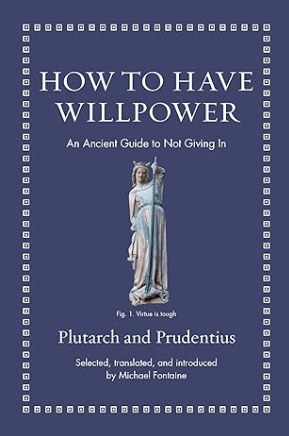
August of 2025 will see the publication of Michael Fontaine’s How to Have Willpower: An Ancient Guide To Not Giving In. The volume is a modern translation and interpretation of two classical texts: Plutarch’s essay On Dysopia and Prudentius’s poem Psychomachia. Very roughly speaking, these works discuss how to manage our emotional states and overcome the challenges posed by shame and vices.
Before diving into the contents of the book, we must begin with some context and background. In his introduction, Fontaine explains that our views of virtue and vice shifted dramatically after the advent of Christianity in Europe. In the pre-Christian era (of which Plutarch was a product), the management of mental states was believed by many philosophers to be possible with discipline, fortitude, and consistent personal effort. It is an attitude we find in Cicero’s Tusculan Disputations, which proposed that depression, anxiety, and other mental perturbations could be overcome with reflection, self-examination, and discipline. It is a stern ethic, and not one for the faint of heart.
The advent of Christianity brought a different perspective on what we would today call “self-improvement” or “personal growth.” The world was seen in Manichaean terms: human beings were participants, willingly or unwillingly, in a battleground between good and evil. Vices battled unceasingly with virtue, and supernatural intervention in the form of a benevolent god, or a cunning Satan, could tip the scales one way or the other. This was the cultural milieu in which Prudentius lived and wrote.
He was born in A.D. 348 and probably died around 413. He lived in an age of disorder, violence, and insecurity, when society was literally falling apart around him; such conditions do not incline a man to cheery optimism. His allegorical poem, Psychomachia, was for many centuries a very popular work. The word psychomachia means “conflict of the soul”; specifically, it meant a personal conflict between the opposing tendencies of good and evil. Like Boethius, who would later imagine philosophy in female form, Prudentius personified the virtues and vices in his poem and, taking his cue from the fact that abstract nouns in Latin are feminine, set them at war with each other as female combatants.
Plutarch is relatively well-known today for his Parallel Lives, those brilliant character studies of ancient personalities that both entertain and instruct. Less well known is the fact that he was a prodigious writer of moral essays. These have been grouped into a compendium of almost eighty long essays to which scholars have affixed the title Moralia. Although little read today, they show an extraordinary range of knowledge and insight, and have inspired renowned literary figures across the centuries. On Dysopia has traditionally been included in the Moralia.
But what does the word dysopia mean? Fontaine wisely leaves the term untranslated, for there is no clear equivalent in English. The word essentially describes a feeling of shame that compels us to do things we do not want to do. It is that discomfort which makes us “cave in” to the demands of others. With a touch of humor and a twinkle in his eye, Fontaine selects a perfect modern example:
How do you feel when a smiling cashier flips an iPad screen toward you and offers you the option of adding a 25 or 30 percent tip to your bill?
Who among us has not experienced the terrible feeling of being ashamed to assert ourselves? And what could be more important than teaching us how to combat this timidity? For while timidity may not exactly be a vice, it certainly opens the door to vices. In his introduction, Fontaine includes a comment from Erasmus, who helped rediscover Plutarch’s essay during the Renaissance. I read the following with very personal agreement:
I translated this essay of Plutarch’s all the more eagerly because in reflecting on the course of my life, I find that dysopia is responsible for more of the mistakes I’ve made than anything else. Nothing has turned out worse for me than all the concessions I’ve made, against my better judgment, to the importuning of friends.
Modern self-help books do not even approach the level of detail with which Plutarch treats his subject. It can take us many years to realize that the ability to say “no” is one of life’s superpowers. For some, this kind of confidence is easy to summon on instinct; but for most of us, it has to be learned and practiced. Fortunately, Plutarch does not retreat into safe generalities. He gives us very specific advice on how we can overcome and banish dysopia. Before doing this, he informs us why we are too sensitive, and the consequences of constantly giving in to external pressure. He then provides us “ten useful reflections,” which are really ten discrete pieces of advice. I will not list them here, for that would ruin the reader’s pleasure of discovering them. Here is where the skill and usefulness of Fontaine’s translation becomes very clear: he presents the ten reflections as separate and identifiable points. Previous translations have obscured and buried Plutarch’s meaning under a mountain of turgid diction; it is with a sigh of relief finally to be able to grasp his counsel.
Fontaine has chosen his writers with great care: the selection of Plutarch and Prudentius is very much deliberate. He skillfully contrasts the rationalism of Plutarch with the allegorical religiosity of Prudentius, and invites readers to consider their differences in approach. We have here, then, the eternal tension between faith and reason, and this is one of the book’s unspoken themes. But Fontaine is too subtle and even-handed to harangue us on this subject: he simply presents the words of his writers, and allows us to form our own conclusions. He opts for a prose translation of Prudentius’s verses. Anyone who believes that prose cannot do justice to a poetic original need only read this vivid excerpt (p. 155):
Everyone, everywhere, pours from the camp and comes rushing together. None of the mind’s components remain unaffected and laggard, hoping to hide their degenerate sloth in a body recess and blame it on blocked-up vessels. All the pavilions are open wide, their flaps pulled back and the canvas retracted to make sure none of the audience dozes off under cover of darkness. Eager to listen, the meeting is anxious to know why their leader, Unity, is summoning victors now that the war is complete, and what dispensation Faith has in mind to impose upon the Virtues.
What makes How To Have Willpower so fascinating, and so useful, is that it invites the reader to ask the question: which approach is better, the rationalist or the faith-based? The book reminds us that every epoch of civilization has sought answers to the moral problems that trouble us and intrude into our daily lives. Yet different ages have produced different solutions. Perhaps the answer depends on each person’s innate nature. Some will respond to rationalist prescriptions, while others may find more comfort in otherworldly conceptions. In the final analysis, what matters is not the frame of reference, but that we continue to think about the virtues and vices, and monitor their relative influence on our lives. How To Have Willpower is an important work, perhaps Fontaine’s best, that deserves to be both studied and discussed. One hopes that it will not only reintroduce these forgotten writings of Plutarch and Prudentius to a new generation of readers, but also reignite the old debate between the merits of faith and reason.
.
How To Have Willpower: An Ancient Guide To Not Giving In (translated by Michael Fontaine). Princeton: Princeton University Press (2025).
 Quintus Curtius
You must be logged in to post a comment.