
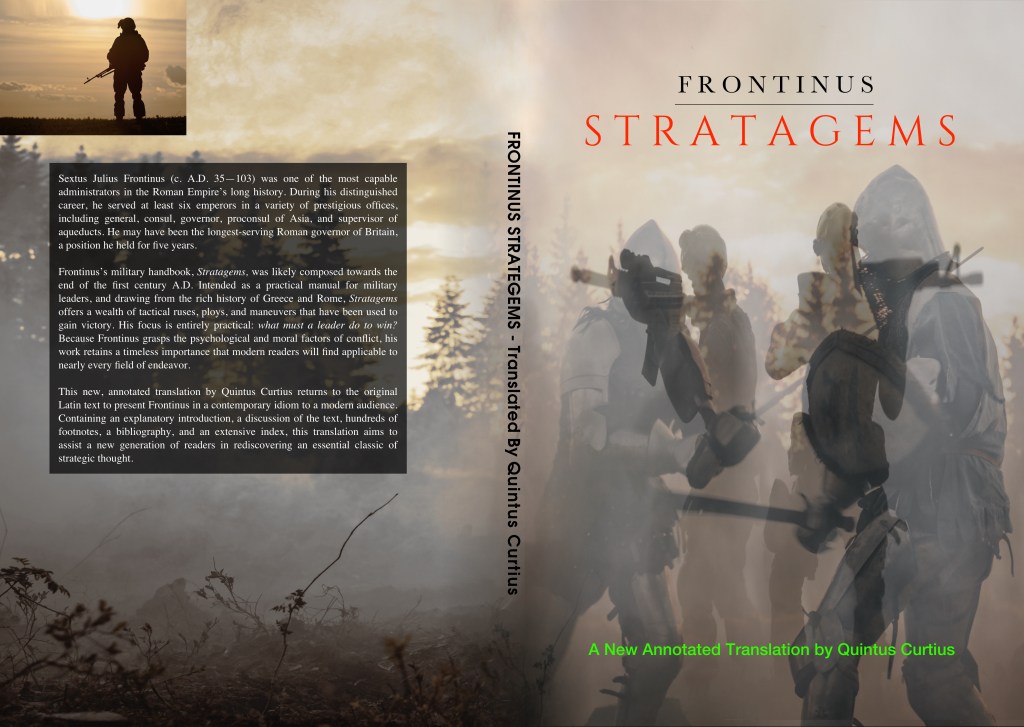
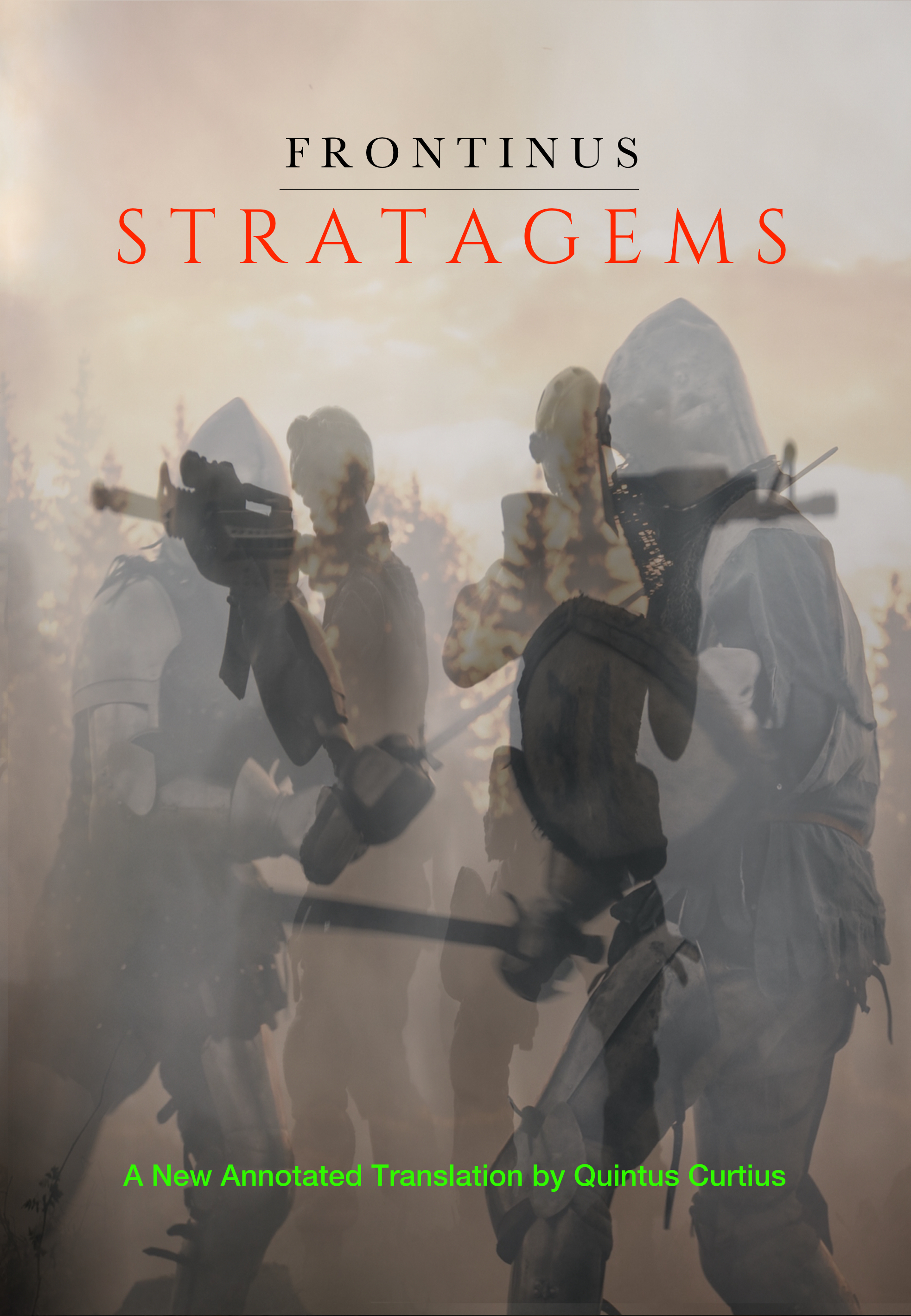
Fortress of the Mind Publications is very pleased to announce that Quintus Curtius’s new annotated translation of Frontinus’s Stratagems has been released. It is currently available in paperback and Kindle editions. The hardcover edition will be available very shortly, and the audiobook edition is expected in early November.
This new translation of Frontinus’s Stratagems restores to its proper place a great and underappreciated classic of military strategy. Sextus Julius Frontinus (c. A.D. 35—c. 103) was one of the most capable administrators in the Roman Empire’s long history. During his distinguished career, he served at least six emperors in a variety of prestigious offices, including general, consul, governor, proconsul of Asia, and supervisor of aqueducts. He may have been the longest-serving Roman governor of Britain, a position he held for five years.
An editorial review of the book can be found here.
Frontinus’s military handbook, Stratagems, was likely composed towards the end of the first century A.D. Intended as a practical manual for leaders, and drawing from the rich history of Greece and Rome, Stratagems offers a wealth of tactical ruses, ploys, and maneuvers that have been used to gain victory. His focus is entirely practical: what must a leader do to win? What forces, both moral and material, matter most in war? Because Frontinus grasps the psychological and moral factors of conflict, his work retains a timeless importance that modern readers will find applicable to nearly every field of endeavor.
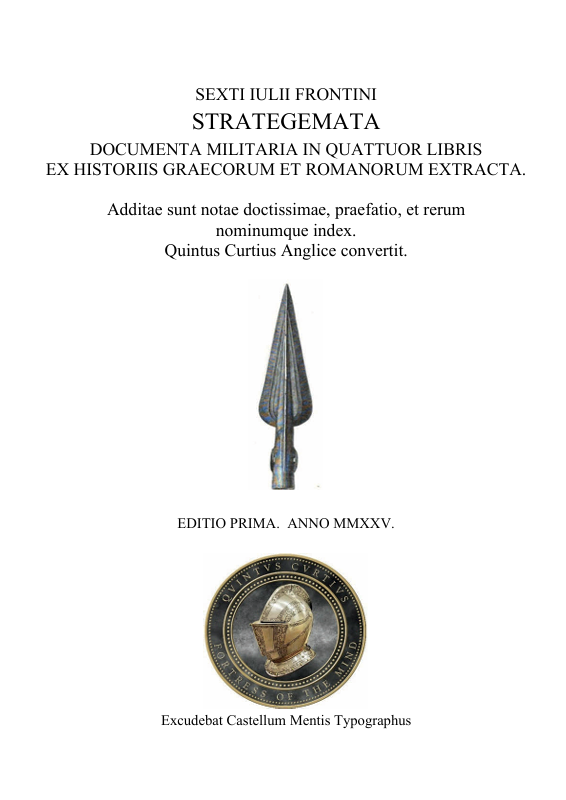
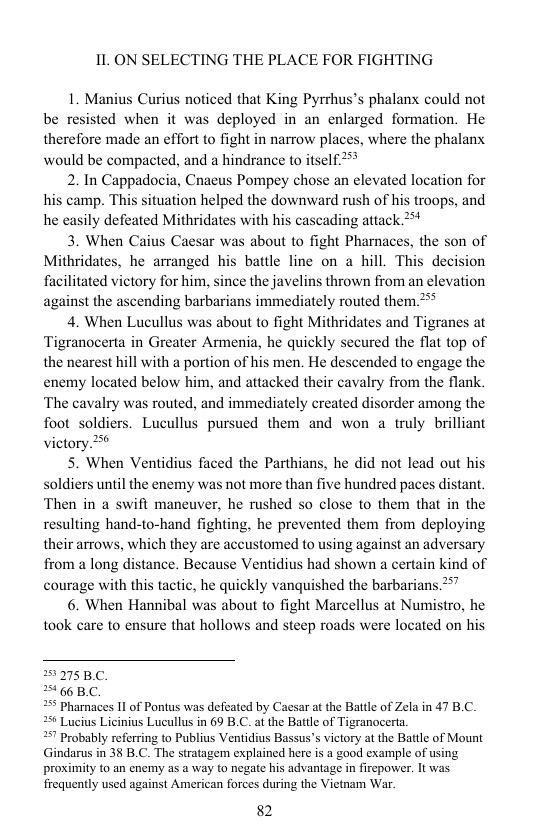
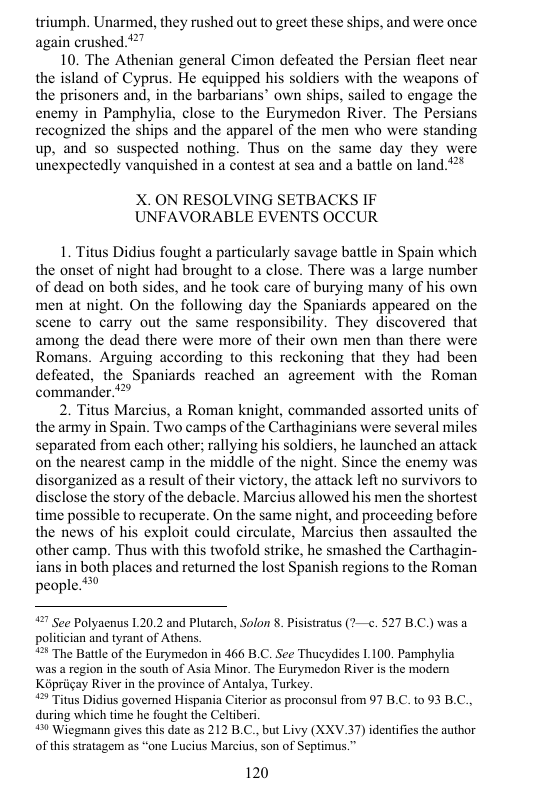
A “slide show” preview of pages from the text. Copyright (c) Quintus Curtius 2025.
This new, annotated translation returns to the original Latin text to present Frontinus in a contemporary idiom to a modern audience. It features the following:
- A detailed, explanatory introduction which includes a biography of Frontinus, a review of classical military theory and literature, a description of the characteristics of ancient warfare, and a discussion of the text;
- Extensive annotations in the form of hundreds of footnotes;
- A bibliography and extensive index.
Using clear, modern language, this translation aims to assist a new generation of readers in rediscovering an essential classic of strategic thought. The following excerpt is from the Foreword:
The Stratagems of Sextus Julius Frontinus occupies a unique and underappreciated place in the history of military theory. He was the first Western writer to attempt to ascertain a coherent set of principles from an all-embracing survey of warfare. “Of those devoted to the study of military science,” he declares in the short preface to book one, “I alone have attempted to organize its principles in a methodical form.” This statement was not an exaggeration. Unlike his predecessors, Frontinus refused to confine himself to a single, narrow aspect of warfare. He wished to comb the entire history of armed conflict, distill the rules of war as far as they could be determined, and offer his findings to future generations. It was a very ambitious goal. But as we will see from the survey of his life in the Introduction, Frontinus was not the type of man to shrink from a daunting challenge. In composing Stratagems, Frontinus deployed his extensive personal battlefield experiences, the lessons he learned as a civil administrator in the Roman Empire, and the conclusions he reached from his studies of history. No other military theorist, before or after him, has had a comparable background.
In addition to Stratagems, Frontinus composed a more theoretical treatise on the art of war. It may have been intended as a companion volume to Stratagems; but no fragments of the work have survived the ravages of time, and we must content ourselves with speculation on its content and purpose. Readers of Stratagems will, I believe, find in it a wealth of practical guidance, not only for military commanders, but for anyone seeking to navigate the struggles of life. For in it we find anecdotes about how leaders concealed their plans, aroused enthusiasm among their men and maintained their loyalty, concealed their losses, dealt with treachery, dispensed justice, and displayed goodwill and moderation.
In fact Stratagems may be read as a manual on the art of leadership. For while technology and warfare may change, human nature most assuredly does not. While military theoreticians like Sun Tzu and Clausewitz have enjoyed a sustained period of popularity in the modern era, Frontinus has by comparison been neglected. This is unfortunate, because a convincing argument can be made that Stratagems is a more natural and useful starting point for the study of conflict than the works of Sun Tzu or Clausewitz…[H]is choice of historical examples, and his presentation of the subject matter, inform the reader what precepts truly are important in war. We draw our conclusions by implication and through inference. The extent of Frontinus’s leadership and military experience has also not been matched by any other theorist. He is, in fact, unique among military writers.
Stratagems brings a classic of strategic thought into the twenty-first century, and is a significant contribution to the world of military theory. Any questions about the book can be directed to the publisher at qcurtius@gmail.com. Further announcements will be made in the coming weeks as the hardcover and audiobook editions become available.
.
 Quintus Curtius
You must be logged in to post a comment.