
I once heard someone pose the question, “Why didn’t the Greeks or Romans produce a military theorist like Sun Tzu?” The answer to this question is that they did, in fact, produce a theorist just as profound—arguably more profound—than the great Chinese sage. The problem is that you’ve never heard of him. His name is Frontinus. He lived from about A.D. 31 to about 104. Here I intend to explain who he was, what is found in his book Stratagems, and why his work is so important.
There has never been a writer of military theory with as much experience in both war and civil leadership as Sextus Julius Frontinus. This fact must be understood and appreciated at the outset of our discussion. The Introduction to my translation of Frontinus’s Stratagems contains his biographical details. As a young man, he served with the legions in the East, and gained considerable field experience. He later served as a land surveyor in North Africa. After this came his political offices. He was a praetor in Rome, and later achieved the high office of consul. Around A.D. 73 he became governor of Britain, an important position he held for about five years. During this time he enlarged the empire’s boundaries by subduing various Celtic tribes. He became an expert negotiator, having frequently to deal with local chieftains and leaders. To subdue the Silures, a Welsh tribe, he combined both force and diplomacy with patient skill.
From about A.D. 82 to 84 he accompanied the emperor Domitian on his campaigns in Germany. After this he served for a time as governor of Asia. He then returned to Rome and became a respected writer, senior statesman, advisor to emperors, and supervisor of aqueducts. This last position was an extremely important civil responsibility, given only to men of proven merit.
No other military theorist, I believe, has had such an impressive background. Sun Tzu was a general only. He never held any positions of civil leadership, as far as we know. The same is true of Carl von Clausewitz, who was and remained an army officer. This is not to denigrate the service or achievements of Sun Tzu or Clausewitz. My point is to highlight the fact that Frontinus’s experience with war and leadership was broader, greater, and more extensive. Frontinus served in a variety of offices in very different parts of the world. The other military writers did not. This fact gives his perspective a depth and profundity that is matched by no one else.
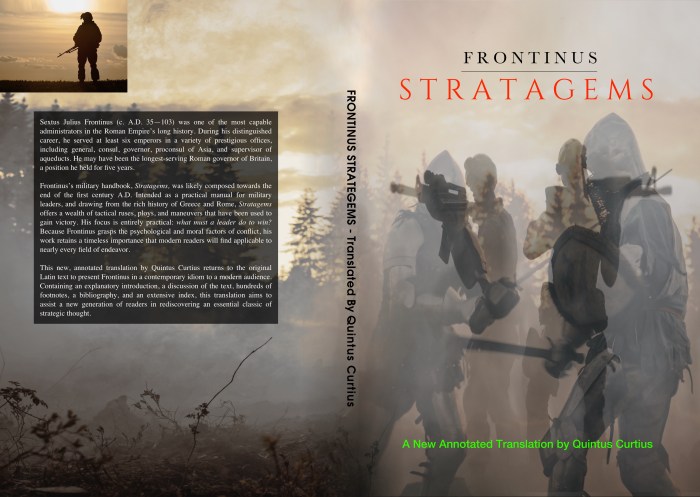
What did he write? We know that he wrote a treatise on the art of war which is now lost. The companion volume to this lost Art of War is the work Stratagems. In Stratagems, Frontinus surveys warfare as a whole, and extracts its general principles. He organizes these principles under various categories in three books, such as “selecting the place for fighting,” “the arrangement of soldiers for battle,” “throwing the enemy into confusion,” “how one may appear to be well provided with what is in short supply,” “with what methods traitors and deserters may be thwarted,” and the like. He illustrates these principles with historical examples. The fourth book of Stratagems contains general leadership guidance, such as “on discipline,” “on justice,” and “on goodwill and moderation.”
All in all, it is a remarkable performance. What makes Frontinus different from all in the West who came before him, and most who came after him, is this: he embraces warfare as a whole, unified effort, and seeks to describe its fundamental rules. Before him, there were only military tradesmen and technicians. They confined themselves to one or two narrow areas of military activity. They saw war as a trade, like agriculture, construction, or engineering. But Frontinus was different. He sought to divine its basic principles. This makes him unique. Only Sun Tzu had the same broad perspective, and he was totally unknown in Europe until the early modern period.
But Frontinus is even deeper than this. If we examine the principles of his Stratagems, which he groups under various headings, we see a distinct pattern. He emphasizes certain themes in warfare: surprise, the mastery of conflict’s psychological dimension, speed of physical movement, rapidity of decision, and the winning of the enemy’s heart and mind. Stratagems can be seen as a psychological work, in a way. It was intended for military commanders, and it attempts to prepare them psychologically for battle. Frontinus aims to instill confidence in his readers by showing them how other commanders handled similar difficult situations. Could there be any better guide? I think not. Stratagems can and should be seen as a manual on leadership.
I suspect that many readers of Sun Tzu are less than satisfied with the abstruse nature of his book. I do not wish to demean Sun Tzu as a writer, or detract from the importance of his achievement. But the fact remains that Sun Tzu’s Art of War has very limited practical utility. Its prescriptions are so general that we feel no wiser upon completing Sun Tzu’s book than when we started it. What are we to make of this kind of advice from Sun Tzu’s chapter on maneuver: “When campaigning, be swift as the wind; in leisurely march, majestic as the forest; in raiding and plundering, like fire; in standing, as firm as the mountains. [Be] as unfathomable as the clouds, [and] move like a thunderbolt.” Such advice does little to achieve real victory. It is also forgettable. As I say in the Foreword to my translation of Stratagems:
While the mind may only with difficulty retain the abstruse and opaque axioms of Sun Tzu or Clausewitz, it will never forget a specific anecdote describing how, for example, a Carthaginian commander ruthlessly dealt with treachery; how Alexander the Great adroitly brought his force across a river; or how Scipio restored the morale of his men with his incomparable firmness. Frontinus understood, perhaps better than any of his predecessors, that theoretical knowledge of war is of little use unless it can be presented in a way that adheres to the reader’s consciousness. In matters of life or death, anecdotes are memorable, while theories are not.
Clausewitz understands the moral dimension of war. The first parts of his treatise On War are masterful in this regard. But after this, he lurches along in fits and starts. He expends his energies in digressions and excessive verbiage. He has the opposite problem of Sun Tzu: whereas the Chinese sage is maddeningly terse, Clausewitz requires five pages to say what should be conveyed in one.
This is what separates Frontinus from all other military theorists. He balances brevity with depth of perception. He had a range of experience that remains unrivalled. He saw how power worked on the battlefield, at the emperor’s conference table, and in the Senate-chamber. He knew both how to fight, and how to negotiate. He had no patience for abstractions. He understood that war was a deadly serious business, and that to be successful a commander needed to be prepared, thorough, and unrelenting. And this is why Frontinus deserves to be read, and studied, today.
But Frontinus has been neglected in the modern era. Until now his work has not appeared in contemporary, clear English. He has not, until now, been adequately explained with historical notes and annotations. He has not been placed in proper context. This new, annotated translation of Stratagems comes fully equipped with an explanatory introduction, which contains a biography of Frontinus, a survey of military writing in the classical world, a general discussion of ancient combat, and an explanation of the text itself. In the text of the translation, every historical example is explained and dated with footnotes.
Until now, Frontinus’s literary achievement and contribution to military theory have not been explained to the general reader. This new translation aims to correct these deficiencies. Frontinus is now accessible to a modern audience. An editorial review of the book can be found here.
Do you want to win, or do you want to waste time? Frontinus is for those who want to win. But you would be surprised by how many people prefer the latter option.
.
This article was read by the author, and can be heard here:
.
.
Read more in the new, annotated translation of Frontinus’s Stratagems.
 Quintus Curtius
You must be logged in to post a comment.