

This incredible story is found in the pages of The Book of Shipwrecks, Narratives of Maritime Discoveries, and the Most Popular Voyages, which was published in Boston in 1840. I relate it as it is described therein. Specific dates and names have been omitted, not by myself, but by the original author, who was a witness to the events. This discretion seems to be consistent with the regular practice of the era.
“In the year 18—, said Capt. M, I was bound, in a fine stout ship of about four hundred tons burden, from the port of P——to Liverpool. The ship had a valuable cargo on board and about ninety thousand dollars in specie.” So begins the American captain’s narrative. He made it clear to the chief mate that he should only employ American seamen for the voyage. However, these instructions were not followed, and after the ship got underway, the captain realized he had two foreigners among the crew, a Frenchman from Brittany and a man from the island of Guernsey.
These two characters, who appeared so cooperative during the boarding process, soon showed their true colors once the ship was at sea. They became churlish and belligerent, and were frequently drunk. “To my great sorrow and uneasiness,” wrote the captain, “I soon discovered in the foreigners a change of conduct for the worse. They became insolent to the mates and appeared to be frequently under the excitement of liquor, and had evidently acquired an undue influence with the rest of the men.” The captain, aware that they had smuggled aboard a stash of liquor, ordered their belongings and berthing area to be searched for contraband.
This the very young second mate did. As the search progressed, the Frenchman physically attacked the second mate, and appeared to be trying to strangle him. The captain “presented a pistol” to the head of the Frenchman, who immediately released his victim. The rest of the crew seemed to be indifferent; for it is well-known that violent troublemakers can wield undue influence, and gain secret sympathies, among the unsophisticated. The two foreigners were put in irons. The captain gave out stern warnings to those members of the crew who had seemed to support the behavior of the miscreants.
The next day, the two foreigners earnestly made apologies and requested that they be unshackled. They swore they would do no wrong again. The captain, taking them at their word, agreed to release them. The captain did notice, however, that the two men harbored a “deep and rancorous animosity” to the chief mate, who had participated energetically in the scuffle. There things stood, and for a week there was no trouble aboard ship. The incident appeared to be forgiven and forgotten.
One night, the ship encountered stormy and turbulent seas. The captain ordered all men on deck to assist in shortening sail. He then went below, and summoned the first mate. But, to the captain’s shock, the first mate was nowhere to be found; a search of the ship revealed his complete and mysterious absence. Everyone was questioned as to his whereabouts, but nothing definite could be discovered. The captain was forced to conclude, to his horror, that the unfortunate man had fallen overboard in the storm. Nevertheless, “I could not but entertain strong suspicions that the unfortunate man had met a violent death.” Something both unnatural and criminal had occurred, he felt in his bones.
The captain prudently collected all firearms and, with the help of the steward, had them secured in his stateroom. The captain quietly counseled the second mate and the steward that they should arm themselves, and be absolutely alert for any sign of trouble from the crew. The captain then sought some much needed rest, and stretched out on his bed. Hours passed. Then he heard three or four sharp knocks originating from the ship’s stern, immediately below the cabin windows. He flung open one of the cabin windows, and called out into the darkness: and the first mate, who had long been thought dead, answered. The captain flung out a length of rope and hauled the shivering, exhausted man into his cabin.
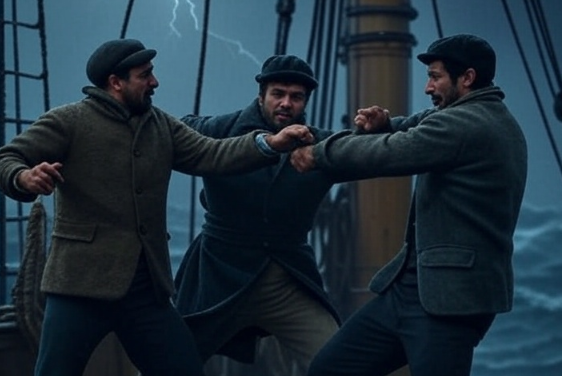
The mate then told his story. During the gale, as darkness, wind, and rain enveloped the ship, he had suddently been seized by the Frenchman and the man from Guernsey. The mate had fought and shouted for assistance, but his screams had been muffled by roars of wind and the snapping of sails. The two men threw him over the ship’s bow, consigning him to a watery death in the inky-black waves. But the mate was a good swimmer. By a miracle his hands managed to grasp the end of a rope towed behind the stern, and he clung to it with all his might. He then caught one of the rudder chains, and hauled himself, by a supreme effort, on to the ship itself. He had the presence of mind to remain there until he felt the appropriate time had arrived to show himself.
The captain decided to disclose the existence of the first mate to only the second mate. The first mate was concealed from all eyes in an empty compartment until the voyage neared its end. As the ship approached Liverpool, and docking procedures began to be implemented, the captain brought out the first mate on deck. The captain describes the incomparable scene:
A scene occurred which is beyond description: every feature of it is as vivid in my recollection as though it occurred but yesterday, and will be to my latest breath. The warp dropped from the paralysed hands of the horror-stricken sailors, and had it not been taken up by some boatmen on board, I should have been compelled to anchor again and procure assistance from the shore. Not a word was uttered; but the two guilty wretches staggered to the mainmast, where they remained petrified with horror, until the officer, who had been sent for, approached to take them into custody.
The Frenchman and the man from Guernsey were clapped into irons. They could neither say anything, nor do anything. Their murderous treachery and guilt was beyond all mitigation or explanation. The trial testimony of their intended victim capitally convicted them, and they were executed.
.
.
Take a look at the new, annotated translation of Frontinus’s Stratagems, a classic of strategic thought.
 Quintus Curtius
You must be logged in to post a comment.