
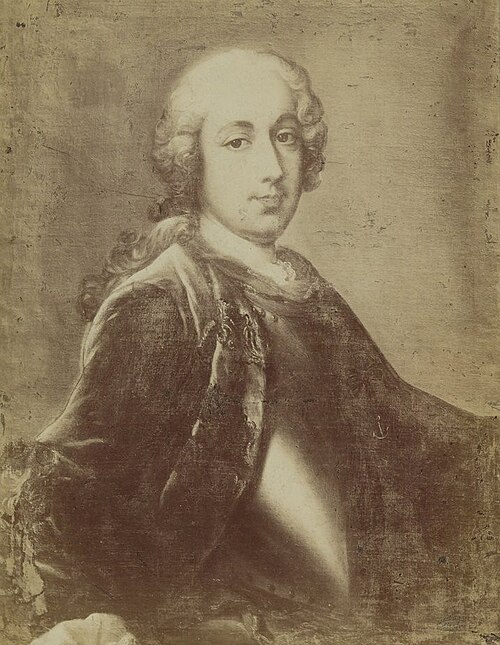
The French naval officer and explorer Antoine Bruni d’Entrecasteaux was born at Aix-en-Provence in 1739. He enlisted in the French Navy in 1754; but he must have shown promise to his superiors, for they granted him an officer’s commission two years later.
When the French government in 1791 assembled an expedition to hunt for explorer Jean-François de La Pérouse, who had gone missing in the South Seas, d’Entrecasteaux was chosen to command it. A secondary purpose of the expedition was to attempt the circumnavigation of Australia, then known as New Holland. This was a feat that had not been accomplished by either Captain Cook or La Pérouse. The expedition’s two sloops, La Recherche and L’Esperance, left the port of Brest on September 28, 1791. The total number of men aboard was recorded at two hundred fifteen. D’Entrecasteaux reached Tenerife on October 17 and there collected provisions; he then sailed for the Cape of Good Hope, and finally advanced to New Guinea. He reached the southeast coast of the Admiralty Islands on July 28, and sighted southwest Australia around December 3rd, 1792.
In March d’Entrecasteaux began to explore the shores of New Zealand; he soon sighted Ebona, which is a part of the Friendly Islands, known today as Tonga. The expedition was impressed with the attractiveness of the Friendly Island natives and the fecundity of the archipelago’s bread-fruit trees. An 1840 account of the voyage notes:
A [bread-fruit] tree would be oppressed with such an enormous load, if the fruit were to ripen all at once; but sagacious nature has so ordered it, that the fruit succeed each other, during eight months of the year, thus providing the natives with a food equally salubrious and plentiful. Every tree occupies a circular space of about thirty feet in diameter. A single acre occupied by this vegetable would supply the wants of a number of families. Nothing in nature exhibits a similar fecundity. As it produces no seeds, it has a wonderful faculty of throwing out suckers; and its roots frequently force their way up to the surface of the earth, and there give birth to fresh plants. It thrives exceedingly in a tropical climate, in a soil somewhat elevated above the level of the sea; and suits very well with a marly soil, in which a mixture of argillaceous clay preponderates.
The expedition left the Friendly Islands on April 10, 1793, and proceeded to Enouan (Oeno Island?), and then to Anaton (Anatahan) in the Marianas. On April 26, d’Entrecasteaux anchored at New Caledonia. The natives were discovered to indulge in cannibalism as a regular practice, and often attacked the expedition’s ships. At the end of May, near the island of St. Croix, a sailor was struck with an arrow fired by a native, and soon died of septic shock. By July, the Frenchmen had reached the Anchoret Islands of Bougainville.
There disaster struck. Near the Hermit Islands in the Bismarck Archipelago, D’Entrecasteaux himself died of “convulsions,” which were probably complications brought on by scurvy. Even at this late date in naval exploration, the importance of diet in combating the disease was not entirely appreciated. Some sea-turtle soup given by the native islanders helped to alleviate the effects of the disease among the remaining crewmen. The two ships reached Bouao on September 3rd, 1793, where three men died of dysentery.
By the end of October, the surviving members of the expedition had reached Java. Here something more serious than scurvy or attacks by natives began to plague the crew. As news of the excesses of the French Revolution began to circulate, fights and factionalism broke out among the men. Divisions formed along class lines: the officers tended to be conservative royalists, while the common sailors favored the radical revolutionaries.
These problems were evidently severe, for on February 19, 1794, the expedition’s new commander, Auribeau, surrendered his vessels to the Dutch government in Java. He did this to deny the French revolutionary government the use of his two ships and their cargoes. The Dutch confiscated all the expedition’s journals, charts, specimens, and maps. Auribeau died soon after, and the remnants of the expedition gradually limped their way back to France aboard Dutch vessels, which were captured en route by the British. In all, thirty-six men had perished during the voyage. Although it was not entirely successful, it did significantly expand European knowledge of the torrid, insular regions in which it had intrepidly ventured.
.
.
Be sure to take a look at the new annotated translation of Frontinus’s Stratagems.
 Quintus Curtius
You must be logged in to post a comment.