
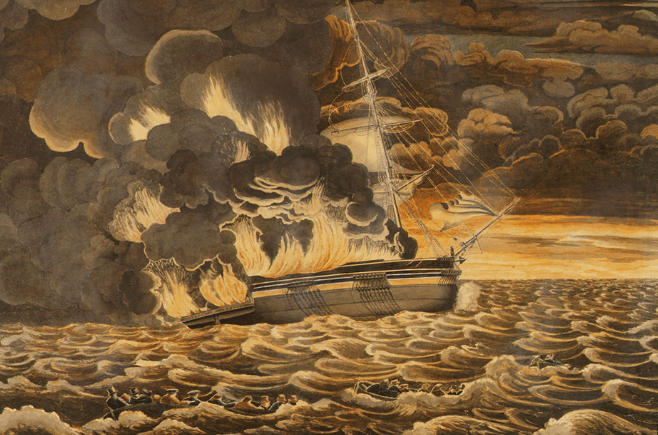
No one should doubt the extraordinarily destructive power of lightning. A dramatic illustration of this power occurred in 1830, when the packet ship Boston was hit by a bolt of lightning in the Atlantic and burned to the waterline, with the loss of one unfortunate passenger.
The Boston, captained by one Harvey Coffin Mackay, left Charleston, South Carolina in mid-May, 1830. In her hold was contained a large shipment of raw cotton. Several passengers were also aboard, as it was not uncommon in those days for commercial vessels to admit paying fares. As she sailed through the Gulf Stream on her way to Liverpool, the ship encountered rough weather. Then disaster struck in bizarre form. At around 10:00 pm on the evening of May 25, Captain Mackay noticed heavy clouds rising in the southwest. Then at about 11:00 pm, multiple flashes of lightning struck the ship, with such force that the ship’s steward and a sailor named Isaac Hopkins were knocked off their feet.
Captain Mackay later wrote that the ship was “filled with electric fluid”; perhaps he meant by this that he could see sparks or other evidence of electrical charge envelop the ship. The crew soon realized that the ship had caught fire, most likely due to the ideal fuel presented by the quantity of cotton in the hold. Captain Mackay describes what transpired next:
We immediately cleared the main and after hatchways, to get at the fire, heaving the cotton overboard and cutting holes in the deck, plying water in every direction—but all in vain; the cotton in the main hold was on fire, fore and aft, on both sides, burning like tinder. Our only alternative was to clear away the boats and get them out, part of the crew and passengers at work keeping the fire down as much as possible by drawing and heaving water, the scuppers being stopped up; we stove water casks over holes cut in the deck and in the main hatchway; starting the water, but all to no good purpose, for before we could get the long boat over the ship’s side, the fire had burst through the deck and out the larboard side of the ship. The flames raged with such violence and consumed the vessel so quick, that nothing could be saved from the wreck.
We got about forty gallons of water and provisions sufficient, on a short allowance, to keep the passengers and crew alive for three weeks—almost every thing else was burnt up in the ship, even the money, watches, and clothes—all destroyed. At 3 A. M. the main and mizen masts were burnt off below deck, and the masts fell in the water at half-past 3, the passengers and crew were all in the boats; the flames had then reached the forecastle, and the ship was one complete flame of fire, fore and aft. The passengers had exerted themselves to the utmost to assist us. The officers had with unwearied exertion, coolness, and persevering activity done all that men could do. The ship’s crew worked like horses and behaved like men; but all would not do. About three hours time had changed one of the best ships that ever swam to a complete volcano, and twenty three persons cast adrift on the open ocean.
So were the passengers and crew left at the mercy of the cold rain and waves of the Atlantic. The sole female passenger, a Miss Boag, died of exposure during the night. Mackay reports that she died “in the arms of her brother.” It was a tragic and unforgettable scene, for she thanked everyone present for their compassion and assistance before expiring. The other survivors buried her at sea the next day after a brief religious service, due to the fact that, as Mackay relates, “our situation [was] not admitting of the corpse being kept longer in the boat.” In the days of nineteenth-century sail, death and tragedy were common occurrences, and men and women were made of sterner stuff. Those who took to the open ocean were philosophical about the risks; for an era hardier than our own, the salve of religion, or the refuge of superstition, were reliable cognitive supports. The survivors remained in the boats for two days near the wreck of the Boston. Deliverance finally came when they were rescued by the brig Idas from Liverpool, captained by one Joseph Barnaby. They remained on the Idas for two days, when they were transferred to the brig Camilla, which offered the survivors passage to the city of Boston.
An agreeable footnote to this tragic story is that one of the original passengers of the Boston, Isaac Coffin, after landing in Massachusetts, presented Captain Mackay with a check for five hundred dollars, as a token of gratitude for his efforts. This was a significant sum in those days. He also later sent Mackay a gold watch to replace the one the captain had lost during the Boston‘s burning. The destruction of the ship was memorialized in an 1830 watercolor by Fitz Henry Lane entitled The Burning of the Packet Ship Boston.
.
.
Be sure to take a look at the new, annotated translation of Frontinus’s Stratagems.
 Quintus Curtius
You must be logged in to post a comment.