
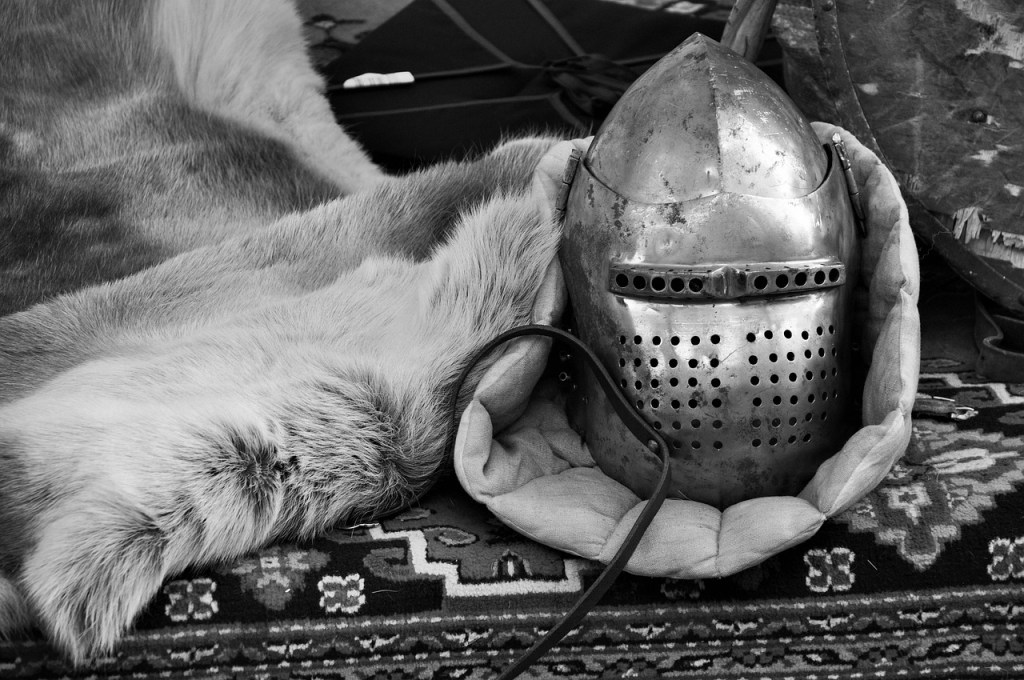
In book nine of the Aeneid, the Rutulian warrior Numanus Remulus makes a famous declamation, in which he speaks the following lines:
Canitiem galea premimus, semperque recentis
Comportare iuvat praedas et vivere rapto.
[IX.612-613]
And this means, “We press white hairs with a helmet, and always find joy in amassing new plunder and living on spoils.” Once he has delivered his speech, he is immediately killed by an arrow shot from the bow of a young Trojan named Ascanius. This outcome is unfortunate—for Numanus Remulus at least—but it should not detract from the lesson imparted by the quoted lines above. I am referring to the first three words: canitiem galea premimus, or we press white hairs with a helmet. What does this mean, exactly? It is a warning. Numanus is telling us that old age can expect no respite from the struggles of life; he is reminding us that battle is not solely a young man’s game. We must always be ready to don the helmet, even if the helmet happens to fall on hairs that have turned white. The struggle only ends when we have breathed our last.

One detects a certain current in our society which seeks to burden the younger generations with the struggles and problems that were created by their elders. This way of thinking advocates, in effect, a retreat from the duties owed to one’s nation and community. But it is of course an illusion. For one never reaches a point in life in which moral combat is not a focus of our existence. We can pretend that we are too old for the struggle. We can try to shirk our obligations; we can seek to heap on the shoulders of the young the problems created by the frivolities of the aged. Yet this path inevitably leads to ruin.
An older man must, at any time, be ready to press a helmet on his white hairs and, so to speak, take to the field. This field may be figurative or symbolic; or it may be a very real field. But prepared he must be nonetheless. He is not permitted to slink off into the sunset and hide while the world burns around him. He is not entitled to turn his back on the problems that his generation created. He should be the first to enter the field, and the last to leave it. The older man who neglects this truth will very soon find himself adrift in life, for he has traded dignity and self-respect for comfort and security, and is far worse for the bargain. He will remain lost in the woods, and will eventually find himself, as Longfellow’s Dante says,
…[A]s he is who willingly acquires,
And the time comes that causes him to lose,
Who weeps in all his thoughts and is despondent.
[Inferno I.55—57]
.
.
.
Take a look at the new, annotated translation of Frontinus’s Stratagems.
 Quintus Curtius
Yes. Yes. This brings to mind a favorite passage from Thomas Paine (Crisis):
I once felt all that kind of anger which a man ought to feel against the mean principles that are held by the Tories [British loyalists]. A noted one, who kept a tavern at Amboy, was standing at his door with as pretty a child in his hand — about eight or nine years old — as ever I saw, and after speaking his mind as freely as he thought was prudent, finished with this unfatherly expression, “Well! give me peace in my day.”
Not a man lives on the Continent but fully believes that a separation must sometime or other finally take place, and a generous parent should have said, “If there must be trouble, let it be in my day, that my child may have peace;” and this single reflection, well applied, is sufficient to awaken every man to duty.
LikeLiked by 1 person
Yes, agreed!
LikeLike