
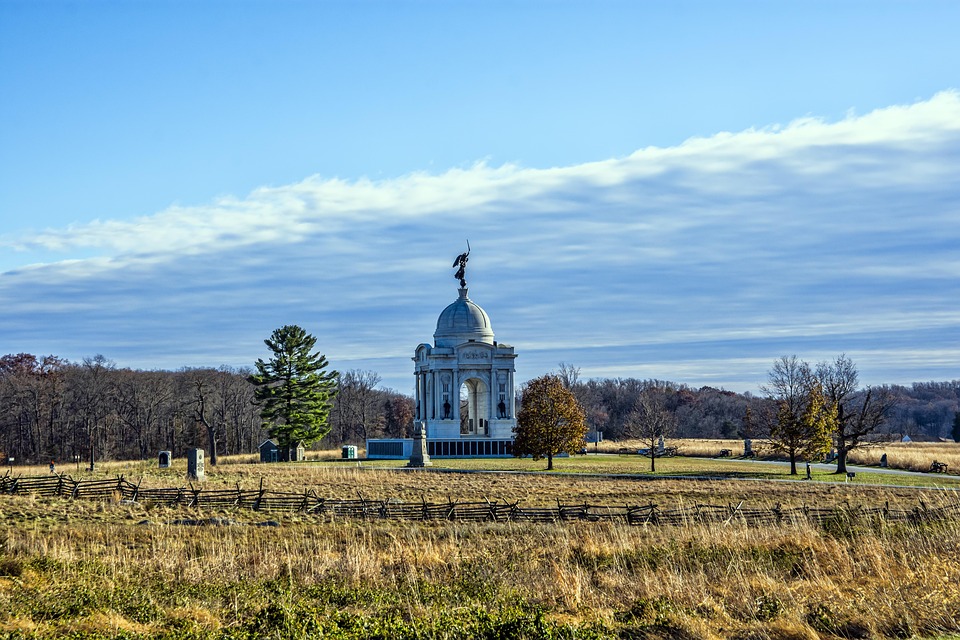
Let us tell the story of the greatest speech ever delivered by an American president.
In July of 1863, the fall of the city of Vicksburg, and the conclusion of the titanic engagement at Gettysburg, seemed to mark a turning point in the American Civil War. This did not mean that the war’s end was in clear sight. But these two events did indicate, however vaguely and tentatively, a definite reversal of fortune in favor of the Union. The contest at Gettysburg had been the largest land battle ever fought in the Western hemisphere; it would thereafter remain, as many observers noted, the “high-water mark” of the Confederacy.
The heroic nature of the struggle at Gettysburg spurred a Pennsylvania attorney named David Wills to complete his plans for a national cemetery. A truly national cemetery for the nation’s war casualties was a new development. In previous conflicts, cemeteries had been created in an ad hoc and impermanent manner; the dead were usually buried where they fell with little in the way of public recognition for their sacrifices. The scope and scale of the Civil War changed all this. Wills and his committee believed that a national cemetery needed a presidential dedication. They therefore extended a speaking invitation to President Lincoln; the date of the ceremony was set for October 23, 1863. A Massachusetts politician, Edward Everett, was also invited to speak. An obscure name today, Everett was at the time one of the country’s most illustrious orators.
Before 1863, Lincoln had declined most invitations to speak outside Washington, believing that his presence in the Executive Mansion, as the White House was then called, was necessary to manage the war. But now he felt differently. Supporters from within his party and among the general public were encouraging him, in the words of Boston businessman John Murray Forbes, to “seize an early opportunity and any subsequent chance to teach your great audience.” Lincoln accepted; he had come to realize that it was essential to communicate to the public the war’s evolving purposes and aims. Wills and his committee also invited some of the country’s most noted literary figures to participate by composing a poem or other written memorial suitable to the occasion. Invitations were extended to Henry Wadsworth Longfellow, John Greenleaf Whittier, and William Cullen Bryant, but none of them responded. It is ironic that the nation’s two truly great living writers, Herman Melville and Walt Whitman, were never even considered. But Melville in 1863 was almost completely forgotten, and Whitman was considered an uncouth renegade.
It is essential to have an understanding of Lincoln’s evolving thoughts about the war as the conflict ground on. Historians have traced the cautious and methodical evolution of Lincoln’s views from his speeches, letters, and cabinet meetings. In 1861, he repeatedly emphasized that the war was being fought to preserve the Union; and in his public utterances, Lincoln went out of his way to remind the public that he did not believe he had the constitutional authority to attack slavery where it already existed. His reasons for this were grounded in both political expediency and his personal beliefs. He did not wish to antagonize the border states, and did not want to risk alienating the majority of Union soldiers, who he knew were not actuated by abolitionist sentiments.
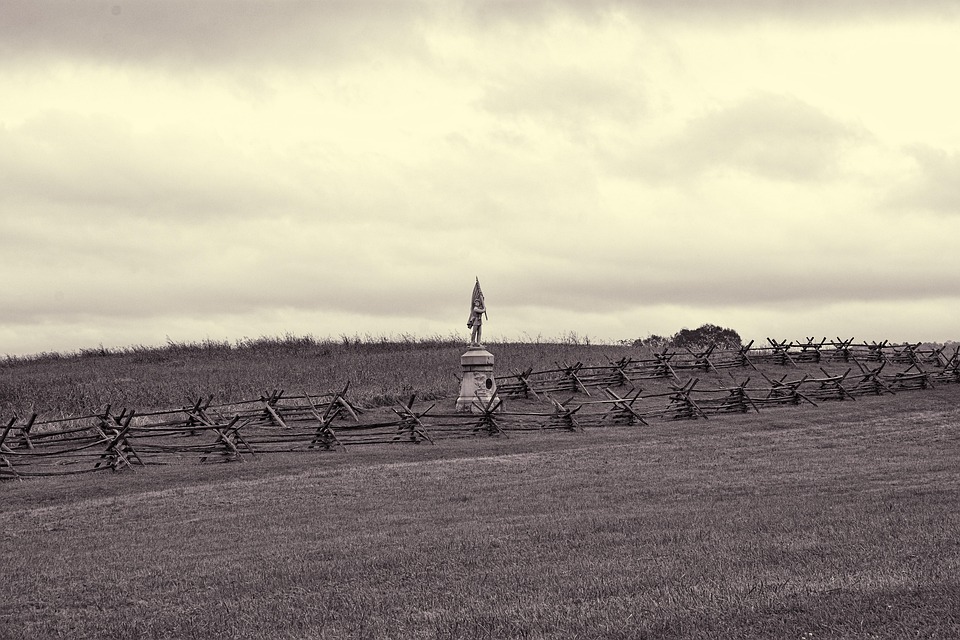
But as the war dragged on, Lincoln’s views changed significantly. As the deadly cost of the fighting climbed ever higher, and began to touch nearly every family, Lincoln began to see the conflict in almost Biblical terms. He understood that there would be no going back to the old order. There would be no return to the status quo ante. As he studied the results on the battlefields, as he continued to read Shakespeare and the Bible, as he discussed developments with his cabinet members, and as he ruminated in the late evening hours, Lincoln determined to forge ahead into the unknown. In his second annual message to Congress on December 1, 1862, Lincoln had said, “The dogmas of the quiet past are inadequate to the stormy present. The occasion is piled high with difficulty and we must rise with the occasion. As our case is new, we must think anew and act anew. We must disenthrall ourselves, and then we shall save our country.”
On January 1, 1863, Lincoln signed the Emancipation Proclamation, which liberated slaves then held in Confederate states. In July of 1862, Lincoln had signed the Militia Act and Second Confiscation Act, which ultimately paved the way for the enrollment of black troops in the Union army. Although these were measures of wartime expediency, they undeniably showed a shift in Lincoln’s thinking regarding what sort of country would emerge when the cannon fell silent. In a letter sent to the largest Union rally of the war in Springfield on September 3, 1863, and publicly read by the president’s friend James Conkling, Lincoln spoke with uncharacteristic emotion about the justice of emancipation and the need for black enlistment in the armed forces.
The shift in thought had become complete by 1864. In April of that year, Lincoln composed a public letter to Kentucky editor Albert G. Hodges which demonstrates that he had come to see the war as a kind of expiation of the nation’s sins. “I am naturally anti-slavery,” he said. “If slavery is not wrong, nothing is wrong…And yet I have never understood that the Presidency conferred upon me an unrestricted right to act officially upon this judgment and feeling…I claim not to have controlled events, but confess plainly that events have controlled me. If God now wills the removal of a great wrong, and will also that we of the North as well as you of the South, shall pay fairly for our complicity in that wrong, impartial history will find therein new cause to attest and revere the justice and goodness of God.”
All these sentiments, in one form or another, swirled in Lincoln’s head as he prepared for his speech at Gettysburg. He had been the last speaker to be invited. Wills’s invitation had reached him only on November 2, 1863, which was seventeen days before the ceremony. Lincoln arrived at Gettysburg by train on November 18, and was driven to Wills’s comfortable house. Throughout the town, children sold sweets and souvenirs picked up from the nearby battlefield. Around fifteen thousand people attended the dedication ceremony, which began with an invocation and hymn. Edward Everett spoke first, and at great length; his interminable address lasted for two hours and eight minutes. Lincoln then stepped to the podium. A photographer, who had suffered through Everett’s oration, believed he would have enough time to capture a clear photograph of Lincoln speaking. He—and posterity—would be disappointed, for the President’s remarks were brief in the extreme. Who will protest our quoting it once again?
Four score and seven years ago our fathers brought forth on this continent, a new nation, conceived in Liberty, and dedicated to the proposition that all men are created equal.
Now we are engaged in a great civil war, testing whether that nation, or any nation so conceived and so dedicated, can long endure. We are met on a great battle-field of that war. We have come to dedicate a portion of that field, as a final resting place for those who here gave their lives that that nation might live. It is altogether fitting and proper that we should do this.
But, in a larger sense, we can not dedicate—we can not consecrate—we can not hallow—this ground. The brave men, living and dead, who struggled here, have consecrated it, far above our poor power to add or detract. The world will little note, nor long remember what we say here, but it can never forget what they did here. It is for us the living, rather, to be dedicated here to the unfinished work which they who fought here have thus far so nobly advanced. It is rather for us to be here dedicated to the great task remaining before us—that from these honored dead we take increased devotion to that cause for which they gave the last full measure of devotion—that we here highly resolve that these dead shall not have died in vain—that this nation, under God, shall have a new birth of freedom—and that government of the people, by the people, for the people, shall not perish from the earth.
It is an undeniable literary and rhetorical masterpiece: so compact, and yet so filled with noble sentiment; so measured and balanced, and yet so soaring in its imaginative possibilities. Lincoln gives the struggle at Gettysburg a meaning almost removed from its present context. It becomes, in his hands, a step toward that original goal, articulated but never realized, of the Founding Fathers in the Declaration of Independence: the promise of universal liberty. Lincoln concludes his remarks by calling on future generations to remember the sacrifices made by the fallen, and to be ever mindful that they have a sacred obligation to see that freedom, justice, and union “shall not perish from the earth.” When Lincoln uses the phrase “new birth of freedom,” he means that the old United States is no more, and that a new United States has taken its place, once based on universal justice and the original guarantees of 1776. It is a speech that moves the soul, an address never equaled in sublimity and evocative power.
And yet, as always, there were detractors. Initial reaction to the Gettysburg Address was mixed. When someone is predisposed not to hear another, his words will never be heard. The Chicago Times complained, “The cheek of every American must tingle with shame as he reads the filly, flat, and dishwatery utterances of a man who has to be pointed out to intelligent foreigners as the President of the United States.” The Times of London was unimpressed. “The ceremony was rendered ludicrous by some of the sallies of that poor President Lincoln.” But a Massachusetts newspaper editor, Josiah Holland, called Lincoln’s speech “a perfect gem, deep in feeling, compact in thought and expression, and tasteful and elegant in every word and comma.” Edward Everett, who knew brilliant oratory and rhetoric when he heard it, was deeply moved by Lincoln’s words. “I should be glad,” he wrote the President, “if I could flatter myself that I came as near to the central idea of the occasion in two hours, as you did in two minutes.”
As time passed, the nitpickings of critics faded, as they always do, into deserved oblivion. The Gettysburg Address came to be recognized as the literary masterpiece that it is. It needs no further praise from us. What it demands is our remembrance, our sober understanding, and our realization that the promises of freedom and liberty, once won, do not stay won forever. The challenges faced by the nation in the 1860s were very different from those faced today. As our institutions, traditions, and liberties are eroded by unscrupulous demagogues, open corruption, and destabilizing concentrations of power, new generations must be willing to act decisively to ensure that “government of the people, by the people, for the people, shall not perish from the earth.”
.
.
Be sure to take a look at the new, annotated translation of Cicero’s On The Nature Of The Gods.
 Quintus Curtius
You must be logged in to post a comment.