

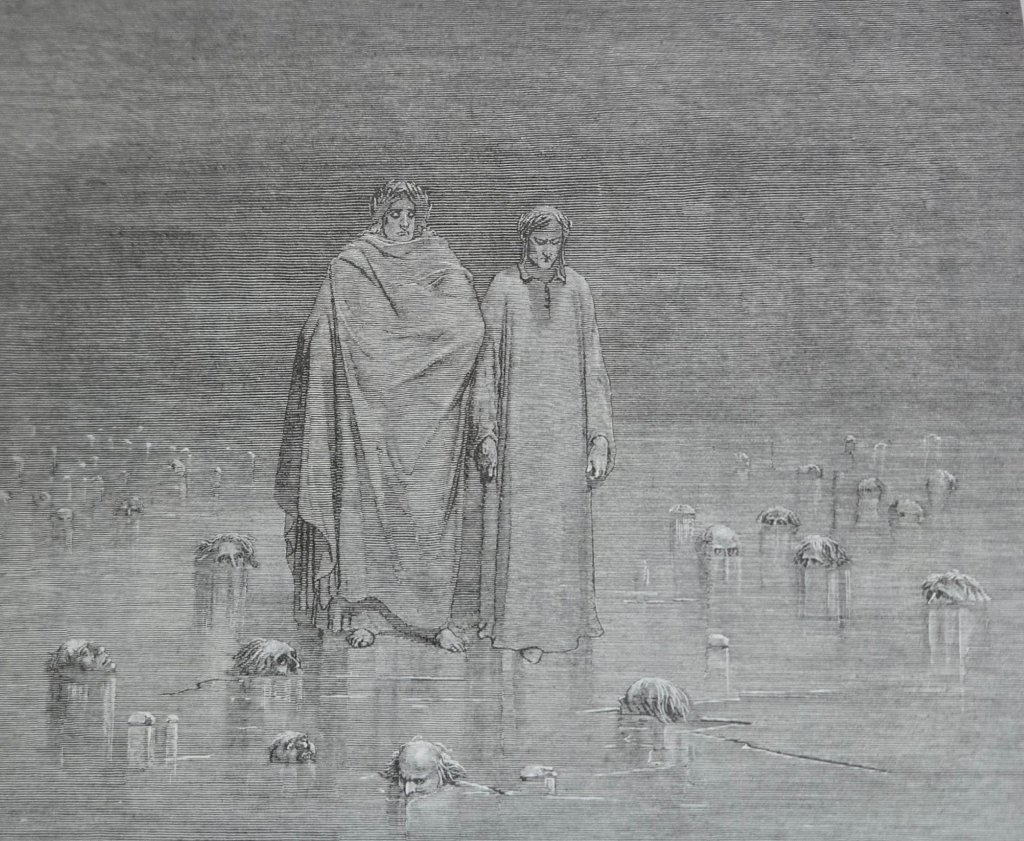
In the thirty-fourth canto of Dante’s Inferno, our intrepid tourists Dante and Virgil find themselves at the very bottom of Hell’s ninth circle, known as Judecca, a name derived from Judas Iscariot. With his enthusiasm for classification and categories, Dante has given us names for the different parts of the ninth circle, in which are housed particular types of traitors: Caina (for traitors to family), Antenora (for traitors to country), Ptolomaea (for betrayers of guests), and Judecca (for traitors to benefactors).
The canto opens with the Latin phrase, Vexilla regis prodeunt Inferni. This means, “The standards [banners] of the king of Hell go forth.” As Dante uses it, the line is a deliberate mockery of a sixth-century hymn entitled Vexilla Regis Prodeunt, composed by the Merovingian poet Venantius Fortunatus. It was intended as a stately processional hymn to celebrate Christ’s triumph over death and evil. But there is nothing triumphant or dignified in the way Dante seeks to employ the phrase: he uses it to generate scorn for the king of Hell himself, Lucifer. Satan is presented as frozen up to his chest in an icy lake, Cocytus, and has been rendered effectively immobile. The “banners” or “standards” of this “king” are Satan’s bat-like wings, which flap frantically and continually, generating the freezing winds that perpetuate Cocytus’s icy solidity and, ironically, Lucifer’s own imprisonment in the ice. So are the evil trapped by the activities in which they themselves take part.
Lucifer is presented as having one head with three faces; tears of rage and pain stream down all of them in an indication of his utter despair. In his three gnashing mouths are perpetually chewed three notorious traitors: Judas Iscariot, Brutus, and Cassius, the last two being the skulking assassins of Julius Caesar. Satan himself says nothing intelligible: there are no speeches, no honey-tongued attempts to justify himself, and no effort to seduce his visitors. All that radiate from him are infinite anger and frustration.
I find Dante’s portrayal of the embodiment of evil so much more unsettling than Milton’s depiction of Satan in Paradise Lost. Milton finds it necessary to put all kinds of eloquent speeches into Lucifer’s mouth, to the point where we nearly begin to sympathize with him as a figure more sinned against than sinning. But old Dante was not one to do this. He did not wish to glamorize evil, or to allow it a foot in the door of our subconscious. He knew what evil truly was, and understood that there was nothing attractive about it. Lucifer in fact cuts a pathetic and contemptible figure in hell: a weeping, flapping, mumbling, powerless monster. For all his power, Lucifer presides over a kingdom of immobility and inertia; it is a direct inversion of God’s kingdom of light and positive, creative action. He becomes, through Dante’s pen, the embodiment of spiritual inversion. Instead of the light and action of the terrestrial realm, we have darkness, immobility, and agony. The banners of the king go forth.

You may be wondering why I am discussing these aspects of Dante’s hellish conceptions. I do it because the banners of the kingdom of evil are not, unfortunately, confined only to Hell. These banners are now willingly carried aloft by a great number of people in our own world, and in our own time. They are proudly and triumphally paraded before us, in open mockery of our laws, institutions, and values. It would be a mistake to think of these vexilla regis Inferni as something confined to an abstract frozen Cocytus. In fact we have leaders and public figures today who cheerfully wave them in our faces, confident that they will never be held to account for their lies and crimes. Perhaps they are right. Or perhaps they are not. Only time will tell.
One thing is certain: those who carry the banners of Hell are never swayed by appeals to reason or conscience. Once they take up the banner, they do not put it down. Malefactors already know what is right, and what is not; the point is that they do not care about the difference. They are contemptuous of the world’s judgment. They consider themselves exempt from the rule of law. A reckoning, a calling to account, an opportunity for justice: these things do not just fall to us from the clouds. There are no dei ex machinis coming down from the skies to save us. Only the resistance of the good, and only the coordinated efforts of the many, can impose some measure of accountability on those who have betrayed the sacred obligations of leadership. Only the sustained and uncompromising efforts of the righteous have any hope of tearing Lucifer’s metaphorical banners from the hands of the corrupt, and of providing the republic with a degree of justice.
.
.
Read more about related topics in the new, annotated translation of Cicero’s On Moral Ends.
 Quintus Curtius
You must be logged in to post a comment.