

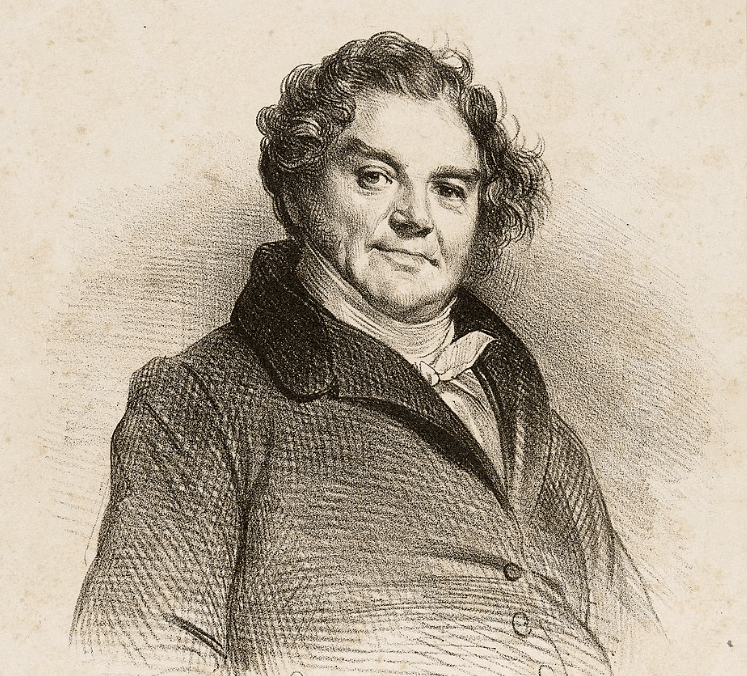
The following crime story is found in an issue of William Evans Burton’s The Gentleman’s Magazine from 1839 (Vol. IV, January—July). It appears under the title “Unpublished Passages in the Life of Vidocq, the French Minister of Police. No. V: The Strange Discovery.” “Vidocq” refers to Eugène-François Vidocq (1775—1857), the French criminalist and investigator who is considered the father of the the Sûreté Nationale, France’s first criminal investigative agency.
There once existed in Paris a hotel called the Renard d’Or. One of the hotel’s frequent patrons was a wealthy widow named Madame Launay, whose husband had once been a prosperous financier in Bordeaux. It was her habit to visit Paris every year to conduct business; and she was usually accompanied by her maid Julie. On this particular visit (we are not given the date), Madame Launay was informed by the hotel proprietor that the only available room was a small one with two separate beds. This was found to be suitable; Mme. Launay and her waiting-woman then brought their belongings to the room and settled in for the night.
Julie awakened during the night, still restless from the long journey. Rising to get a glass of water from her dressing table, she looked over at her motionless mistress, assuming her to be in the throes of slumber. After drinking, Julie’s eyes fell on Mme. Launay’s impressive travelling cloak, an article that Julie had long admired. Assuming her employer would not mind, she tried the cloak on, and admired its fit and appearance. She then placed Mme. Launay’s bonnet on her head, and found the addition to be most agreeable. “I really do look extremely well in it!” she said audibly. “I really wonder why the men are so devoid of taste as to suffer me to continue still unmarried!”
Julie removed the garments and returned to bed, happily buttressed by pleasant dreams. The morning, however, would bring a very different set of sensations. When Julie tried to rouse her mistress, she was horrified to find the bedsheets drenched in blood. During the night, Mme. Launay had been stabbed through the heart. Apparently the death-blow had been administered with such force, or skill, that the poor woman had not even been able to cry out. Julie was immediately aware of her own dire situation: no one else had entered the room, so suspicion would naturally fall on her. Yet circumstances turned in her favor. At the inquest, she answered the questions of the investigators and the judge with forthright honesty. She was able to secure a multitude of witnesses who could attest to her honesty and fidelity. Not a single franc of Mme. Launay’s funds had been touched or appropriated. Because no murder weapon could be found, and no direct evidence could tie Julie to the killing, the police released her and left the case open.

Yet Julie decided to remain in Paris for some time, determined to remove any taint of culpability that might linger over her head. Perhaps she could secure new evidence to bring the killers to justice. One day, she decided to take a carriole ride along the Champs-Eysees (a carriole is a small, horse-drawn carriage designed for a single passenger). They were the 19th century version of a taxi cab. As she was waiting in the carriole-line, her turn came up. But there was something about the two drivers that made her wary, and Julie decided to wait for the next carriole. The two drivers, offended at the perceived slight, began to taunt Julie. “Guillaume,” one man said, “the lady thinks you don’t look enough like a gentleman to be honored with her company! Why don’t you brush your hair, and place your hat in a more elegant style, and then when she comes this way next time, perhaps she’ll go with you! Pretty women sometimes imagine themselves to be more important than they are!” Then came a response from the other man that immediately caught Julie’s attention. “Yes! I wonder the men are so devoid of taste as to suffer her to continue still unmarried.”
As she walked away, she thought it very strange that the man had repeated the same words she had used during that fateful night, as she admired herself in the mirror while wearing Mme. Launay’s cloak. The more she thought about it, the more it troubled her. She went directly to Inspector Vidocq and related the incident to him; he also thought that the coincidence was too uncanny to be the work of random probability. Vidocq and Julie returned later to the carriole-stand and confronted the two men. They went visibly pale upon seeing the police, and pretended to be contrite for their rude behavior towards Julie. One question led to another, and Vidocq soon had secured consent to enter the men’s lodgings. A search of their quarters revealed certain property of Mme. Launay, their possession of which they could not explain. Vidocq himself provides the additional details:
But to be brief, there were many circumstances [which] came out against them [that] left but little doubt of their being the guilty parties. The words they had made use of, the things belonging to Madame Launay, and their being unable to account in any way for themselves on the night in question, were strong proofs against them. They were found guilty, and condemned to expiate their crime at the Place de Greve. Previous to their execution, they confessed that one of them had, before Madame Launay’s arrival, got unperceived into the hotel, and had hidden himself under one of the beds in the room where she had slept, and that it was there he had seen Julie admiring herself in the glass, and heard the expressions she had made use of.
During the night, the robber hidden under the bed had let in his companion. As the robbery was in progress, Mme. Launay had stirred; and, not wanting to leave a living witness, one of the vicious blackguards had knifed her. One can only speculate that the killers might forever have eluded capture had they enough restraint to keep their mouths shut; but it is in the nature of such types to boast and insult others, even to their own detriment. And this was what sent them to the executioner. So are the wicked, in due time, trapped and convicted by their own unrestrained deviations of character.
.
.
.
Be sure to take a look at the new, annotated translation of Frontinus’s Stratagems, which has never been more relevant.
 Quintus Curtius