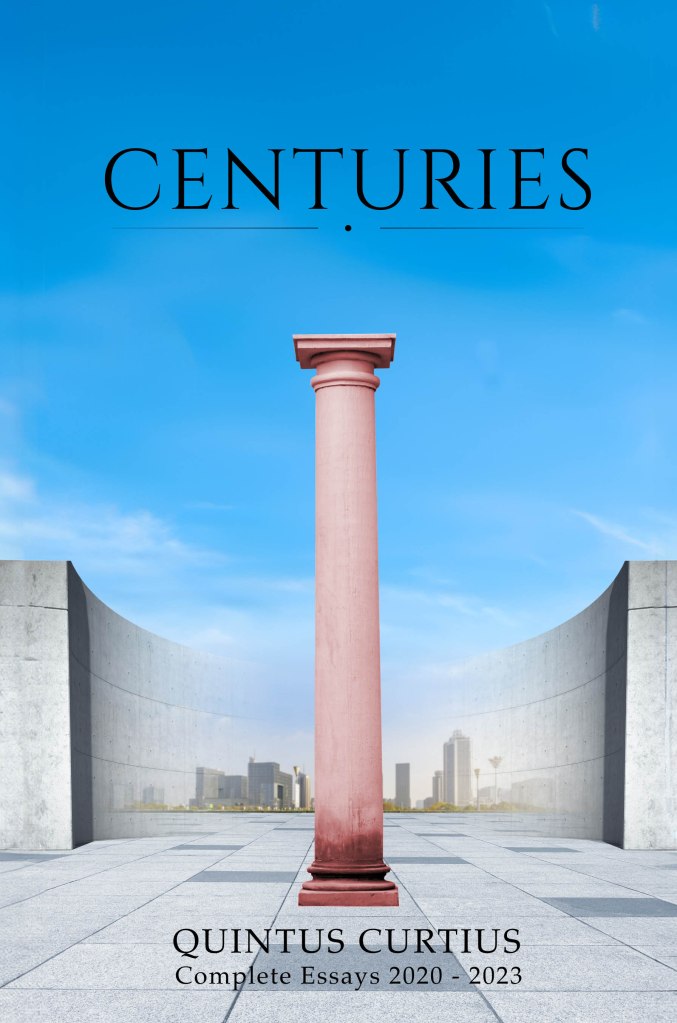
“Centuries” Is Now Available

Centuries, the complete collection of my essays from 2020 to 2023, was released today. The book is available in paperback, hardcover, and Kindle editions. The essays deal with varied topics in moral philosophy, history, and biography. In addition to essays, the volume also includes a special collection of aphorisms and maxims under the chapter “Gnomology.” An enduring source of practical wisdom and inspiration, these timeless writings are unified by, and imbued with, a passionate belief in direct experience, moral structure, and endurance in adversity. The full table of contents can be found here.

Continue reading

Thoughts On Friedrich Nietzsche (Podcast)

Nietzsche is one of the most popular and discussed of the modern philosophers. He tends to be highly polarizing: some see him as a kind of secular saint, while others see him as a laughable poseur. I wanted to give my own thoughts on his life, ideas, and place in the history of thought.

Continue reading

“How To Get Over A Breakup”: An Ancient Guide To Moving On (Literary Review)

How To Get Over A Breakup: An Ancient Guide To Moving On, by Ovid. Translated and introduced by Michael Fontaine. Princeton University Press, 2024. Available in hardcover, Kindle, and audiobook.

Ovid is the most famous of the amorous poets of Rome’s literary Golden Age.  What distinguishes him from his approximate contemporaries Tibullus and Propertius is his depth of insight, and this is why we still read him today. 

Continue reading

With Useless Delays, Threats Succeed

According to the biographer Ibn Khallikan, the poet Ibrahim Al-Suli (?—857 A.D.) was once employed by a caliph to compose a threatening letter to some rebellious subjects.  The letter contained the following words:

Continue reading

You Can’t Separate The Message From The Messenger (Podcast)

Some people think the only thing that matters is what a teacher or instructor says, not what their character is. I don’t agree with this. In choosing a teacher or instructor, we have to remember that character and integrity are all-important. Nothing good can ever come from moral corruption, as Cicero has said. You have to look carefully at a man’s track record, background, and conduct to get an accurate assessment of his character. In this podcast, we probe into this subject.

Continue reading

How Do You Define Success? (Podcast)

In this podcast, we discuss a very revealing video that appeared on YouTube a few weeks back. Someone who prioritizes materialism and appearances is confronted by another man who has a very different value system. The resulting clash between the two of them is highly revealing.

Continue reading

The Tale Of The Rat And The Gerbil

The following tale is found in Ibn Zafar’s political treatise, The Consolation For The Ruler During The Hostility Of His Subjects.  Because it is likely to unfamiliar to most readers, I will paraphrase it here.

Continue reading

Two Letters Of Consolation From Abraham Lincoln

Abraham Lincoln’s literary powers were a product of his life experiences and his innate abilities.  From a young age, his exposure to tragedy had been personal and continuous.  The death of his mother, the death of Ann Rutledge, and various other hardships had given him an acute sensitivity to the meaning of loss.  In the writing of letters of consolation, Lincoln was able to harness these sentiments and express them in ways that gave specific tragedies a timeless and almost cosmic significance.  We have already here discussed the famous Bixby Letter.  Two other letters of consolation from Lincoln’s hand, much less well-known, merit our attention as models of compassion and heartfelt sympathy. 

Continue reading

Let Us Never Despair (Podcast)

This is a podcast reading of my essay Let Us Never Despair, which was published here on May 18, 2024. What is the origin of despair? And how may it be confronted? We provide some answers to these questions, and related ones, in this podcast. The man of virtue and fortitude will never abandon himself to despair.

Continue reading

Let Us Never Despair

There is an inscription in the Bayeux Tapestry which reads Isti mirant stella, or “these men wonder at the star.”  The scene in which it appears depicts a group of men pointing to a highly stylized image of Halley’s Comet, which made an appearance around the time of the Norman conquest of England.

Continue reading