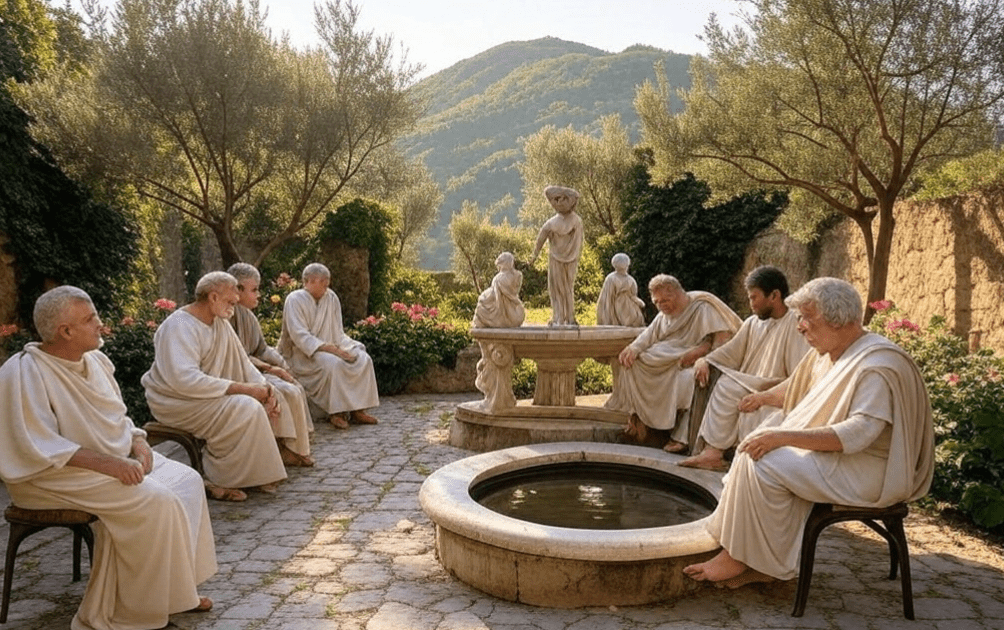
The Stoic philosopher Ariston of Chios was said to have believed strongly that the wise man should avoid making absolute judgments. Certitude, he felt, was neither possible nor desirable.
Continue reading
The Stoic philosopher Ariston of Chios was said to have believed strongly that the wise man should avoid making absolute judgments. Certitude, he felt, was neither possible nor desirable.
Continue reading
De poena prophetarum falsarum. If a leader cannot base his decisions on verifiable truth, or on the closest approximation of what he believes to be the truth, he will not escape calamity. He must surround himself with advisors who have his, and not their own, interests at heart; and he must seek independent confirmation of advice provided, especially during times of war or crisis.
Continue reading
For a great personality to flourish and find expression, the historical times must be favorable. History is filled with examples of great men who withered in obscurity simply because the periods in which they lived were unable to hear their voices. Greatness can only accomplish so much; it must be nurtured by propitious circumstances.
Continue reading
Below are listed the most visited essays of 2024. Not surprisingly, the movie pieces showed considerable traffic. But I did not expect a few essays from much earlier years to resurface: as the waters of time churn and seethe, what was once submerged can often break through the surface. The essays are listed in descending order, based on the number of views.
Continue reading
It can often be instructive, in the study of history, to play the intriguing game of “what if?” We are inclined to believe in the inevitability of historical events, simply because things turned out as they did; yet we tend to forget that different decisions might have produced very different outcomes. Thought experiments also help us to review those timeless principles of leadership and morals that may be applicable to our own lives. Let us, then, review Hannibal’s decision not to march on Rome in the immediate wake of his shattering victory at Cannae in August of 216 B.C.
Continue reading
When Napoleon was finally imprisoned on St. Helena, the British government thought it prudent to occupy a small volcanic island named Tristan da Cunha, which was located about twenty degrees south of St. Helena. It was assumed that, if the wily French emperor attempted an escape from his island lodgings, Tristan da Cunha would present an ideal staging area. Occupation of Tristan would forestall such an eventuality. Within a few years a fort and barracks had been constructed, and the island was eventually garrisoned; a few dairy cows completed the island’s fortification.
Continue reading
Among the most remarkable events of the late medieval period was the rise and growth of the Ottoman state in Anatolia and beyond. George Finlay, in his seven-volume history of Greece, called the Ottoman Empire “one of the most singular creations of human genius.” In the empire’s early centuries, at least, we cannot disagree with this verdict. How was it that a tiny, obscure tribe of Asiatic migrants came to conquer the proud and ancient domains of the Byzantine Greeks with such rapidity?
Continue reading
Every man should periodically make an intense sojourn. The destination matters less than the journey itself, for it is the act of discovery that soothes the turbulent soul. I recently returned from a 10-day trip to Europe, during which I visited Amsterdam, Italy, Spain, and Portugal. I wanted to summarize my impressions here. You have heard and read, no doubt, an endless number of travel accounts by countless authors. Much of what I say may already be known to you. But there is still some value, I think, in hearing these things from a voice with a different inflection.
Continue reading
In November of 43 B.C., Rome was gripped by a terrible sense of foreboding. The historian Appian, in his Civil Wars (IV.1.4) relates that all kinds of strange portents were observed around the city. Statues sweated blood; a newborn infant uttered words; lightning struck sacred temples; and cattle spoke with a human voice. So alarmed were some senators that they summoned expert diviners from Etruria to weigh these ominous signs. The most authoritative of these was an elderly man who told them, “The monarchical rule of ancient times is returning. You will all be slaves except me.” Once the Etruscan priest spoke these words to the startled senators, says Appian, he closed his mouth and held his breath until he dropped dead before them.
Continue reading
One of Saladin’s advisors was a man known by the honorific title Al-Qadi Al-Fadil (“The Excellent Judge”). We will not try the reader’s patience by recording his protracted real name, but we will note that he lived from 1135 to 1200. Great conquerors in history always seem to be accompanied by wise counsellors; perhaps there is an important lesson to be derived from this fact.
Continue reading
You must be logged in to post a comment.