Civil And Military Organization Of The Later Roman Empire

 rome1

Introduction

Current news headlines of populations on the move into Europe have drawn attention to a previous era in European history, one in which mass migrations of foreign peoples played a major role.  The Roman Empire of the fourth and fifth centuries was faced with these very challenges from the movements of Germanic tribes, as well as Avars, Bulgars, and Huns.

As I looked more into the details of this period of history, I was struck with how resilient and stable the Empire’s organization was.  There is vast ignorance of this period of history, even (or especially) among Europeans.  While it is often portrayed as an age of continuous decline and decadence, this picture is not the whole truth.

The civil and military organization established by Constantine was wise and enduring, and it deserves to be better known.  It stands in stark contrast to the ineptitude and feebleness of the heads of state in modern Europe.

This article is technical in nature, and will be of interest to the few, rather than to the majority.  Those comprising the latter group may wish to pass on this post, and spare themselves some heaviness of the eyelids.

Continue reading

The Wisdom Of Moderation, And The Danger Of Extremism

prog4

Plutarch’s lives of Phocion and Cato the Younger can be read as case studies on the contrasting features of moderation and extremism.

The successful, rational leader will know when to compromise and seek settlements; the extremist will not, and thereby brings himself and others to ruin.

Continue reading

Aldus Manutius: The First Great Publisher In History

book2

We take so much for granted today about printed books.  The wisdom of the ages can be captured and preserved for costs that are so low as to almost negligible.  Save for the surfeit of information that currently exists, the modern man has no excuse not to be reasonably acquainted with his heritage.

It was not always so.  Before the advent of the printing press, books circulated in manuscript form.  They had to be copied by hand, and this was laborious and costly.  In the ancient world, manuscript books were relatively cheap and plentiful; but papyrus became unavailable from Egypt during the Middle Ages, leaving expensive vellum as the only available medium for “mass” writing.

Continue reading

Jack London Sails Across The Pacific

writer

Readers no doubt are familiar with Jack London.  One of the great 20th century American novelists and short-story writers, he is justly famous for his harrowing tales of survival and courage, often set in exotic locales like the Klondike, the South Seas, and the abysses of urban squalor.

He lived a life that was as adventurous as one of the characters in his stories.  Before becoming a full-time writer, he had knocked about as a vagrant, an oyster pirate, a seaman, a gold prospector, and most bitterly as an industrial slave-laborer.

Continue reading

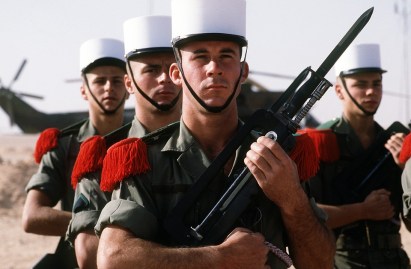
Simon Murray: Legionnaire

I have recently finished reading Simon Murray’s memoir of his life in the French Foreign Legion, which is titled simply Legionnaire: Five Years in the French Foreign Legion.  First published in 1978, it was recently reissued in 2006 as a mass market paperback.

Continue reading

Justinian’s Codification Of The Law

law1

Great men make laws, and greater men interpret them.

If a leader wishes to achieve immortality, let him organize, arrange, and codify a body of law for his people.  Many of the greatest leaders (Numa Pompilia, Lycurgus, Solon, etc.) have been lawgivers.  The monuments of stone have crumbled, but the laws remain.

To codify is to bestow immortality.

Continue reading

The Fall Of Queen Amalasuntha

anxiety1

Here is a good story of palace intrigue and conspiracy.  We turn our attention to late antiquity, to the Ostrogothic kingdom in Italy.

Amalasuntha (c. 495-535) was the daughter of Ostrogothic King Theoderic the Great.  When Theoderic died, his grandson Athalaric nominally became king.  But being a child, the real power lay with his mother Amalasuntha, who ruled as regent.

Continue reading

The Scheming And Ruthless Antonina

In a previous article here we recounted the dramatic fall of one of the Emperor Justinian’s venal officials, John of Cappadocia.  The key roles of this drama were the Empress Theodora and her amoral compatriot Antonina (c. 484-565), the wife of Belisarius.  It is now time to relate yet more adventures of this depraved yet admittedly fascinating figure.  Almost all of what we know about her and her unscrupulous maneuverings comes from the historian Procopius, whose Secret History (Anecdota) is a scorching indictment of Justinian, Theodora, and their court.  He is not an impartial source; and he seems to have been a snubbed official who revenged himself on the court by chronicling their indiscretions for posterity.  Yet there is some truth to his accounts, and his is not a voice that can easily be dismissed.

Continue reading

The Story Of John The Cappadocian: Schemes And Intrigues In The Palace

The Emperor Justinian (A.D. 485-565) and his wife, the Empress Theodora, are well-known sovereigns of the eastern Roman Empire.  The absolute power which centered around the throne at this period in history encouraged palace intrigues of all sorts, and their reign was no exception.  One of the more interesting stories of betrayal and revenge during their rule is that of John the Cappadocian, the Praetorian Prefect of the East.  He was a native of Caesarea in Cappadocia, and was of obscure background.  He came to the attention of the emperor somehow during the scope of his duties as a magister militum (master of soldiers).  By his own schemes he rose up through the ranks to become Praetorian Prefect around A.D. 531.

Continue reading

The Strange Adventures Of Antonio Marques Da Sylva

omens1

Toby Green’s excellent book Inquisition:  The Reign of Fear contains an interesting story that highlights how uncertain and adventurous life could be in ages past.  The story concerns one Antonio Marques da Sylva, a Brazilian man who lived in seventeenth century Bahia.

In 1647 he was married to Maria Figeuira de Abreu.  He had children with her and lived in Bahia for three years.  He then decided to sail to Portugal for business in 1650.  What seemed like a simple decision actually set in motion a bizarre sequence of events.

Continue reading