
Only The Brave Will Find Redemption

There are two things that a man must learn to accept in life:  the inherent ambiguities in choosing between alternatives, and the omnipresence of suffering.  Consider the story told about Socrates in Diogenes Laertius’s Lives of the Philosophers (II.33):  a young man asked the philosopher for his advice on whether he should get married.  The old man told him that there were good arguments both for and against the proposition, and that he would regret whatever decision he made.  “If you do not get married,” he said, “you may be lonely and your bloodline will die out; if you do get married, you may be henpecked, beset by financial strains, and dubious in-laws.  You may also have to tolerate bad children.”

Continue reading

The Wisdom And Recklessness Of Ibn Al-Sikkit

The birthdate of the philologist and grammarian Yacub Ibn Al-Sikkit (ابو يوسف يعقوب ابن السكيت) is not known with certainty, but 800 A.D. is a reliable estimate.  His father enjoyed notoriety and prestige in court circles, and may have conferred on his son some access to the corridors of power.  The sobriquet “Al-Sikkit” was given to him because of his taciturnity, for the Arabic verb sakata (سكت) means “to be silent.”  However, as the reader will soon discover, he was evidently not silent enough.

Continue reading

The Thief Who Stole The Pharaoh’s Money

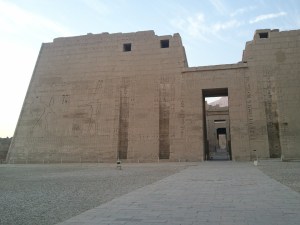
One of Herodotus’s charms is that he is always willing to share a good tale.  Some of these stories he apparently believes; others strike him as dubious.  Either way, he considers them imporant, and dutifully records their details.  “Those who find such things credible,” he warns us, “must make what use of them they will of the stories of the Egyptians.  My own responsibility, however, as it has been throughout my writing of this entire narrative, is simply to record whatever I may be told by my sources [II.123].”

Continue reading

The Positivism Of Benjamin Constant

I made an effort today to visit the house and museum of Benjamin Constant in the Santa Teresa neighborhood in Rio de Janeiro.  I had visited it some years ago and thought it would be a good idea to see it again to gain some perspective.  The site was closed for renovations, unfortunately, so I had to content myself with a few photographs of the surrounding area.  These can be found below.

Continue reading

Selection And Supervision Are Critical In Any Great Enterprise

I have lately been rereading Candace Millard’s excellent River of Doubt, a narrative of Theodore Roosevelt’s ill-fated sojourn through the Amazon in 1914.  As is well known, the expedition was plagued by a lack of adequate food supplies and equipment.   This fact nearly caused the entire project to unravel once it was deep in the Amazon.

Continue reading

The Pitfalls And Vices Of Old Age

We are afflicted by different vices in different periods of life.  While much energy is spent in discussing the pitfalls and failings of youth, it is just as important to be mindful of the pitfalls of old age.  It seems to me that these are especially difficult to correct if not identified for what they are; and just as ivy may slowly encroach on a neighboring plant and choke the life out of it, so may the vices of old age bring what may once have been an admirable life to a miserable conclusion.

Continue reading

The Importance Of Thinking On One’s Feet: A Lucky Escape For Ibn Abi Muslim

We all know that the ability to think on one’s feet is an important skill.  There may even be times when this ability makes the difference between survival and execution.  The amusing anecdote that follows appears in Ibn Khallikan’s biographical sketch (IV.200) of a government official and administrator (مولى) named Yazid Ibn Abi Muslim, who served under an Umayyad governor of Iraq named Al-Hajjaj Ibn Yusuf (c. 661—714 A.D.).

Continue reading

Hercules And The Apple Of Athena

One of the fables of Aesop concerns Hercules and Athena.  One day, Hercules was proceeding along a pathway in the mountains when he spotted an apple lying on the ground.  Irritated at its presence, he decided to smash it with his club; and when he tried to do so, the apple doubled in size.  Shocked, he swung his club at it again, this time determined to crush it completely.

Continue reading

What Are We, After All?

I was recently reading some of Cicero’s letters to Atticus, and came across this sentence in one of them:

Quid enim sumus, aut quid esse possumus?  Domis an foris?

[Epistulae XIII.10]

Continue reading

Camels, Eyes Of Needles, And An Old Proverb

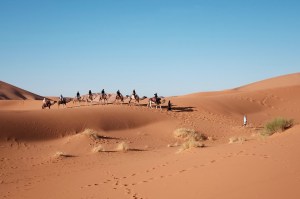
Readers are likely to have heard, in one form or another, the New Testament proverb, “And again I say to you, it is easier for a camel to go through the eye of a needle than for a rich man to enter the kingdom of God” (Matthew 19:24).  The saying is an old one, and probably was in common currency centuries before its alleged utterance by Jesus.  I find proverbs and adages interesting, as they contain not just worldly wisdom, but information about the culture and period in which they were composed.  This point was recently impressed upon me while reading a forgotten bit of nineteenth-century travel literature, the Rev. F.J. Arundell’s 1834 memoir Discoveries in Asia Minor.

Continue reading