Oliver Stone’s memoir Chasing the Light, which I began reading two weeks ago, relates an interesting anecdote. After returning from military service in Vietnam, the future director enrolled in film school at New York University; one of the classes he attended, taught by a professor named Tim Leahy, dealt with classical drama.
I was recently asked in correspondence to provide some thoughts on the pitfalls and obstacles to the study of philosophy. I have to admit that it was something of a relief to get this request, as it offers me a pretext to describe my own ideas on this subject. All of us seek a greater level of understanding of things; but perhaps few of us give much thought to avoiding the obstacles to understanding. A horse and its equestrian rider, however, cannot clear a hurdle until they have had experience in judging its height and length. Here, then, are some of the most commonly encountered pitfalls of the student of philosophy.
Philo of Alexandria wrote a relatively obscure essay entitled On the Prayers And Curses Uttered by Noah When He Became Sober. His translator has fortunately shortened this unwieldy title to the compact De Sobrietate, or On Sobriety. It contains the following passage of importance:
The philosopher Philo of Alexandria relates the following anecdote in his short treatise On the Life of Moses (II.23.178). The prophet Moses, we are told, had appointed his brother to the office of high priest. His decision had been based on his brother’s merits, but there was inevitably some grumbling by people who believed that the appointment was the result of familial favoritism.
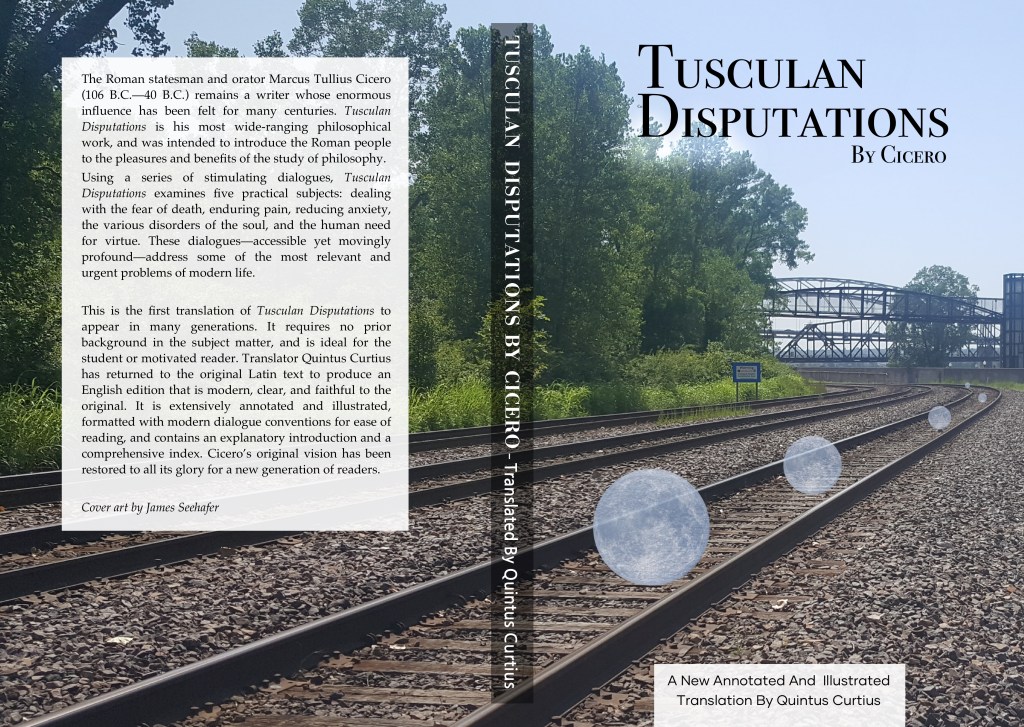
In this podcast I discuss my new translation of Cicero’s Tusculan Disputations. The work deals with five critical problems that face all of us: the fear of death, how to endure pain, how to alleviate mental distress, the various disorders of the mind, and why virtue is important for living a happy life. (A review of the book can be found in the October 2021 issue of The New Criterion). What questions could be more essential and fundamental than these?
After nearly two years of preparation, my annotated, illustrated translation of Cicero’s Tusculan Disputations is now available in hardcover , paperback, Kindle , and audiobook.
In this podcast, we discuss a serious subject. A reader explains that his family has just lost a young child, and he is searching for advice on how to deal with this calamity. I offer some suggestions drawn from Plutarch’s letter of consolation to his wife on the death of his two-year-old daughter Timoxena. We also discuss anecdotes from other sources (e.g., Cicero’s views on grief, the life of P.T. Barnum, etc.), and my own personal experiences. Fiat voluntas tua.
The Ionian philosopher Heraclitus, who flourished around 500 B.C., was even in ancient times known for his obscurity and elusiveness. His well-deserved nickname was “The Obscure,” due to the fact that his elliptical sayings could be variously interpreted. Yet this was no impediment to his influence; his renown was considerable, and his fame rested on the strength of one book, On Nature. Time has not preserved it for us intact, but we do have about a hundred short fragments, and these provides us with the rudiments of his thought.
In one of his letters to his brother Quintus, Marcus Tullius Cicero makes the following observation:
The more virtuous a man is, the less he considers others to be evil. [Letters to Quintus I.4.12]
The idea is the same as that expressed in an old Korean proverb, which I remember from my residence in that country many years ago: “In the eyes of a Buddha, everything is Buddha-like; but to a pig’s eyes, everything appears piggish.” The proverb sounds much more beautiful, of course, in the original Korean; but the point remains valid. A great spirit—a soul imbued with a certain nobility—finds it difficult to comprehend, or accept, venality and baseness displayed by others. Such a man can be trained to recognize and avoid these things, but they will always retain an air of incomprehensibility to him, as if they were fundamentally anathema to his soul. Why is this?










You must be logged in to post a comment.