

Would a captain deliberately wreck his own ship, or turn it over to privateers, in order to collect insurance money? This is one of the central questions surrounding the strange and controversial story of the British merchant ship Nottingham Galley, which was wrecked off the coast of Maine in December of 1710. It is a dark and compelling incident, one which will invite readers to draw their own conclusions as to what actually happened.
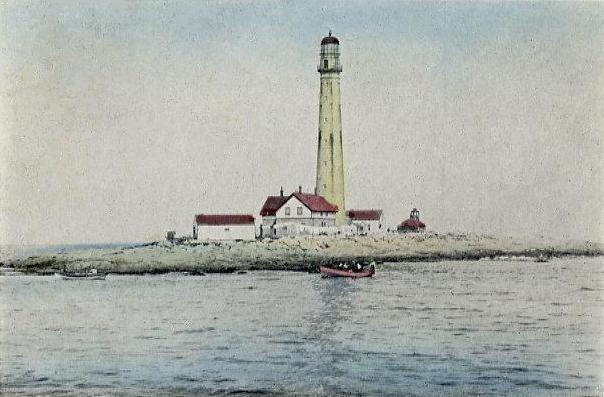
The Nottingham Galley sailed from England in September 1710 after taking aboard dairy products from Ireland. The 120-ton ship was headed for Boston. She was commanded by John Deane, and had a crew of fourteen men, together with the armament of ten small cannon. As the vessel approached the New England coast, sleet storms intensified, blinding and disorienting the crew. The ship was wrecked at Boon Island, a small cluster of rocks located about five miles off the coast of southern Maine. All fourteen men survived the wreck, but their situation was dire. Boon Island was a desolate place that could not support life for an extended period. Southern Maine in 1710 was not heavily populated; even if the survivors could get a fire started, it was uncertain whether anyone would see their signal. Captain Deane, who published a 41-page account of the wreck and its aftermath in 1711, wrote as follows:
Part of the ship’s stores, with some pieces of plank and timber, old sails, canvas, &c., drove on shore, but nothing eatable, excepting some small pieces of cheese which we picked up among the rock-weed, in the whole to the quantity of three small cheeses. We used our utmost endeavours to get fire, having a steel and flint with us, and also by a drill, with a very swift motion; but having nothing except what had been long water-soaked, all our attempts proved ineffectual…After we had been in this situation two or three days, the frost being very severe, and the weather extremely cold, it seized most of our hands and feet to such a degree as to take away the sense of feeling, and render them almost useless; so benumbing and discoloring them as gave us just reason to apprehend mortification. We pulled off our shoes, and cut off our boots; but in getting off our stockings, many whose legs were blistered, pulled off skin and all, and some of the nails of their toes. We then wrapped our legs and feet as warmly as we could in oakum and canvas.
The men were trapped on the tiny island, and exposed to the cruel elements of a New England winter. They had little to no food, and could not even make a fire. One crewman, a cook, died within a few days, and another, a carpenter, died about two weeks after the initial wreck. Two men pieced together a raft and attempted to reach the mainland; but they both perished in the attempt, probably due to hypothermia followed by drowning. A sail was once seen coming out of Maine’s Piscataqua River, but the men could make no adequate distress signal. What was most agonizing to the survivors was that they could, here and there, see wisps of smoke from settlements in the distance, but they had no way to alert anyone for help.
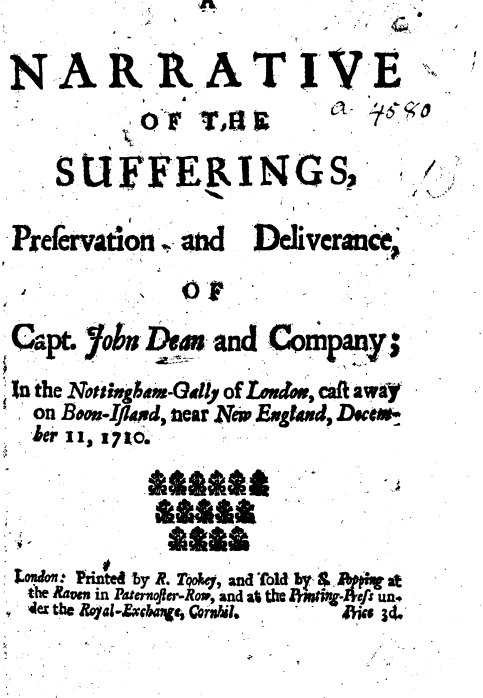
The full horror of survivors’ situation became apparent when, after hovering for many days on the brink of starvation and hypothermia, they finally agreed to cannibalize the dead carpenter’s corpse. Deane’s grisly account tells the tale:
The horrors of such a situation it is impossible to describe; the pinching cold and hunger; extremity of weakness and pain; racking and horrors of conscience in many; and the prospect of a certain painful, and lingering death…We at length determined to satisfy our hunger, and support our feeble bodies with the carcase of our deceased companion. I first ordered his skin, head, hands, feet, and bowels to be buried in the sea and the body to be quartered, for the convenience of drying and carriage, but again received for answer that none of them being able, they entreated I perform that labor for them. This was a hard task; but their incessant prayers and intreaties at last prevailed over my reluctance, and by night I had completed the operation. I cut part of the flesh into thick slices, and washing it in salt water, brought it to the tent and obliged the men to eat rock-weed with it instead of bread. My mate and two others refused to eat any that night, but the next morning they complied and earnestly desired to partake with the rest.
Lacking the ability to make fire, the starving men were obliged to consume the flesh raw. But deliverance would come after twenty-four horrific days on the frozen rocks. Apparently some people on shore had found the washed-up raft and the corpses of the two men who had tried to escape from Boon Island. Someone thought of sending a ship to investigate what might be happening five miles offshore, and in this way Deane and his men were saved.
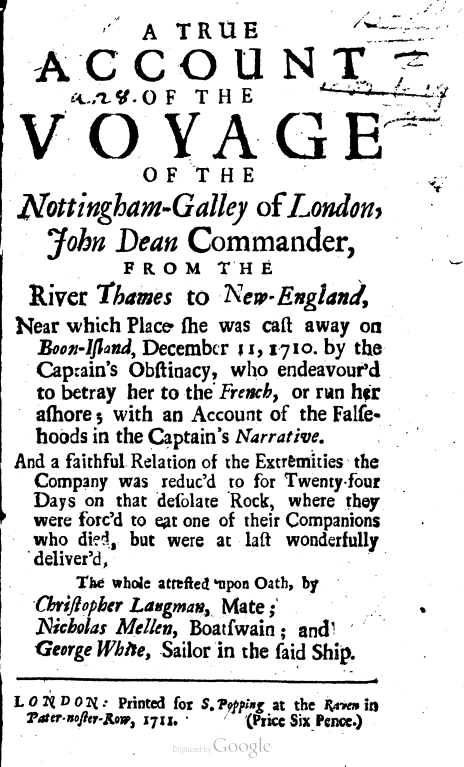
The story of the Nottingham Galley would have been a strange enough episode in New England lore if it had ended there. But it did not. There now ensued a bizarre duel of narratives as to what exactly had happened aboard the ill-fated merchant ship. In 1711, back in London, three of Deane’s crewmen (the mate, Christopher Langman, the boatswain, Nicolas Mellen, and a sailor named George White) affixed their names to their own account of the ordeal. In response, Deane published his own version of the tragedy. The two narratives generally agree on the details of what had happened. Where they depart from each other is in their descriptions of the captain’s conduct.
Deane’s account presents him as a reasonable, level-headed individual who did his best under the most extreme circumstances. The mate Langman, however, paints a very different picture of the captain. According to his account, Deane severely beat several of the crew at the outset of the voyage, permanently alienating them. But Langman does not stop there. He asserts that Deane boasted of having taken out a lucrative insurance policy on the Nottingham Galley, and intended either to wreck the ship for the insurance money, or turn her over to French privateers. The shipwreck of December 11, 1710 was, according to Langman and his associates, a deliberate and malicious act. The controversy surrounding the shipwreck has never been completely resolved. In the absence of additional evidence, we are forced to weigh the respective credibility of these two competing testimonies.
I have read both accounts, and it seems to me that Deane’s is the more plausible. The tone is rational and even-tempered, containing no word of beratement or criticism of his crewmen. It is also difficult to believe that a ship captain would deliberately wreck his own ship when he himself was a passenger. Physical discipline aboard British ships in that era was not unusual; there might have developed severe personal antagonisms between Deane and some of the crew that poisoned their interactions thereafter. We must not overlook the fact that extreme duress can bring out the best, and the worst, in men. Small grievances can escalate into larger ones; and the fraternal bonds of maritime life may, at the moment of truth, be unable to withstand the strain of Nature’s savagery.
On the other hand, Deane’s crewmen may not have been fabricating their account. As we will see, Deane’s later career hints at roguish personality traits that may have gone undetected by his superiors for years.
Captain Deane’s superiors apparently believed he had acted properly. Born in 1679, he enjoyed a long career in both the British and Russian navies. He may have been a captain in the Royal Navy (the evidence is uncertain), possibly participating in the capture of Gibraltar during the War of the Spanish Succession. In 1709 he entered the merchant service. In 1714, he entered the service of the Russian navy, and distinguished himself by his record, at least in the beginning. In 1719, however, he was accused of accepting bribes in return for releasing two captured Swedish vessels. Deane was convicted at a court-martial, expelled from the naval service, and sentenced to a year in a Russian prison.
The tsar later commuted the sentence to a demotion in rank, but ordered the controversial Englishman never to return to Russia. Deane continued to lead a turbulent and colorful life. Nothing seems to have deterred him. He published a history of the Russian Navy in 1721; in 1725, he managed to enter the diplomatic service with an appointment as the British consul in St. Petersburg. In 1728, we find him serving as consul at Ostend, in what is now Belgium. He retired to a comfortable house in England in 1736, after a diplomatic career that was, by all accounts, successful. His life ended on a strange note: he was killed in 1762 at the age of eighty-three during an armed robbery attempt in a field near his house. The perpetrator was hanged.
What are we to make of the Nottingham Galley incident? Was Deane a conniving fraudster who abused his crew, or an unfairly maligned captain who did his best in an impossible situation? Was he a smooth-talking scoundrel who manipulated his way from one profitable career to another? Good arguments can be made one way or the other. As is often the case with such historical events beyond the scope of evidentiary review, each reader will have to weigh all the relevant facts, and arrive at his or her own conclusions.
.
.
Take a look at the new, annotated translation of Cicero’s On The Nature Of The Gods. Now available on Amazon and all major publishers.


You must be logged in to post a comment.