
The following story is found within the pages of an 1840 volume entitled The Book of Shipwrecks and Narratives of Maritime Discoveries and the Most Popular Voyages. The narrator of the tale, as seems to have been the custom in those days when relating first-hand accounts, has omitted some specific details, such as the ship’s name, the dates, and the identities of major protagonists.
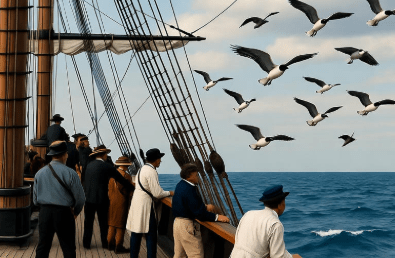
A ship sailing from the United States was, after five weeks at sea, within a hundred and fifty miles of Jamaica’s north shore. Aboard were a number of male and female passengers. The voyage had thus far been uneventful, even tranquil. Soon, however, a strange omen darkened the journey’s future prospects. There is little doubt that the narrator, despite asserting his contempt for the superstitions of sailors, had come to believe that what happened next was a terrible portent. Some of the women aboard took an interest in the seabirds that congregated about the ship, and asked the crew to shoot a few specimens for examination. The birds are identified as “Mother Cary’s chickens,” which is an old nautical term for a seabird now know as the storm petrel. The name is apparently a corruption of Mater Cara, a Latin term for the Virgin Mary.
Eventually a few of the sailors relented, and shot a few of the birds, which dropped into the waves. The ship’s captain was alarmed at the event; his countenance immediately took on an aspect of pronounced anxiety. He refused permission for a crewman to retrieve the birds. “Here is a serious business,” the captain intoned gravely. “Be assured that we have not seen the end of it.” Readers have doubtless heard of the custom prohibiting the killing of the albatross. It seems that this taboo extended to other seabirds as well.
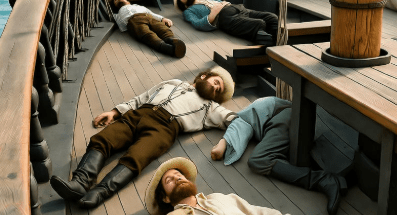
As the ship approached land, it came into contact with a variety of marine life. A large number of fish was caught; these were then turned over to the steward to be prepared for eating. All aboard assembled in the cabin that night for a sumptuous feast. Plans were made for music and dancing on deck that night. But Fate, it turned out, had other plans. The crewmen, who had eaten about an hour and a half before the passengers, began to show signs of poisoning. Several bodies were sprawled out on deck, completely incapacitated. Soon the passengers began to collapse. The captain said, “This is a dreadful business. The fact is—it is my duty to tell you—I fear we are all poisoned by the fish we have ate. One of the crew died a few minutes since, and five others are dangerously ill.” What species of fish may have been the source of the toxin is not known. But within a few hours, several people were dead, and the rest of the crew and passengers had slipped into a coma. Only the narrator remained ambulatory.
Before collapsing, one of the ship’s mates had tried to secure the tiller with ropes, so that the ship might remain on course in the event of the crew’s unconsciousness. The narrator describes the surreal and horrific scene:
On going forward to the bows, I found the crew lying motionless in every direction. They were either insensible of the dangerous situation in which our vessel was, or totally indifferent to it; and all my representations on this head failed to draw forth an intelligible remark from any of them. Our ship carried a great press of canvass, the lower studding sails being set, for we had enjoyed a gentle breeze directly astern, before the wind headed us in the way already mentioned. About an hour after sunset, almost every person on board seemed to have become worse. I alone retained my senses un impaired. The wind now blew very fresh, and we went through the water at the rate of ten knots an hour. The night looked dreary and turbulent. The sky was covered with large fleeces of broken clouds, and the stars flashed angrily through them, as they were wildly hurried along by the blast. The sea began to run high, and the masts showed, by their incessant creaking, that they carried more sail than they could well sustain. I stood alone abaft the binnacle. Nothing could be heard above or below deck, but the dashing of the surges, and the moanings of the wind. All the people on board were to me the same as dead; and I was tossed about, in the vast expanse of waters, without a companion or fellow-sufferer. I knew not what might be my fate, or where I should be carried. The vessel, as it careered along the raging deep, uncontrolled by human hands, seemed under the guidance of a relentless demon, to whose caprices its ill-fated crew had been mysteriously consigned by some superior power.
At about midnight, the fore topmast came crashing down to the deck. At about the same time, the narrator claimed to have seen a gaunt figure sprint across the deck and hurl himself into the ocean. Whether this was a vision generated by delirium, or whether it was a witnessed suicide, our narrator is uncertain. Finally, not knowing what else to do, our narrator crawled below deck and collapsed on his bunk in sleep. When he awakened the next morning, he found that the weather had improved. As he made his way on deck, he noticed the bodies of the dead, including the captain. Four men had perished; but four more had regained consciousness, and appeared to have the ship under control. The survivors prepared the bodies of the fallen for burial at sea. That night, amid prayers and lamentations, they consigned the weighted corpses to the deep. Around midnight, the mate ordered the men to drop the anchor and secure the ship in place.
The next morning, the narrator became aware of some commotion on deck. Investigation into the matter revealed a ghastly sight:
I was roused early next morning by a confused noise upon deck. When I got there, I found the men gazing intently over the side of the ship, and inquired if our anchor held fast.—”Ay, ay,” returned one of them, “rather faster than we want it.” On approaching the bulwarks, and looking down, I perceived, to my horror and astonishment, all the corpses lying at the bottom of the sea, as if they had just been dropped into it. We were now exempted from the ravages and actual presence of death, but his form haunted us without intermission. We hardly dared to look over the ship’s side, lest our eyes should encounter the ghastly features of some one who had formerly been a companion, and at whose funeral rights we had recently assisted. The seamen began to murmur among themselves, saying that we would never be able to leave the spot where we then were, and that our vessel would remain there and rot.
That afternoon, the ship got underway. A strong breeze arose, inspiring hopes among the crew that they would soon be rescued or reach a friendly port. Soon a flock of Mother Cary’s chickens appeared astern, which was taken as a favorable sign by all who saw the birds. When the narrator tells a sailor that he considers the birds an omen, the sailor responds: “They say experience teaches fools, and I have found it so; there was a time when I did not believe that these creatures were any thing but common birds, but now I know another story—Oh I’ve witnessed such strange things!”
The ship soon encountered an American schooner. The traumatized crew finally expected to be delivered from their nightmare, but it was not to be. The schooner’s captain turned out to be a callous, greedy rogue who offered nothing in the way of relief; in fact, he tried to sell the astonished crewmen three slaves. When this offer was rejected, the schooner promptly sailed away. The narrator’s vessel then set a course for New Providence. The ship enjoyed good weather, and was able to reach Exuma Island in two days. Whether the killing of the “Mother Cary’s chickens” at the outset of the voyage triggered Fate’s furious retribution, or whether this idea remains an irrelevant nautical superstition, will be a question for the reader to decide.
.
.
Be sure to take a look at the new, annotated translation of Frontinus’s Stratagems, a classic of military theory.
 Quintus Curtius
You must be logged in to post a comment.