
The word climacteric is not one commonly encountered. The Oxford English Dictionary describes its variegated colors of meaning. A consultation with Volume II of the 1970 edition (covering the letter C) informs us that the word is an adjective “applied to that period of life (usually between the ages of 45 and 60) at which the vital forces begin to decline.”
Yet there is more detail. The word can also represent a “critical stage in human life; a point at which the person was supposed to be specially liable to change in health or fortune. According to some, all the years denoted by multiples of 7 (7, 14, 21, etc.) were climacterics; others admitted only the odd multiples of 7 (7, 21, 35, etc.); some included also the multiples of 9.” Other writers claimed that “the 63rd year of life (63 = 7 x 9)” was a particularly important inflexion point, which they call a grand climacteric. Still others alleged that year 81 (9 x 9) was also a grand climacteric.
Now without the benefit of medical training, I am unable to offer physiological proof of the mathematical regularity of climacterics. Certainly these cycles do exist in one form or another; the trajectory of age, from youth to decrepitude, progresses along a predictable curve, and this cannot be denied. Whether the inflexion points can be identified with precision is another matter. I myself tend to think that seven to nine years is correct enough; we seem to reinvent ourselves, and modify our thinking to some degree, after each such duration of time. Perhaps the body changes the mind, or the mind changes the body: we cannot be certain which one precedes the other. But such changes do occur. This is one of the reasons why it is so difficult for us to cast our minds back decades, and understand what our reasoning and motivations may have been in some distant era. As each climacteric cycle runs its course, a man grows into a new iteration of himself, as an adult butterfly, in its strenuous eclosion, emerges from the chrysalis.
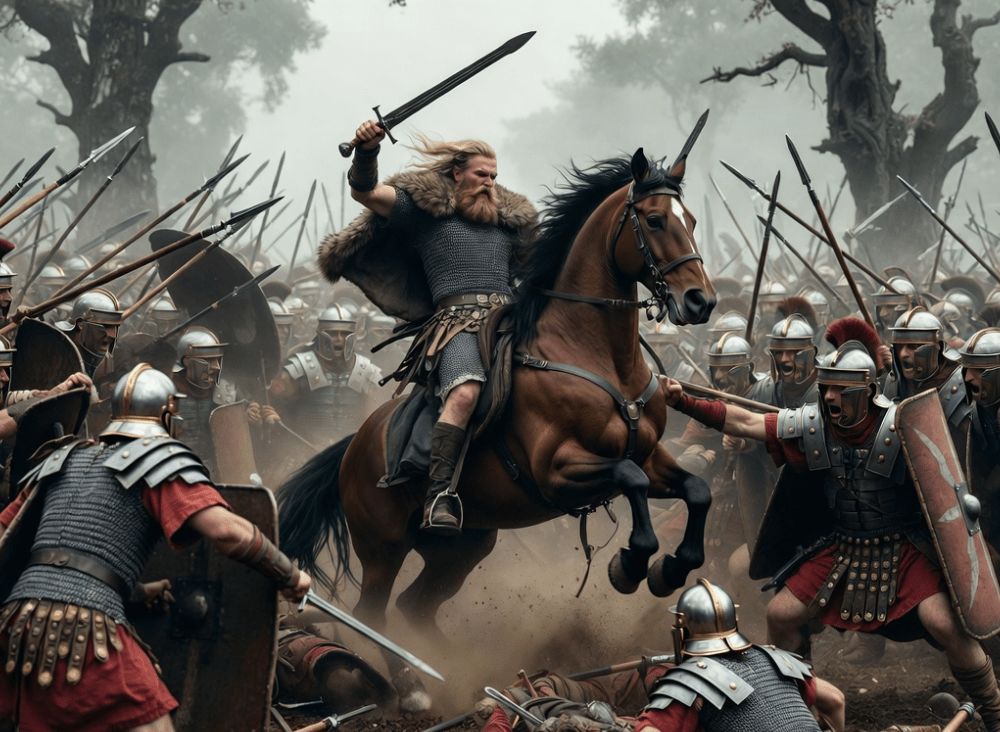
I think it is wrong for us to observe these biological processes with feelings of melancholy. Each climacteric should be greeted and confronted with a spirit of pugnacity and defiance. Age may take its toll, but it cannot dampen our spiritual ardor, or lessen our mental vigor, unless we give our consent. Defy age. Challenge time’s erosions. Sustain the fight with hand, with voice, and despite one’s wounds. Be as Arminius was during the Battle of Idistaviso (also known as Idisiaviso), which took place in Germany in A.D. 16. As the tide of battle turned in favor of Germanicus and his legions, and the Teutonic confederation began to collapse under Roman pressure, Arminius, the German chief, could be seen fighting to the last. Tacitus relates the scene:
[A]mong them was the distinct figure of Arminius who, with his physical exertions, his loud voice, and the wound he had sustained, was doing all he could to continue the fight…Through intense physical exertion and the forward movement of his horse, however, he forced his way through. To hide his identity, he had daubed his face with his own blood.
[Annals II.17]
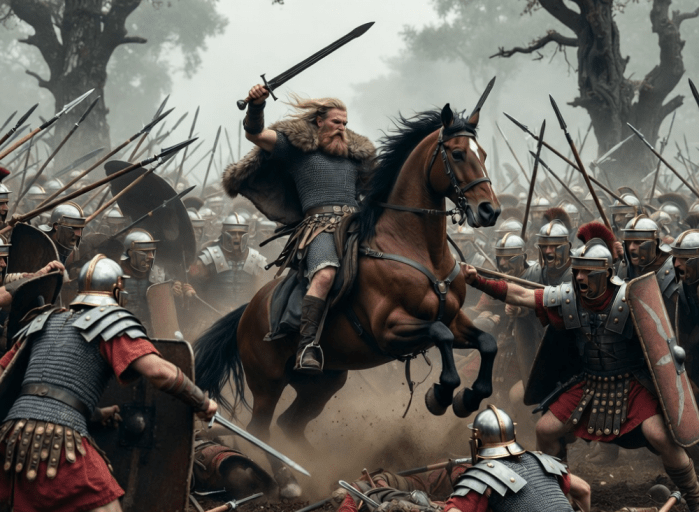
Arminius burst through his restraints and escaped; some authorities, says Tacitus, claim that Rome’s native allies had recognized him and had slyly allowed him to evade capture. Nevertheless, the point remains that he did not acquiesce in his situation; through “intense physical exertion” and the impetus of his horse, he shattered the ring around himself and lived to fight another day. This is the attitude we should adopt with regard to the climacteric cycles: daub our faces with figurative blood, blast through all obstacles, and keep moving, using our own exertion and whatever other impetus may be available to carry us through. Once we have broken through, we must do as much as we can, while we can. The climacterics of the mind or the body have limited effects on him who is animated by a spirit of purpose, and attuned to the dictates of virtue.
Somewhat in this vein, we should recall what Herodotus tells us (IV.7) about the Scythians who guarded their sacred gold with extreme resolution. They visited it once per year, and offered sacrifices to it as part of a festival. If anyone was outside in the open with the gold, and fell asleep, he would not live out the year—and they would grant him as much land as he could circumscribe with his horse on a single day. He would be lord of a large estate, but for a brief period of time. We should be mindful of the frenzied exuberance of the Scythian who made this mad dash; for, with the progressively decaying curve of climacteric life, we have only a transient moment in which to carve out a domain for posterity.
.
.


You must be logged in to post a comment.