
While the power and utility of forensic linguistics is taken for granted today, this was not always the case. The world of scholarship was slow to appreciate the degree to which written language betrays its authorship and pedigree. The “Phalaris Controversy” is a famous, and striking, example of the use of textual analysis in resolving an acrimonious intellectual brick-fight.
In general terms, the controversy was a dispute that pitted Charles Boyle, the Earl of Orrery, against the classical scholar Richard Bentley, the Keeper of the Royal Library and Fellow of the Royal Society. We should first note that during the 1690s, learned circles in England and France vigorously debated the comparative merits of ancient and modern literature. Some believed the works of antiquity were superior to what modern authors produced; some took the opposite position; and some argued that each should be judged on its own merits, and that diamonds and trash proliferate in every age.

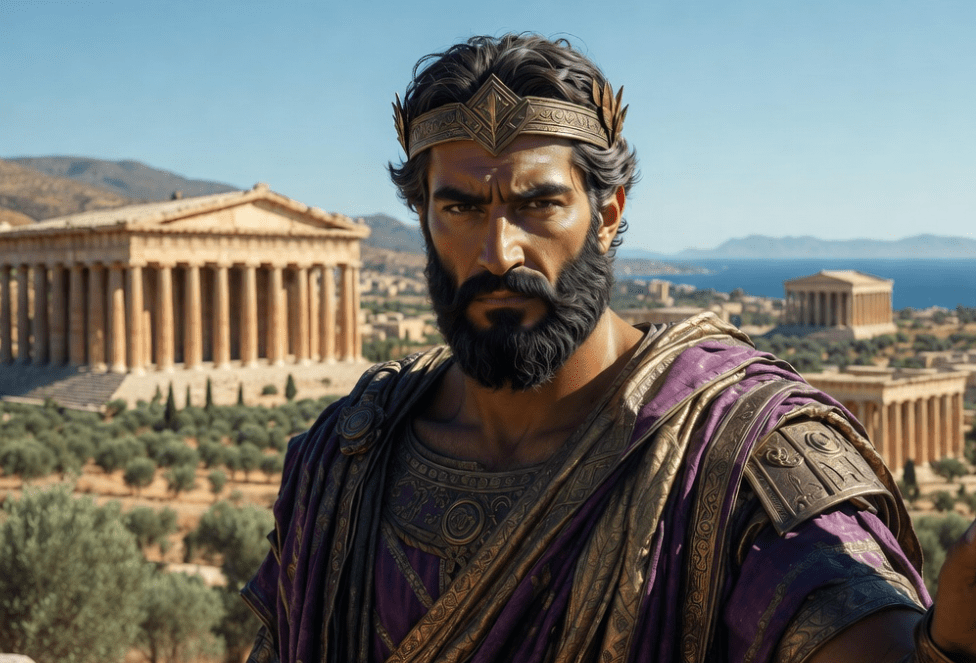
In 1690, Sir William Temple touched off a powder keg with the publication of his Essay Upon Ancient And Modern Learning, in which he argued for the superiority of classical writers. Unfortunately for Temple, he made the mistake of citing as an example a collection of Greek writings known as the Epistles of Phalaris, supposedly composed by the notorious tyrant Phalaris of Akragas in Sicily. Phalaris ruled his city with an iron fist from about 570 to 554 B.C. Readers may be aware that, according to a likely apocryphal tradition, he punished his enemies by roasting them alive in a brazen bull. The dean of Christ Church, Oxford, based on Temple’s recommendation, then decided to publish a new edition of Phalaris’s “letters.” He assigned the task of preparing the text for publication to one Charles Boyle, a student at the college.
In 1697, a clergyman named William Wotton published a second edition of his work on the comparative virtues of ancient and modern literature, and asked Richard Bentley to contribute his thoughts to the volume. Bentley did. His “Dissertation” on the epistles of Phalaris, which was included in Wotton’s book, attacked not only the authenticity of the Phalaris corpus, but also the dubious work of Charles Boyle himself. The fellows of Christ Church, stung by Bentley’s exposition, considered the gauntlet to have been thrown down. They determined to destroy Bentley’s credibility. But in so doing, they set in motion a chain of events that would lead to their own eviceration.
In 1698 a publication bearing the title Dr. Bentley’s Dissertations on the Epistles of Phalaris and the Fables of Aesop, Examined by the Honorable Charles Boyle, Esq. appeared. Although this paper bore Boyle’s name, he seems to have had played little, if any, role in its composition. It was a collaborative effort penned by Francis Atterbury, Boyle’s tutor, and several other Christ Church scholars. This engaging essay was humorous enough, and pungent enough, to attract the favor of a public always hungry for acrimonious drama. Bentley was mocked as an untrustworthy, overbearing pedant who had allowed his ego to cloud his judgment. Even the satirist Jonathan Swift, who was associated with William Temple’s family, took a swipe at Bentley in his Battle of the Books. Although many delighted in Bentley’s supposed comeuppance, they mistook their glee for competence in judging the scholarly merits of the case. For his part, Bentley was not unduly concerned. “Indeed, I am in no pain about the matter,” he told one acquaintance. “For it is a maxim with me that no man was ever written out of reputation but by himself.”
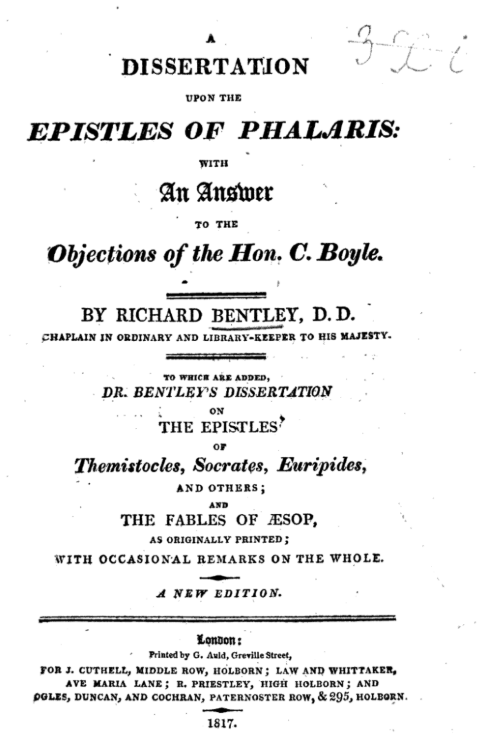
But those who thought they had inscribed Bentley’s epitaph had no idea whom they were dealing with. Atterbury and his colleagues at Christ Church may have scored at his expense, but they had prodded a sleeping tiger, and would soon experience the fruits of their mischief. Bentley’s full response was finally issued in 1699 under the innocuous title Dissertation on the Epistles of Phalaris: With an Answer to the Objections of the Hon. Charles Boyle, Esq. This document was so thorough in its research, so excruciating in its logic, and so unanswerable in its conclusions, that it settled the Phalaris controversy forever. Bentley’s methodical, learned analysis of the Greek text proved that the epistles could not have been written in Phalaris’s lifetime, but must have been the work of an author living many centuries later. The letters were, in short, forgeries.
Not only did Bentley’s work perform a service to classical scholarship, it helped call attention to the process of linguistic evolution as a matter of general principle. In a justly famous passage, Bentley stated:
Even the Attic of the true Phalaris’s age is not there represented, but a more recent idiom and style, that by the whole thread and colour of it betrays itself to be many centuries younger than he. Every living language, like the perspiring bodies of living creatures, is in perpetual motion and alteration; some words go off and become obsolete; others are taken in and by degrees grow into common use; or, the same word is inverted to a new sense and notion, which in tract of time makes as observable a change in the air and features of a language as age makes in the lines and mien of a face. All are sensible of this in their own native tongues, where continual use makes every man a critic. For what Englishman does not think himself able, from the very turn and fashion of the style, to distinguish a fresh English composition from another a hundred years old? Now, there are as real and sensible differences in the several ages of Greek, were there as many that could discern them. But very few are so versed and practised in that language as ever to arrive at that subtilty of taste.
Here, in condensed form, is the premise that has guided so many scholars of textual analysis since Bentley’s era. While it may seem self-evident to us now, it was not so in 1699. Yet it requires a sensitive and practiced eye to capture linguistic nuances, and not everyone is attuned to these frequencies. Turns of phrase, choices of words, the arrangement of sentences and clauses, the sentiments expressed by the writer: all of these things disclose authorship and era. The best scholars had understood this at least since Lorenzo Valla demonstrated the Donation of Constantine to be a forgery in 1440.
Yet outside scholarly circles, the idea of forensic linguistics never really gained the traction it should have. Even as late as the 1990s, the idea was controversial, if not ridiculed, until it proved instrumental in the capture and conviction of the Unabomber Theodore Kaczynski. Until Kaczynski was arrested in 1996, no criminal search warrant had ever been issued on the basis of linguistic analysis. By demonstrating the need for painstaking rigor and methodical reasoning in the interpretation of literary documents, the Phalaris Affair remains an important episode not only in the evolution of classical scholarship, but in the advancement of learning in general.
.
.
.
Be sure to take a look at the new, annotated translation of Cicero’s Tusculan Disputations, the first full and complete translation to appear in generations.


You must be logged in to post a comment.