

You can find a complete listing of all the articles on this site here. They are listed in reverse chronological order, and are all clickable links. Twenty-five articles are displayed per page, with the publication date included. To find older articles, click on the page numbers at the bottom.
To search the site by subject, topic, or name, you can use the “Search” function on the right sidebar.
_______________________________
-
The Top Ten Articles Of 2022
Year’s end is a time of reflection. We survey the landscape, and evaluate the passage of time. The ten most popular articles of 2022 are listed below. Some of them are surprises; others, less so. If you have not had a chance to check these pieces out, now might be a good time. The list…
-
You Can’t Stampede People (Podcast)
A young woman from a conservative culture asks a relationship question. She is very fond of her boyfriend, an American man. She wants to move things in the direction of marriage, but the young man is ambivalent. He keeps putting her off. She wants to know what she can do to deal with the situation.
-
The Serpent Of Pindus
The following tale is related by Aelian in his treatise On Animals (X.48). In very ancient times the region of Emathia in northern Greece had a king name named Lycaon. This king’s son was named Macedon; and it is from this name that the word for the country called Macedonia has come about.
-
The Tolerant Wisdom Of Ibn Al Jawzi
We turn now to the wisdom of those who are able to extricate themselves from the ensnaring brambles of theological thickets. The scholar and theologian Abd Al Rahman Ibn Al Jawzi, or more commonly Ibn Al Jawzi (ابن الجوزي), was born in Baghdad around 1115, and died there in 1201.
-
The Re-Examiner
The rhetorician Libanius, who lived from about A.D. 314 to 392, wrote a letter of consolation to the emperor Julian after the city of Nicomedia was devastated by an earthquake in A.D. 358. The letter contains the following sentence:
-
The Opossum (Podcast)
A reader asks a question about the 1982 movie First Blood. Why, he asks, was Sheriff Teasle so hostile to John Rambo? What could have been his reasons? We offer some explanation. We then move into another related subject: an opossum in my backyard, and how I dealt with it.
-
The Resolution Of Mevius
We find a stirring anecdote in the history of Valerius Maximus that does not appear in any other ancient source. There was once a centurion named Mevius who fought for Octavian (who would eventually become Caesar Augustus) during the civil war between him and Antony. Of Mevius we know very little; even his full name…
-
Not Seeing What Is In Front Of Our Eyes
Gavan Daws, in his Prisoners of the Japanese, recounts many harrowing stories of suffering and survival in the Asian prison camps of the Second World War. I recall one anecdote.
-
Do Not Tamper With What Belongs To The Gods
Homer tells us: “He shall have dread hereafter when some god shall come against him in battle; for hard are the gods to look upon when they appear in manifest presence.” (Iliad XX.130—131).
-
Dire Circumstances Arouse Latent Powers
The advent of extreme circumstances either activates the latent abilities of the brave man, or smothers the spirit of the timid soul. Of the many historical examples that verify this, we will discuss one that is unlikely to be familiar to most readers.
-
The Testimony Of Language
The words and syntax of a speaker are as revelatory of identity as a fingerprint, a ballistics test, and a DNA sample are to a criminologist. The critical inquiries of the scholar, or the practiced eye of the native speaker, will as readily deduce the origin of a written text from an examination of its…
-
Michael Bonner’s “Defense Of Civilization”: Review And Commentary
It is an unhappy commentary on the state of societal affairs when a scholar is compelled to remind readers of civilization’s benefits. Have things become so bad that we need to lay out arguments in favor of order, discipline, and our cultural patrimony? Is what was believed to be self-evident for centuries, now not self-evident…
-
Revisitations (Podcast)
We should periodically “revisit” things that once meant something to us years earlier. Every 7 to 10 years or so, we grow significantly in outlook, perspective, and attitude. Things that once meant something to us, may mean something very different to us years later. This holds true of books, movies, individuals, and many other things.…
-
The Four Pillars Of Self-Confidence
So much has been written on the subject of self-confidence that a few more observations are unlikely to draw an objection. It seems to me that self-confidence rests on four pillars: (1) one must accurately and honestly assess one’s value; (2) self-confidence should never veer into the territory of arrogance or insolence; (3) self-confidence must…
-
You Declare Yourself (Podcast)
Some guys think that they need to wait for some magical confluence of circumstances to exist before they can pursue their goals. The world doesn’t work like this. Sometimes you have to announce yourself, declare your purpose openly, and let your will shape the environment to your own purposes. You have to declare yourself. You’re…
-
Gold Mountain
The outline of the story that follows appeared in Edward R. Snow’s volume The Fury of the Seas, which was published in 1964. Snow relates that he first became aware of its details in 1934. His book is now long out of print, so it will be a pleasure for us to retell it here.
-
The Stirrings Of Conscience
The etymologists tell us that the word conscience is derived from the Latin conscire, meaning to know well, or to have an intimate knowledge of something. This verb could be used in two contexts: conscire alii (to know something along with someone else), and conscire sibi (to know something with oneself only). Time and modern…
-
Not As Bad As You Think, But Different From What You Think (Podcast)
Our minds often play tricks on us. We come to believe things are much worse than they really are. Once we get through what we’re worried about, we realize that things were not as bad as we thought–and we also realize that things ended in a way that was different from what we expected.
-
A Consolation Inspired By Cicero: “How To Grieve”
For several years now, Michael Fontaine has dedicated himself to discovering and reanimating the buried treasures of late Latin literature. This is a mark of the true humanist: the ability to sift, patiently and deliberately, through the silt of literary time, and locate those true gems that have been consigned to undeserved neglect. In 2020…
-
Roosevelt In Cuba
Theodore Roosevelt was going to Cuba when war with Spain broke out, and no power on earth was going to stop him. As Assistant Secretary of the Navy, he had fought, schemed, and maneuvered to get an officer’s commission, and he had prevailed.
-
Ibn Gabirol Discusses The Virtues
If we accept the premise that personal sufferings and misfortunes provide excellent grist for philosophy’s mill, then we must concede that Solomon Ibn Gabirol was provided with incomparable ingredients for speculative thought. He was born to a prosperous family in Malaga, Spain around 1022. Yet life wasted no time in dealing him cruel cards; his…
-
Secluded Bodies, Wandering Tongues
An edifying and unintentionally humorous story emerges from a letter written by St. Jerome in A.D. 405. It is epistle 117, which was addressed to a quarreling mother and daughter residing in Gaul (Ad matrem et filiam in Gallia commorantes).
-
Pythagoras: An Introduction To His Life, School, And Ideas
Only one name in European history unites the realms of religion, mathematics, and philosophy, and that name is Pythagoras. Yet it is this very achievement that so torments posterity when assessing his legacy. Centuries of speculative accretions, hagiographic mythologizing, and the dubious testimonia of ancient authors have so obscured his original doctrines that the exasperated…
-
The Unrelenting Fires Of Heraclitus
It was in Ionia that the Greek-speaking world of the sixth century B.C. jostled with the ancient kingdoms of Asia’s westernmost region. Phrygia, Lydia, Caria, and the other principalities of Asia Minor were Greece’s portal to the Asiatic interior. The empire of Persia, herself irrigated to fertility by various Asiatic streams, retained a power and…
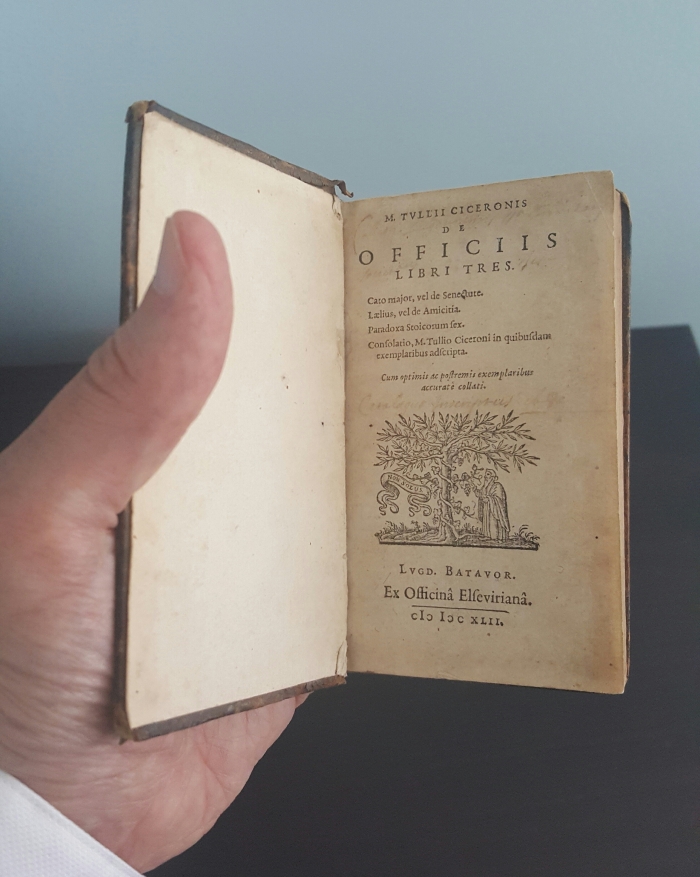
Original copy of Cicero’s De Officiis (On Duties) published in Holland in 1642. From the collection of Fortress of the Mind.
 Quintus Curtius
You must be logged in to post a comment.