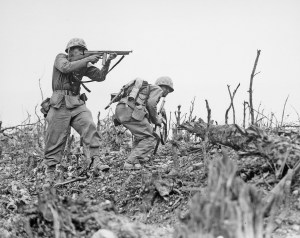
One of the more remarkable military men of recent history was Samuel B. Griffith (1906-1983). Born in Lewiston, Pennsylvania, he graduated from the U.S. Naval Academy in 1929 and was commissioned a second lieutenant in the U.S. Marine Corps. From 1931 to 1933, he served in Nicaragua with the American forces aiding that country’s Guardia Nacional, in what later became somewhat derisively referred to as the “Banana Wars.”
After this, he was posted to China. It is not widely known now, but units of the Fourth Marines were posted in Shanghai in the early 1930s to protect American interests. China at the time was experiencing one of its periodic descents into chaos and war, and duty there was not without its share of excitement. Duties there consisted primarily of policing the borders of the international concessions that had been carved out by various foreign powers.
Griffith, however, was assigned at the language officer at the American Embassy in Peking. From the moment he arrived in China, he devoted himself to the study of the Chinese language. According to his statements in later interviews, he spent six hours per day, five days per week, in intensive study of this most challenging and subtle language. Within two years he was able to read a basic newspaper article. After leaving China in 1938, he was confident that he had gained a working knowledge of modern Chinese. This knowledge would serve him well in his later career.
Griffith also took the opportunity to study the nature of the irregular conflict that was raging all around him. China and Japan were openly at war; and although the Americans were strictly forbidden from intervening, it was impossible for an observant mind not to be impressed by the tactics of the Chinese insurgents. Japan had occupied Manchuria in 1931 before launching an all-out invasion of the rest of the country in 1937. Griffith traveled widely in China, and came to know personally Merrit A. Edson, a language student like himself who would later become famous as leader of a “raider” unit against the Japanese during the Second World War.
The Second World War closed in on him quickly. After hostilities between Japan and the United States began, Griffith served with the 1st Marine Raiders Battalion (rising to the command of that unit) on Guadalcanal. He was awarded the Navy Cross and the Purple Heart on Guadalcanal for his part in the fighting at Matanikau River; later, at the island of New Georgia, he was decorated with the Distinguished Service Cross. The Navy Cross is the second-highest award for combat bravery that can be issued by the Navy; the Distinguished Service Cross is its equivalent for the US Army. Without doubt, Griffith was intimately acquainted with combat in a variety of settings.
With the end of the war in 1945, he returned to occupation duty in Northern China in the city of Tsingtao. The remainder of his career was spent in the United States in a variety of staff and command appointments. He retired from active duty in 1956 as a brigadier general.
It was at this point in his life that Griffith proved he was no ordinary military man. Whereas most veterans would have been content to rest on their laurels and seek a comfortable retirement in some government post, Griffith felt the call of other disciplines. So he exchanged the tunic of the soldier for the robe of the scholar. He applied for, and was accepted to, a Ph.D. program at Oxford University in the Chinese language.
This was not the colloquial, modern Chinese that Griffith had been exposed to previously: this was the classical language of ancient China, as different from modern Chinese as the language of Euripides would be to a modern resident of Athens.
Nevertheless, his proficiency in the modern language did give him a huge advantage over other students. He received his doctorate in 1961, and soon after published translations of two military texts that had interested him for some time. One was Sun Tzu’s Art of War; and the other was Mao Tse-tung’s On Guerrilla Warfare.
In the modern era, Sun Tzu has become a familiar fixture of contemporary literature, to the point of almost being a cliché. This was not the case in the early 1960s. Sun Tzu was almost completely unknown outside of specialist circles. The text had been translated into English only a few times previously, none of them satisfactorily; and Griffith’s version remains, in my mind at least, the most authoritative and readable version of the many that have emerged in recent decades. The translation was begun, he tells us in the foreword to his book, a “considerably revised version of a thesis submitted to Oxford University in October 1960 in part satisfaction of the requirements for the [Ph.D.] degree.”
The translation of Mao’s work On Guerrilla Warfare had actually been done in the 1930s, when Griffith had been in China. It had appeared in an issue of the Marine Corps Gazette in 1941. Griffith revised this previous translation before issuing it as a separate volume in 1961.
Griffith thus proved himself to be a man acquainted with both the theory and brutal practice of warfare. Besides the two works noted above, he has also published later in his life such notable accounts as The Battle For Guadalcanal and The Chinese People’s Liberation Army.
My own acquaintance with Griffith came as a Marine second lieutenant at The Basic School in 1991, where his translation of Sun Tzu was required reading for young officers. After reading about Griffith’s background, I was impressed by how his career blended both the profession of arms and the labor of the scholar. There were no other military men like him, and I wondered why he was not more widely known.
His translation of Sun Tzu is packed with the most recondite and detailed information about ancient Chinese warfare and linguistic subtleties. There are also special sections on the influence of Sun Tzu on Mao Tze-tung and on Japanese military doctrines. Regarding the latter topic, he makes this grim (and accurate) assessment of his former adversaries:
Both the Americans and their British allies learned important lessons from [their] early defeats and developed successful methods of combating Japanese tactics…During these operations the Japanese showed themselves to be obstinate fighters, but unable to cope with the unorthodox methods their opponents now used against them. Thus it appears that in spite of devoted study the Japanese understanding of Sun Tzu was not better than superficial. In the most profound sense, they knew neither their enemies nor themselves; their calculations in the councils had not been made objectively.
Griffith died in 1983 in Rhode Island. It is unfortunate that he has not achieved the notoriety that he deserves. He knew warfare not through books, but through actual experience in the field. He knew the Chinese language intimately, in both the colloquial patois of its bustling cities, as well as in its rarefied classical form. Few, if any, military men in modern history attaining the rank of brigadier general can claim the same level of combat experience and scholarly distinction.
Read More: Robert Burns: Scotland’s Greatest Poet



 . Kendall’s book is a biography of Peter Mark Roget, the British scholar-magus who created the classic reference work Roget’s Thesaurus. Here again it is proved that often the most inspiring stories can lie hidden in the most unlikely places. I knew absolutely nothing about Roget before hearing this book, but was taught a lesson in how misfortune can be turned to our advantage, if the right approaches are taken. It is a theme I’ve written about often, and one that continues to hold my fascination.
 Quintus Curtius
You must be logged in to post a comment.