

Do Not Buy At Such A Price, Only To Regret It

What may at first consideration be an enticing course of action, may take on a much more negative hue after further scrutiny.  This was the point of an anecdote related by the Roman writer Aulus Gellius in his Attic Nights (I.8).  Although the story is essentially a humorous one, the idea it conveys is one that carries the utmost seriousness with regard to the fates of men and nations.

Continue reading
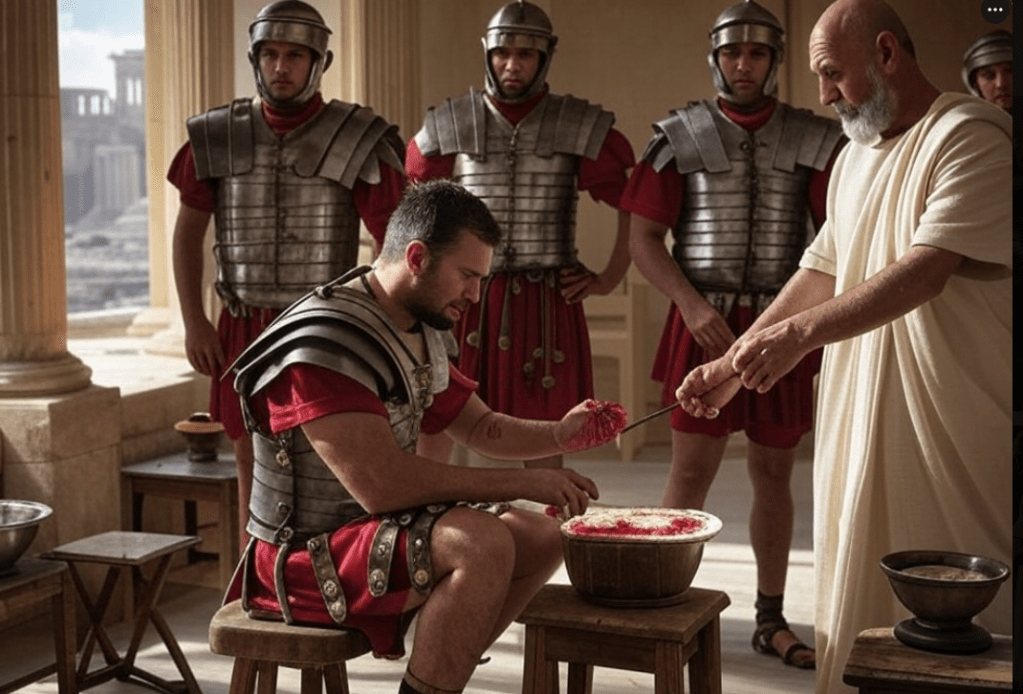

Purgation

The Roman writer Aulus Gellius (X.8) relates an interesting anecdote about his country’s military punishments in olden times.  He says that if a soldier committed some offense, he would be “bled”:  that is, he would be subjected to a ritualistic opening of a vein and be forced to lose some blood.

Continue reading

On Why A Slovenly Appearance Is A Form Of Muted Hostility

The Roman writer Aulus Gellius, in his Attic Nights (XIII.22), records the following anecdote.  Gellius was once conversing with his teacher, one Titus Castricius, whom he describes in glowing terms as “a man of the greatest prestige and dignity.” 

Continue reading

Preserving Something For Time To Make Better

Before I explore the main subject of this essay, I wanted to relate a tale about Alexander the Great’s leadership acumen.  The historian Arrian relates an event that he believes best distills Alexander’s genius for command.  It can be found in VI.26 of his History of Alexander.  When Alexander and his army were passing through the Gedrosian desert (a part of what is now Baluchistan), they ran low on water and began to be tormented by extreme thirst.  Water was almost nowhere to be found, and it would be some time before they could reach a reliable aquifer.

Continue reading

Between Mouth And Morsel

The Roman writer Aulus Gellius relates an anecdote about his discovery of the meaning of an old proverb.  He tells us that he read the following line in one of the speeches of Marcus Cato Censorius:

Continue reading

Talent Applied Consistently Is Never Wasted

The following parable is found in Aulus Gellius (XVI.19), who himself takes it from Herodotus (I.23).  It reminds us that effort and talent, if applied consistently, will eventually reap rewards.

Continue reading