
I had the privilege of doing a recent interview with Ms. Anya Leonard of Classical Wisdom, a publication that focuses on classical learning and education. The interview can be seen here:
Continue readingI had the privilege of doing a recent interview with Ms. Anya Leonard of Classical Wisdom, a publication that focuses on classical learning and education. The interview can be seen here:
Continue reading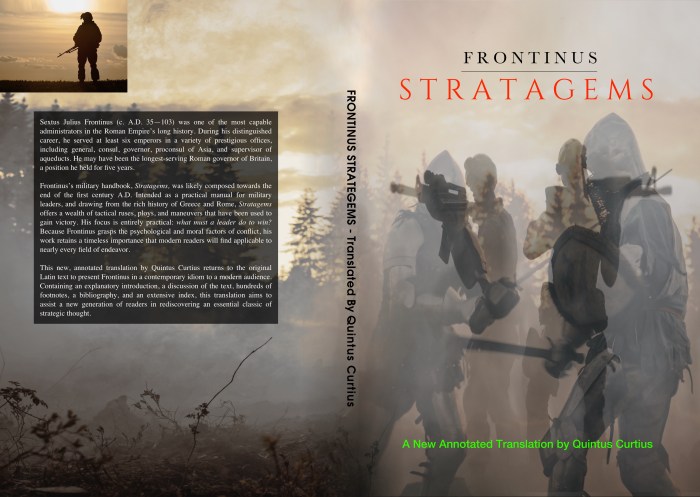
Fortress of the Mind Publications is pleased to announce that the audiobook of the new translation of Frontinus’s Stratagems is now available. The link to Amazon Audible can be found here. The book is read by narrator Saethon Williams, whose expert audio renditions have featured in Quintus Curtius’s other translations. Besides Amazon Audible, the audiobook can be found at a number of retailers, library platforms, and streaming services:
Continue reading
I once heard someone pose the question, “Why didn’t the Greeks or Romans produce a military theorist like Sun Tzu?” The answer to this question is that they did, in fact, produce a theorist just as profound—arguably more profound—than the great Chinese sage. The problem is that you’ve never heard of him. His name is Frontinus. He lived from about A.D. 31 to about 104. Here I intend to explain who he was, what is found in his book Stratagems, and why his work is so important.
Continue reading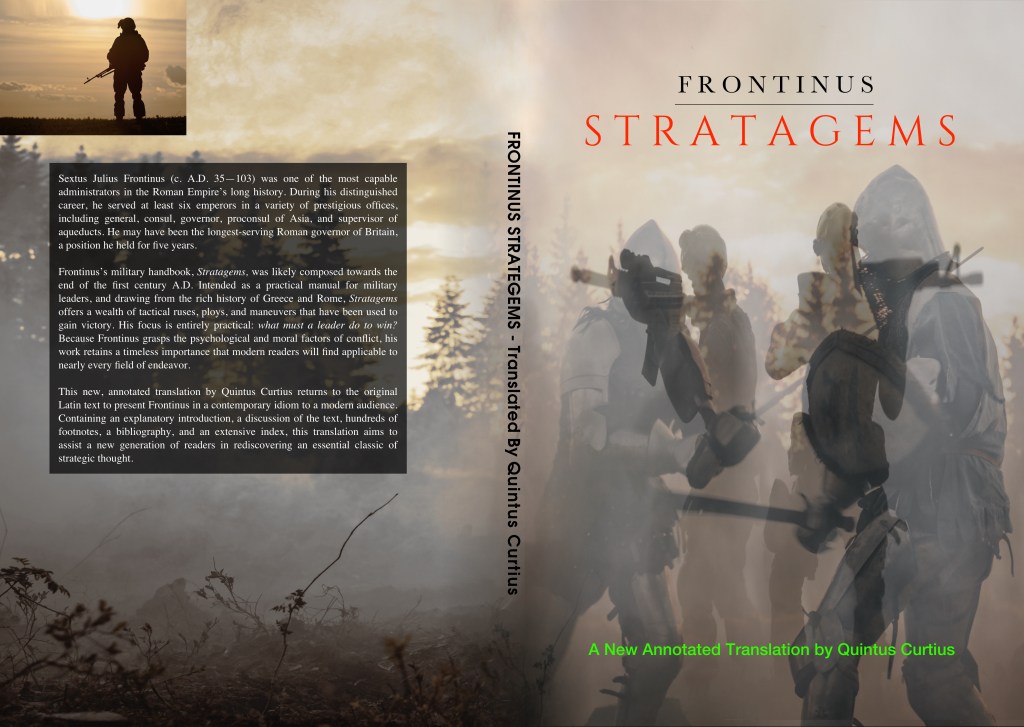
Fortress of the Mind Publications is very pleased to announce that Quintus Curtius’s new annotated translation of Frontinus’s Stratagems has been released. It is currently available in paperback and Kindle editions. The hardcover edition will be available very shortly, and the audiobook edition is expected in early November.
Continue reading
In the 1998 film Fallen, one of the characters intones an ominous motto: “What goes around, really goes around.” This is a more emphatic version of the old adage, “What comes around, goes around.” In both cases the meaning is the same: he who spreads iniquity and evil, will eventually be himself visited by iniquities and evils of even greater magnitude.
Continue reading
It is tempting to believe that our current social problems are uniquely modern, and that they have no analogues to conditions of previous ages. A review of the thoughtful writings of the past shows that this belief is far from the truth. Consider, for example, this comment from the Latin dialogue Antonius, which was composed by the humanist Giovanni Pontano around 1487 and first printed in 1491:
Continue reading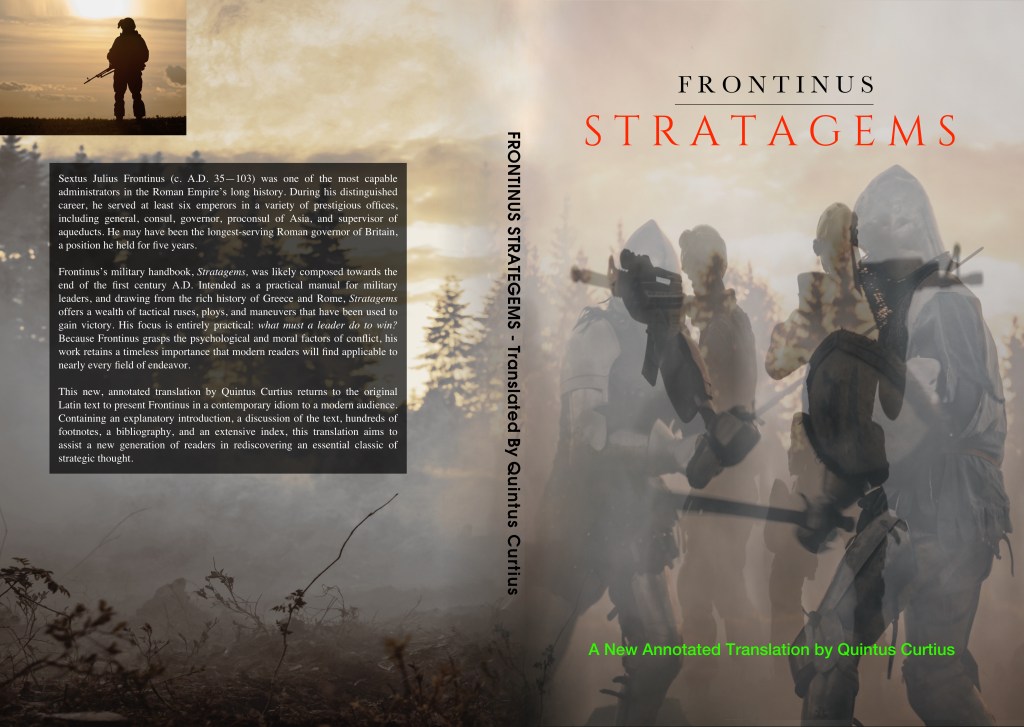
I expect to publish a new, annotated translation of the Roman military classic Stratagems. It will contain a detailed explanatory introduction, hundreds of footnotes, a commentary on the text, a bibliography, and an extensive index.
Continue reading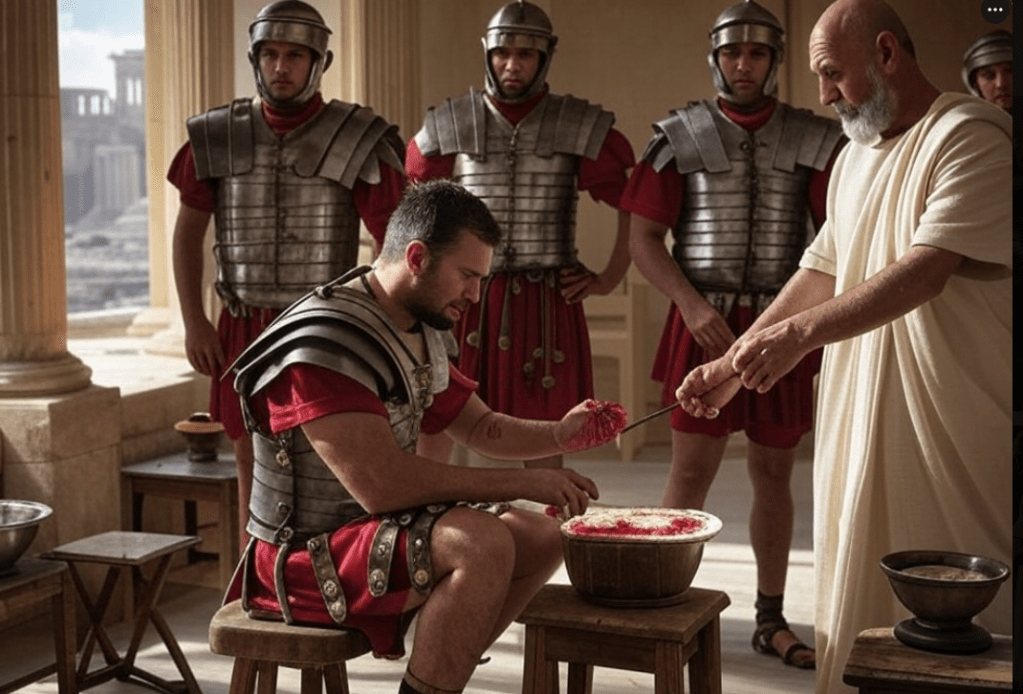
The Roman writer Aulus Gellius (X.8) relates an interesting anecdote about his country’s military punishments in olden times. He says that if a soldier committed some offense, he would be “bled”: that is, he would be subjected to a ritualistic opening of a vein and be forced to lose some blood.
Continue reading
There is a humorous scene in the 1969 film Butch Cassidy and the Sundance Kid that you may be familiar with. Paul Newman’s character (Butch), when confronted by a rebellious member of his gang who wishes to displace him as leader, is challenged to a knife fight.
Continue reading
In a letter to Holy Roman Emperor Charles IV in 1361, the scholar Petrarch included the following lines of advice:
Continue reading Quintus Curtius
You must be logged in to post a comment.