
I had the privilege of doing a recent interview with Ms. Anya Leonard of Classical Wisdom, a publication that focuses on classical learning and education. The interview can be seen here:
Continue readingI had the privilege of doing a recent interview with Ms. Anya Leonard of Classical Wisdom, a publication that focuses on classical learning and education. The interview can be seen here:
Continue readingA literary review of the new translation of Stratagems appeared on the Classical Wisdom substack on October 6, 2025. The review is entitled Rome’s Lost Art of War.
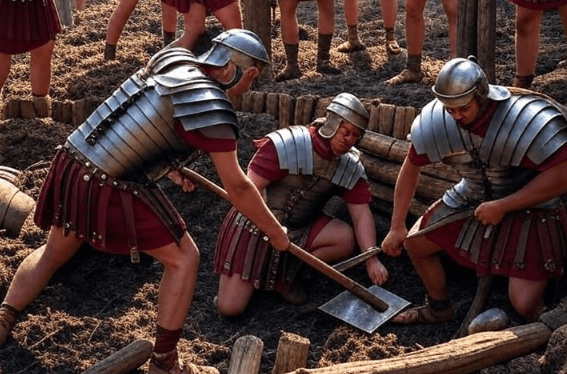
I once heard someone pose the question, “Why didn’t the Greeks or Romans produce a military theorist like Sun Tzu?” The answer to this question is that they did, in fact, produce a theorist just as profound—arguably more profound—than the great Chinese sage. The problem is that you’ve never heard of him. His name is Frontinus. He lived from about A.D. 31 to about 104. Here I intend to explain who he was, what is found in his book Stratagems, and why his work is so important.
Continue reading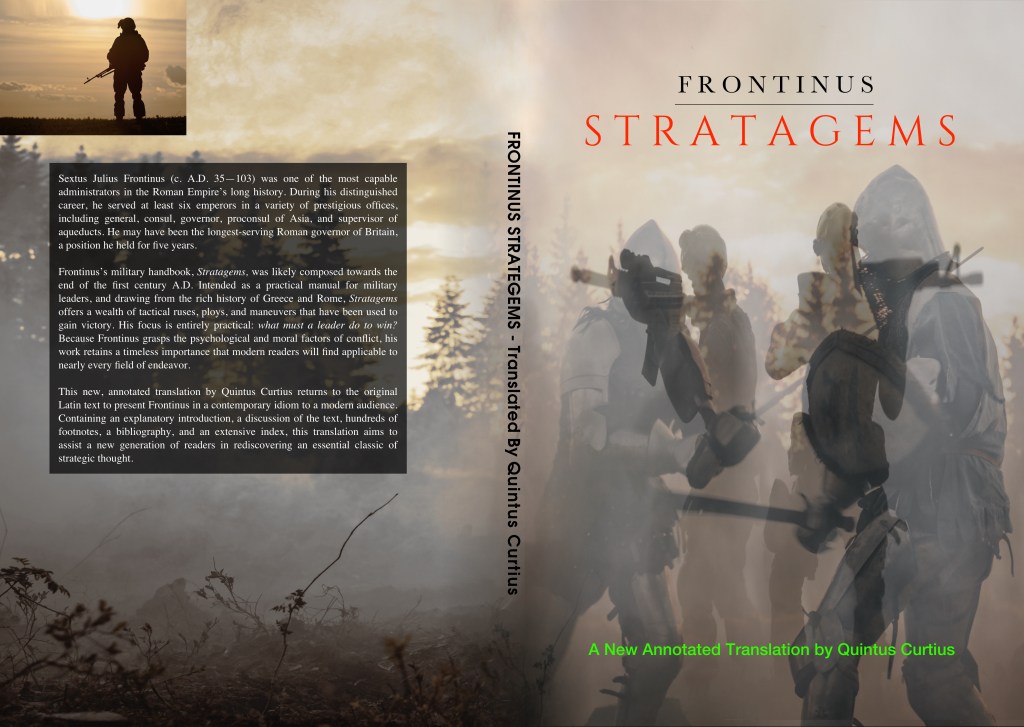
Fortress of the Mind Publications is very pleased to announce that Quintus Curtius’s new annotated translation of Frontinus’s Stratagems has been released. It is currently available in paperback and Kindle editions. The hardcover edition will be available very shortly, and the audiobook edition is expected in early November.
Continue reading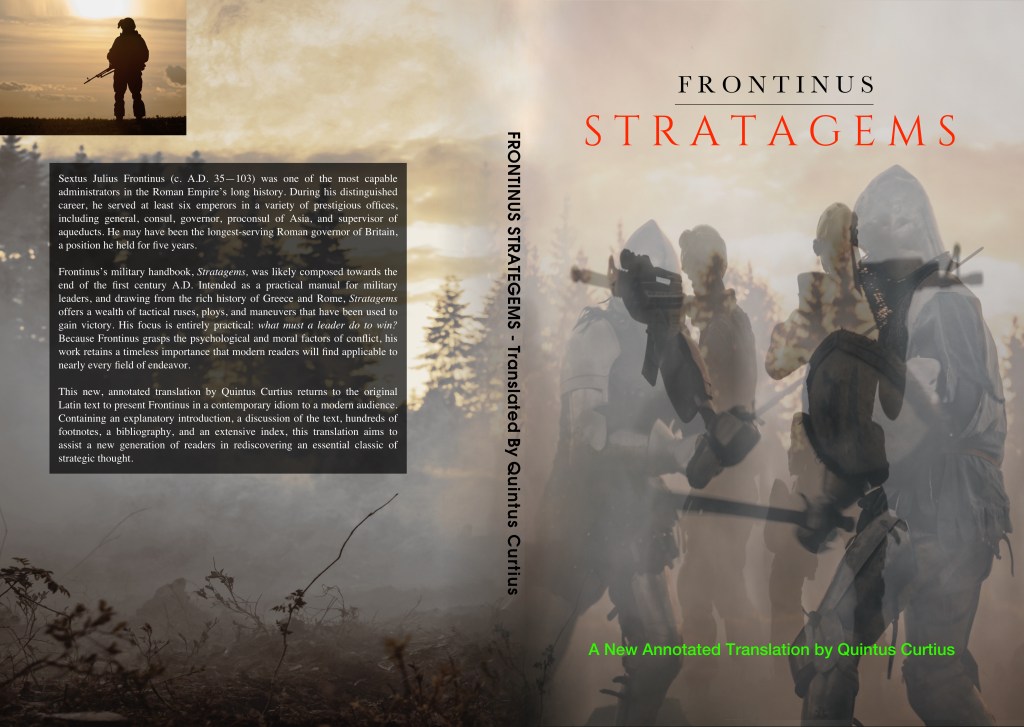
I expect to publish a new, annotated translation of the Roman military classic Stratagems. It will contain a detailed explanatory introduction, hundreds of footnotes, a commentary on the text, a bibliography, and an extensive index.
Continue reading
There is a humorous scene in the 1969 film Butch Cassidy and the Sundance Kid that you may be familiar with. Paul Newman’s character (Butch), when confronted by a rebellious member of his gang who wishes to displace him as leader, is challenged to a knife fight.
Continue reading
Wisdom is neither easily found, nor painlessly acquired. If we seek it out, it is likely to present itself to the prospector in a way that conceals its true utility. In the same way that precious metals and gems are distributed unevenly and clandestinely among geologic sediments, so is wisdom often submerged in quantities of intervening irrelevancies, or cloaked in a sheen of protective coloration. For wisdom—prudentia—knows that only the truly worthy will bring to bear pickaxe, shovel, and grindstone to extract, refine, and polish her secret ores for all the world to see.
Continue reading
Betrayal, treachery, and treason are among the most hated of crimes. From antiquity until our own time, commanders have devised numerous ways to prevent or limit them. Some examples are presented here. The reader will discover that all of them involve either incentives or punishments; sometimes a mixture of the two is employed. The Roman commander Frontinus, in his Stratagems (III.16), provides us with several examples.

The historian Sextus Julius Frontinus (c. 40-103 A.D.) wrote an interesting book called Stratagems (Strategamaton) which provides historical examples of various military ruses. It is actually a vast digest of historical examples that was meant to serve as a commander’s handbook of military advice. One of the chapters I was reading recently I wanted to share with readers here. It is called “How An Army Should Be Aroused To Battle (Quemadmodum incitandus sit ad proelium exercitus).
Frontinus gives us a series of examples on this topic. He teaches by way of illustration, not by explanation. The reader is expected to draw his own conclusions on the wider principles involved. Here are his examples (taken from I.11 et seq.) of how armies and men can be inspired to do battle.
1. Fulvius Nobilior was fighting against the Samnites with a small force. He was losing. So he pretended that one legion of his enemy had been bribed by him to turn traitor, even though this was not true. Fulvius had his men set aside a large sum of money in furtherance of this assertion. He promised his men that when victory had been achieved, he would amply reward those who had contributed gold and silver for the alleged “payoff.” Fired by this promise, the Romans attacked with ferocity and won a great victory. Sometimes it is necessary to deceive even your own men.
2. Caesar was fighting against the Germans and their king, Ariovistus. He called his men together and told them that he was especially selecting one of his units–the Tenth Legion–to attack the enemy alone. He praised the unique qualities and heroism of unit to his other units. By doing this, he inspired in the other units a healthy feeling of competition and envy. In this way, he raised the fighting morale of all his units.
3. Agesilaus, a Spartan general, had pitched his camp near the city of Orchomenos. He learned that many of his soldiers were storing their possessions within the safety of the town. So he told the townspeople not to accept any of his soldiers’ belongings. He reasoned that his men would fight better knowing that they were fighting for their worldly goods, and that there was no safe place for such things except through combat.
4. Epaminondas once lied to his men about the intentions of the Spartans. He told his men–falsely–that if they were to lose to the Spartans, that the Spartans would slay all males and destroy the city of Thebes. Inspired by courage born of desperation, the Thebans attacked the Spartans with ferocity and overwhelmed them.

5. Pericles, on one occasion before battle, had one of his troops actually dress up as a “god” and appear partially obscured in a grove of trees and announce that the Athenians had been divinely selected for victory. When his men heard things, they were filled with ardor.
6. The commander Quintus Sertorius was once using barbarian troops who were known to be superstitious. So he brought around his camp a perfectly white deer, and took it around with him. He used this animal as a talisman and a good-luck charm, and claimed that it had come to him by way of the gods. His men were inspired by this spectacle. (This incident is mentioned in Aulus Gellius, XV.22).
7. Alexander the Great was known to manipulate the entrails of animals so that it appeared that the livers of the sacrificial victims were imprinted with his initials. By using such hocus-pocus, he would convince his men that the gods were on their side.
8. Gelo, the tyrant of Syracuse, knew his men were fearful of their enemies the Carthaginians. To dispel this feeling, he had some captured Carthaginians stripped naked and paraded, so that his men could see that they were fragile mortals like all other men.
9. Cyrus, king of the Persians, liked to keep his men busy and occupied. He ordered them to cut down a forest on one day. On the next day, he gave them a feast. When he asked them which even they liked better, they told him, “the feast.” He responded by saying that a feast has no taste unless it has been won by labor. This was how he motivated them for battle against his foes.
10. Lucius Sulla used the same tactic as Cyrus. He wore out his men with tedious and exhausting tasks, so that eventually they came to prefer battle to having to fulfill his manual labor assignments.
These, then, are some of the ways that ancient commanders inspired their men to enter battle with enthusiasm. The methods use a mix of trickery, shame, and psychological insight into the motivations of men. Here is illustrated a principle: appeals to altruistic goals are often not enough. To get men moving, something more is often needed. This is not an absolute principle; in history, men have often been inspired by religious, ideological, or patriotic motivations. But other incentives certainly do help.
Read More: Invective Has A Distinguished Lineage
 Quintus Curtius
You must be logged in to post a comment.