
The Wisdom Of Ibn Al-Muzarra

The writer and scholar Yamut Ibn Al-Muzarra’ (يموت ابن المزرع) was a native of Basra, Iraq.  In the words of his biographer Ibn Khallikan, he was known as “an accomplished literary scholar, and well-versed in history.”  His name (Yamut) was a source of some consternation for him as a young man, for it is the third-person active form of the Arabic verb “to die” (مات).  He apparently never fulfilled his obligation of visiting the sick in hospitals, for fear that his name would bring misfortune upon patients confined to bed.  “The name,” he said, “which l received from my father has been a great annoyance to me.  So when I go to visit the sick and am asked my name, I answer, ‘The son of Al-Muzarra,’ and suppress my real name.”


Continue reading

The Door In The Wall (Podcast Reading Of A Story By H.G. Wells)

This podcast is a reading of H.G. Wells’s short story “The Door In The Wall.” Published in 1911, it is considered one of his finest short pieces. It describes a young boy’s discovery of a secret door that led to an enchanted land, and the effect that this secret revelation had on the rest of his life.

Continue reading

On The Death Of Seneca

There is a preparatory plaster statue, very finely executed by Eduardo Barrón, on display at the Museo Nacional del Prado Museum in Madrid.  It is called Nero and Seneca, and it was completed in 1904.  Barrón never produced a final version in marble or bronze; and although it remains a preliminary study, it is a powerfully evocative depiction of two strong personalities.  Seneca points at a passage in an unrolled book before him, and is leaning towards Nero, evidently to make some pedagogic point.  The young Nero, whom Seneca had the misfortune to tutor, remains slouched in his chair, a clenched fist pressed against his temple in sullen opposition to the lesson his teacher is attempting to expound.

Continue reading

Two Poems: “Sailing To Byzantium” And “The Lake Isle At Innisfree”

In this podcast, I read two short poems by William Butler Yeats:  “Sailing to Byzantium” and “The Lake Isle at Innisfree.”  Listen, relax, and let your mind roam to some other place.

Continue reading

Sentinels Of The River Of Life

One of the myths associated with the foundation of Rome was that of the reconciliation between the Romans and the Sabines.  This took place through the mediation of the Sabine women, who, after having been abducted by the Romans, grew tired of conflict and longed for peace.  The kings of the two tribes—Romulus for the Romans and Titus Tatius for the Sabines—held a conference at a location where a battle had recently been fought between the two sides.  Their purpose was to unify their two nations.

Continue reading

The Brazilian Cat. A Tale Of Terror By Sir Arthur Conan Doyle (Podcast)

This podcast is a reading of A. Conan Doyle’s terrifying tale “The Brazilian Cat.”  First published in 1898, the story describes the ordeal of a young heir to a fortune who is deliberately locked in a cage with a ferocious jungle cat by a sinister relative determined to murder him.

Continue reading

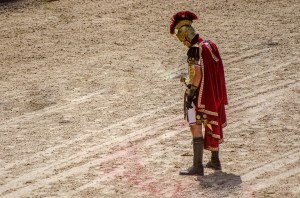
The Roman Gestures Of The Clenched Thumb, And The Turned Down Thumb

The meaning of hand gestures may vary widely from culture to culture.  In the modern West, approval is popularly expressed by the “thumbs up” sign, and disapproval by the downward turn of the thumb.  These hand gestures even seem to be universal, at least in the modern era.  But perhaps it was not always so.  The humanist Angelo Poliziano’s Miscellanies contains a passage in chapter 42 of his book that raises some doubts, at least to my mind.  Philology may shed some light on the subject.

Continue reading

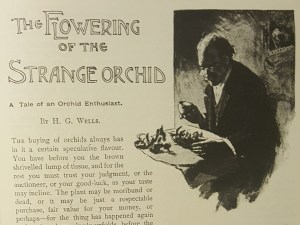
The Flowering Of The Strange Orchid (Podcast)

In this podcast, I read H.G. Wells’s short story The Flowering of the Strange Orchid.  It relates the weird tale of a mild-mannered orchid enthusiast who buys an unknown species of jungle orchid.  As he cultivates it, he finds out that he got more than he bargained for.  This story was first published in Pearson’s Magazine in 1905 and remains a potent tale of unease.

Continue reading

The Meaning Of The Augury Of Safety

The Renaissance humanist Angelo Poliziano (1454—1494) composed a work called Miscellanies (Miscellaneorum Centuria Prima) that discussed various issues in classical literature, philology, and linguistics.  Now while this sort of work may not suitable for every taste, it is certainly congenial to mine.  What may be trifles to some, turn out to be treasure to others; and the meandering flow of critique and discussion may, like swift-moving mountain streams gurgling through sand and rock, reveal here and there some flecks of gold ore for our enrichment.

Continue reading

A Sudden Punch To Shatter Glacial Rigmarole (Podcast)

When things have reached a state of paralysis or gridlock, it is often necessary to shatter the paralysis by taking decisive, muscular action.  Real leaders do not sit on their hands and wait to test the prevailing winds of opinion.  Have the moral courage to act.  Many today who call themselves “leaders” ignore or have forgotten this principle.  This podcast discusses three historical examples taken from Winston Churchill’s The World Crisis.  They show how he harnessed this concept in 1919 to break through the paralysis that had come to surround several difficult issues.

Continue reading