

Some time in the 1840s—the precise year is not certain—a British ship returning from the Mediterranean was obliged to delay its arrival in England for a few days, due to the persistence of stormy weather and thick fog in the Channel. One of the landsmen passengers found it difficult to sleep; and, to pass the time less fretfully, he took to conversing with an experienced old tar, a grizzled Cornishman, who proved to be a fascinating night-watch companion. He had mastered the lore and history of his native country. This mariner told our landsman many ancient tales of disasters, shipwrecks, escapes, and raw courage. One unsettling story, however, proved to be more memorable than all the others. And it is this one which we will now relate.
At the end of the sixteenth century, when parts of the Cornish coast were still wild and barbarous, there existed a species of coastal pirate called a wrecker. Wreckers were murderers and thieves who lured unsuspecting ships to the coastline, where they were likely to be smashed against the dark and jagged rocks. The poor sailors or passengers were then put to death by these criminals, and their cargoes or possessions guiltlessly stolen. Wreckers would fasten a lantern to a horse’s head, and guide the animal along the tops of coastal cliffs. Mariners who saw these lights could easily mistake them for other vessels; and by the time they realized the error, their ships would be too near the shoals to reverse course.
One of these wreckers was an old codger—Terloggan by name—who supplemented his criminal activities with a bit of fishing and smuggling. But in his heart and inclinations, he enjoyed wrecking more than any other activity. His wife, a miserable hag, assisted him in his vocations of plunder and murder. The couple had one child, a son, who had many years earlier fled the family domicile in horror at his parents’ activities. The last news they had heard of him was that he was part of the West Indian merchant service.
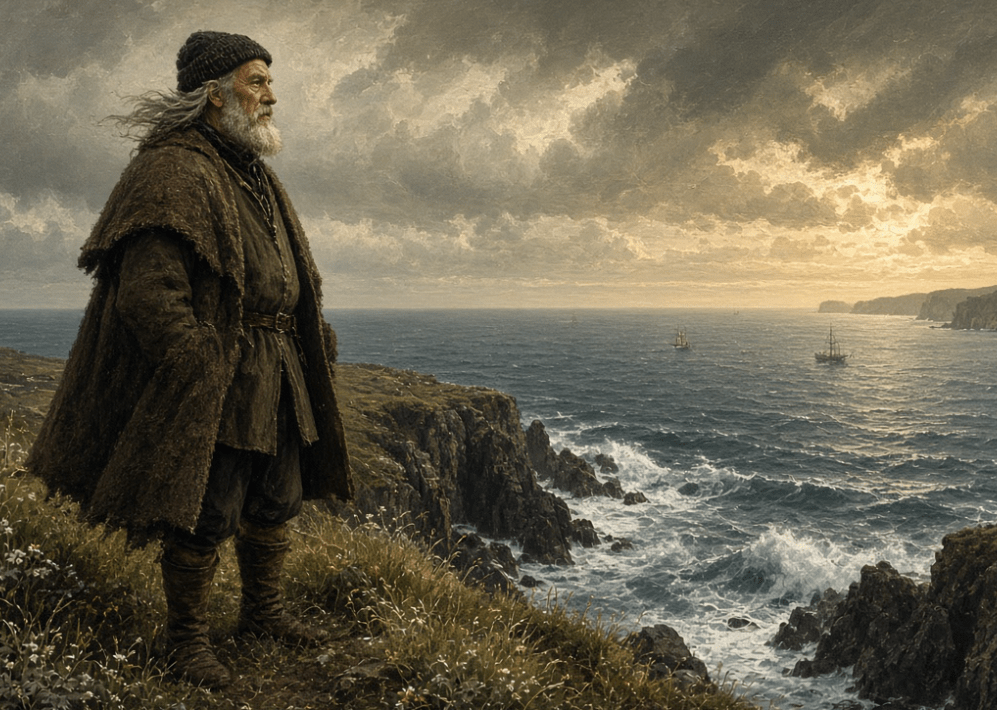
One summer night, after a long hiatus of good weather, a tempest descended upon the coastal area where Terloggan lived. As the winds lashed the shore into a frenzy, the old man left the house with his horse and lantern, determined to trap some wretched ship and lay claim to what it carried. Terloggan ascended a promontory and began his walk; soon he spied an offshore light in the distance. As it came closer, he realized he might find success. Gradually the old man could make out the ship’s white sails, and he could hear the frantic voices of the crewmen as they scuttled about the deck. As the captain became aware of his predicament, he fired the ship’s signal guns, and shouted for all hands to come on deck; but nothing could prevent what was now inevitable.
Terloggan then heard a tremendous crash as the ship struck the rocks; amidst the cries of the desperate men, he could make out the white-capped waves beating against the vessel’s wooden hull. Oars, lifeboats, flotsam, and helpless bodies bobbed, flailed, and sunk beneath the churning waves. The old man felt neither pity nor guilt at this horrid spectacle. Quite the opposite, in fact: the demon was positively elated, for now he might be able to acquire a substantial monetary windfall. A rising, luminous moon spread the scene of destruction before him. It appeared that all the crewmen, save one, were dead. Terloggan crept up to the lone survivor, killed him, and proceeded to empty his pockets and remove a ring from the sailor’s finger. Laden with as much booty as he could carry, the old man tramped home, and presented the fruits of his thievery to his despicable wife. Terloggan explained with enthusiasm how he had lured the ship to its doom, how he had murdered the survivor, and how he had made off with his spoils. Spread out on a table, he and his wife now had an opportunity to examine more closely what they had. Slowly, the old man raised the stolen ring to the light. And to his horror, he realized it was the ring of his only son Tom.
With a shriek, the old hag fell to the floor and rolled about in a frenzy of despair and agony. Her cries filled their tiny hovel, and would not subside. Terloggan was struck speechless; paralysis overtook him and he was unable to move. Yet there was some doubt that lingered in his mind. At first light he returned to the site of the wreck to see if, indeed, he had really destroyed his son. As his eyes fell upon the pale corpse, he received his confirmation of the truth of the murder: it was indeed his son Tom. For several days and nights, the doomed Terloggan wandered among the promontories and the coastal rocks, searching for something he knew not what, or perhaps seeking forgiveness from some unknown being. But neither relief nor forgiveness were to be had.
There would be no rest for the wicked. He who had remorselessly wrecked the lives of so many was now tasked with wrecking one last life: his own. One morning Terloggan’s broken body was found by a villager at the base of a tall promontory, from where he had leapt to this death. The decrees of Fortune can neither be escaped nor assuaged. So did divine retribution mandate that the same fate to which an evil man had consigned so many others, should finally, and inevitably, be visited upon himself.
.
.
.
Read more essays on moral, biographical, philosophical, and historical subjects in the collections Digest and Centuries.


You must be logged in to post a comment.