
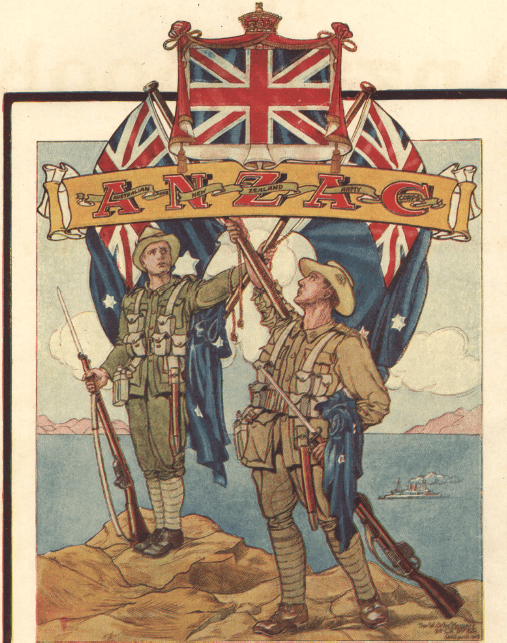
I recently chanced upon one of those fascinating old volumes that reaffirms the value of the book hunter’s pursuits. The book is entitled The Anzac Book, and it is a collection of anecdotes, stories, poems, and sketches made by the Australians and New Zealanders who fought at Gallipoli during the First World War. For those unfamiliar with the term, Anzac is an acronym for Australian and New Zealand Army Corps. The manuscript was written and set in 1915, while the fighting still raged, and the volume was intended to be published in late 1915 as a kind of Christmas treat for the men in the trenches. The withdrawal of the landing force in December 1915 and January 1916, however, put an end to this schedule. The book was eventually released in England in 1916.
The book’s purpose was to raise the morale of the men, record their longings and experiences, and serve as a mouthpiece for their common struggle. In the days before broadcast radio, before television, and before the internet, print was one of the few ways communications could circulate. Drawings, paintings, and literary pieces of all types were solicited, and an editorial staff of soldiers was asked to sift through the mass of material submitted by all ranks.
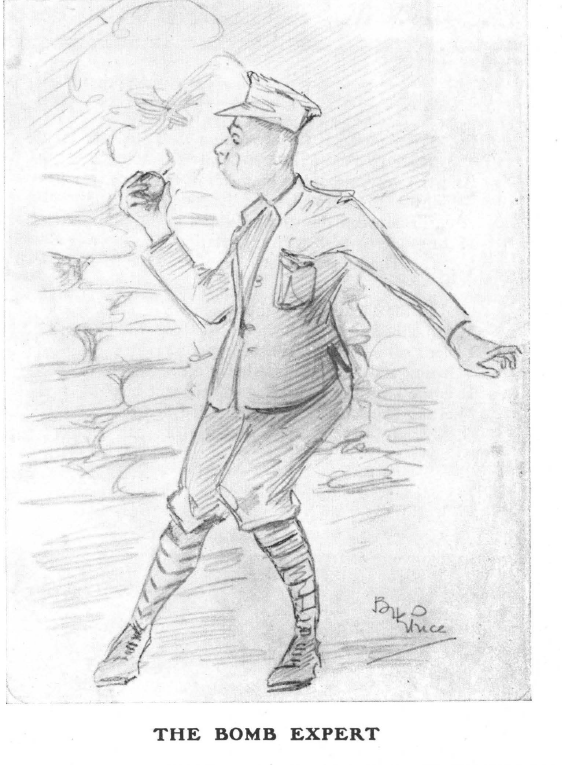
What strikes the modern reader is the extraordinary quality of the poetry; educational levels in the humanities were clearly far higher than they are today. One doubts whether one man in a hundred today could compose verses of equivalent merit.
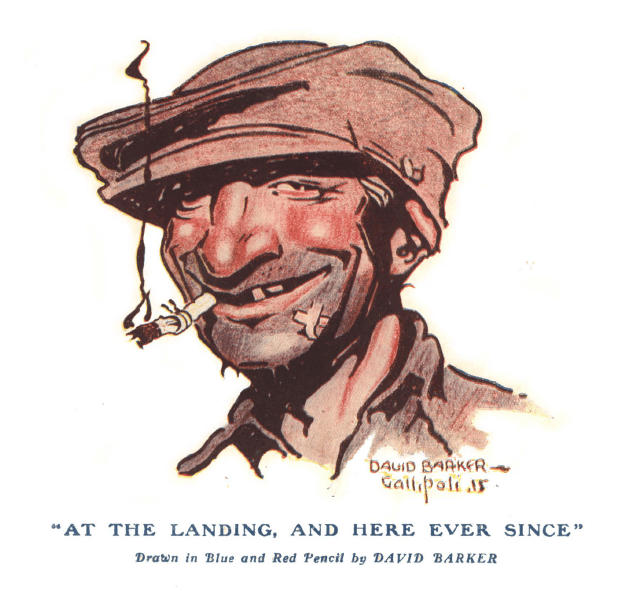
There emerges from the volume’s two hundred pages a spirit of dogged determination, of consciousness of honor-bound duty, and of irrepressible Australian humor. It is a stirring testament; what makes the publication all the more remarkable is the fact that the contents were written under conditions of the most extreme adversity. As the editor’s note states:
The book of Anzac was produced in the lines at Anzac on Gallipoli in the closing weeks of 1915. Practically every word in it was written and every line drawn beneath the shelter of a waterproof sheet or of a roof of sandbags-either in the trenches or, at most, well within the range of the oldest Turkish rifle, and under daily visitations from the smallest Turkish field-piece. Day and night, during the whole process of its composition, the crack of the Mauser bullets overhead never ceased. At least one good soldier that we know of, who was preparing a contribution for these pages, met his death while the work was still unfinished.
Here is a humorous anecdote written by a correspondent in the Australian Field Artillery “Sea View,” Boltons Knoll, near Shell Green:
I was looking out from the entrance of my dug-out, thinking how peaceful everything was, when Johnny Turk opened on our trenches. Shells were bursting, and fragments scattered all about Shell Green. Just at this time some new reinforcements were eagerly collecting spent fuses and shells as mementoes. While this fusillade was on, men were walking about the Green just as usual, when one was hit by a falling fuse. Out rushed one of the reinforcement chaps, and when he saw that the man was not hurt he asked: “Want the fuse, mate?” The other looked at him calmly. “What do you think I stopped it for? he asked.
Another story, entitled “The Yarns That Abdul Tells,” was written by someone identified by the initials “A.P.M.”:
One of the chief pastimes of the Turks who live behind the black and white sandbags opposite (writes an officer who knows them. intimately) is that of listening to stories told by the storytellers in the cafes of the Asia Minor villages. The hero of these stories is very often a certain Nastradi Hodja (who really existed at one time, and made a reputation by his wit as well as through his stupidity). Here is an example of the sort of story about Nastradi which especially pleases the Turk: Nastradi Hodja’s wife woke up one night through hearing a noise. She got up, and going out on to the landing on the upper floor, outside her bedroom, called out: “Nastradi, what was that noise?” Nastradi’s voice came up from below. “Don’t pay any attention to it,” he said. “It was only my shirt that tumbled down the stairs.” ” Does a shirt make such a noise?” she asked. ” No,” was the reply; “but I was in it.”
A private named Charles Lowry of the 9th Australian Battalion composed this fine short poem, “How I Shall Die”:
I only wait the eventide,
The rising of the moon–
My little barque I’ll gently slide
Into the still lagoon.
Here storms are fierce and nations wage
Across the seas their strife,
And death’s wild billows break their rage
Against the rocks of life.
I only wait the last, long call–
Perchance a short farewell–
Then gently for the mists to fall
O’er silent hill and dell.
From one “A. Carruthers” of the 3rd Australian Field Ambulance Corps comes this vivid description he titled “Flies and Fleas”:
Regarding these two particular pests, my attitude in the past has been characterised by the utmost forbearance; I tolerated them and looked upon them as harmless and possibly of some usefulness to the community. The Gallipoli specimens, however, have changed my state of “benevolent neutrality” into one of most deadly warfare. No “Hymn of Hate” has yet been composed which would give expression to the hatred which has possessed me. Do you but go into the trenches in the endeavour to perform your duty to your country, and the flies immediately try to dissuade you by getting into your eyes, ears, nose and mouth. Nothing will drive them away; they delight in this; they are entirely without pity. Retire to your dug-out in the hope of escaping their attentions, and they are sure to follow you. Smoke till you all but asphyxiate yourself, and you find them as active as ever. Nothing that human ingenuity can devise will cause them to retreat; they defy our puny efforts.
You may imitate the Kaiser and “strafe” them for all you are worth, but it is only waste of breath; they glory in this and come back all the more. What we frequently distrust in the way of tucker holds no terrors for the Gallipoli flies; they delight in taking risks if only to impress us with their fearlessness. Stepping boldly on the edge of a syrup-covered biscuit, they immediately get their feet entangled; but they will not retreat—that would be against all their traditions. Instead, they will struggle their way towards the centre, where they gladly give up the contest and die.
They are born conquerors. I doff my hat to them in spite of my hate. With the setting sun the flies retire, but operations are simply handed over to their allies, the fleas; and no worthier ally could be, found than those pilgrims of the night. You may feel beat to the world; but there is no rest for you; as soon as you lie down to enjoy a well-earned rest the attack commences. Advancing in open or close formation, according to circumstances, the enemy attacks on every flank with fixed bayonets, in the handling of which his units are experts. If driven off, they come again in still greater numbers; they appear to have unlimited reserves of reinforcements which can be mobilised on the shortest notice. Their organisation is perfect. Counter-attacks in the dark are all in the favour of the enemy, and morning finds that they have withdrawn their forces to advantageous cover in the blankets, from which it is impossible to dislodge them…The honours have so far fallen to the enemy. Personally, I would be inclined to discuss terms of peace, but I doubt not he is too depraved to accept my advances.
Perhaps the finest poem is this beautifully reflective gem entitled, “A Confession of Faith,” composed by a medical officer named Capt. James Sprent:
Who would remember me were I to die,
Remember with a pang and yet no pain;
Remember as a friend, and feel good-bye
Said at each memory as it wakes again?
.
I would not that a single heart should ache–
That some dear heart will ache is my one grief.
Friends, if I have them, I would fondly take
With me that best of gifts, a friend’s belief.
.
I have believed, and for my faith reaped tares;
Believed again, and, losing, was content;
A heart perchance touched blindly, unawares,
Rewards with friendship faith thus freely spent.
.
Bury the body—it has served its ends;
Mark not the spot, but “On Gallipoli,”
Let it be said, “he died.” Oh, Hearts of Friends,
If I am worth it, keep my memory.
Should anyone ever doubt the sustaining capacity of artistic endeavor, let him browse the literary and pictorial efforts in the pages of The Anzac Book. In its original conception, it was intended as a communal survival guide for men enduring the very worst physical conditions on earth. Now, over a hundred years later, it stands as a historical testament to the greatness of the men who fought at Gallipoli and, perhaps, serves as a buoyant reminder to those seeking refuge from private hells that one must persevere. For we have the ability, through the faculties of the imagination, to make good our own escapes, even from the most acute crises, or the most dire of circumstances.
.
.
.
Read essays on moral, biographical, philosophical, and historical subjects in the collections Digest and Centuries.

