
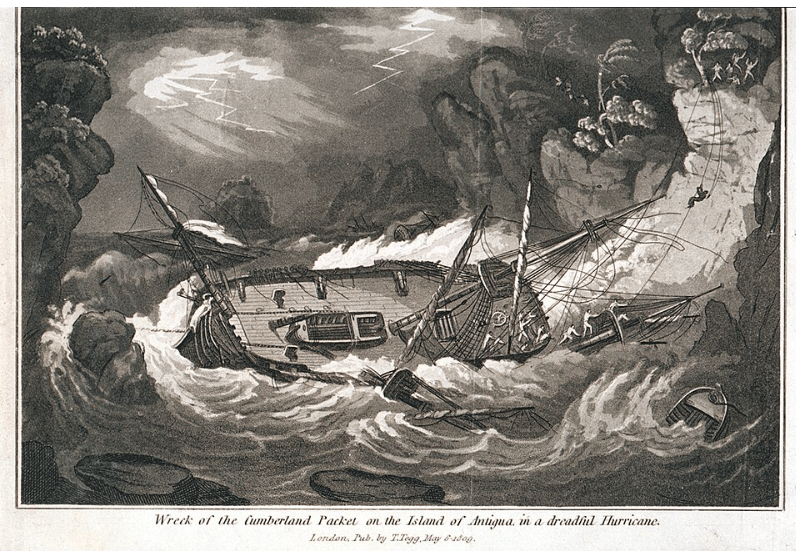
On September 4, 1804, the British packet Duke of Cumberland was wrecked in a ferocious hurricane that pounded the island of Antigua. Readers unfamiliar with nautical classifications may wish to know that the term packet refers to a ship carrying, on schedule, mail, passengers, and other cargoes. The story of the aftermath of the wreck is an inspiring one, as all hands were saved by the intrepid action of the first mate, Mr. Doncaster. His first name has not come down to us.
When the hurricane struck Antigua, the Duke of Cumberland lay at anchor, along with several other ships. Captain Lawrence, who was in command of the vessel, took the required actions (“striking the masts and yards”) that would have allowed the packet to ride out the gale. But the intensity of the storm rendered these precautions useless. The ship became detached from its anchor, and its destruction seemed to the crewmen to be almost inevitable. Captain Lawrence summoned the men on deck and informed his men that all was lost. Some sailors said their prayers; others clung to bits of rope or wood in the hope of surviving the fury of the waves. For over an hour the ship drifted here and there, battered unendingly by rain and immense waves.
The packet drifted into the harbor of St. John’s, and fired two guns, in the hope that they might be rescued by anyone within hearing. The crew thought there might be a chance that the ship would simply be beached, but these hopes proved illusory. The captain ordered the carpenter to pass out hatchets, so that the rigging and masts could be cut away and fashioned into a raft. The vessel then crashed violently against rocks, and began to take on water; but in the darkness of night, it was not possible for the men to determine their precise location or circumstances. All the men could do was to cling to the remains of the ship, endure the hurricane, and wait for daybreak. Not a man slept.
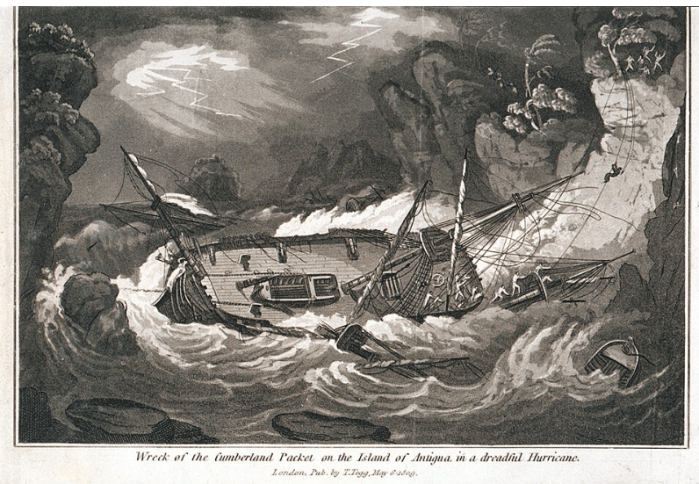
Dawn brought even more anguish. The men could see that the Duke of Cumberland was completely destroyed, with its fragments trapped in coastal rocks at the base of an immense cliff. This looming precipice was twice the height of the ship’s main mast. The crew believed that their best hope of salvation lay in reaching the top of the cliff. But how to do it, when the storm had not yet abated? The first efforts were focused on trying to position a surviving mast as close to the cliff as possible, and then throwing a rope at the apex of the cliff. The hope was that a line could be securely fastened there, and the crew could be hauled out, one by one. These attempts were unsuccessful, as the rope could find nothing secure to cling to. There were only a few bushes at the top of the cliff, and these simply pulled away.
One man planned to crawl out to the end of a mast, high up in the air, and leap onto the cliff face, hoping that he might be able to climb to the summit and there receive a rope thrown to him. This plan ended in failure when the top of the mast broke off and he plummeted into the sea. It was at this point that the taciturn first mate, Mr. Doncaster, took matters into his own hands. Without informing anyone, he walked to the remnants of the bow and leapt into the water. A huge wave disgorged him on a jagged rock; a second wave threw him closer to the base of the cliff. To the astonishment of the other survivors, Doncaster then proceeded to climb the sheer rock face. He reached the summit in about thirty minutes of intense exertion. At the apex he walked to a point where he could receive a rope thrown from another sailor who had crawled to the end of a mast. The men now had a means of pulling each man to the safety of land. Over the span of three hours, every man was lifted out. But their ordeal was not yet over. Exhausted and dehydrated at the summit of the cliff, they still had to reach an inhabited location. The men were forced to wade through three miles of flooded sugarcane fields, but reached St. John’s without the loss of a single man. Doncaster had taken matters into his own hands, and his courage had been rewarded.
.
.
.
Read more essays on moral, biographical, philosophical, and historical subjects in the collections Digest and Centuries.


You must be logged in to post a comment.