
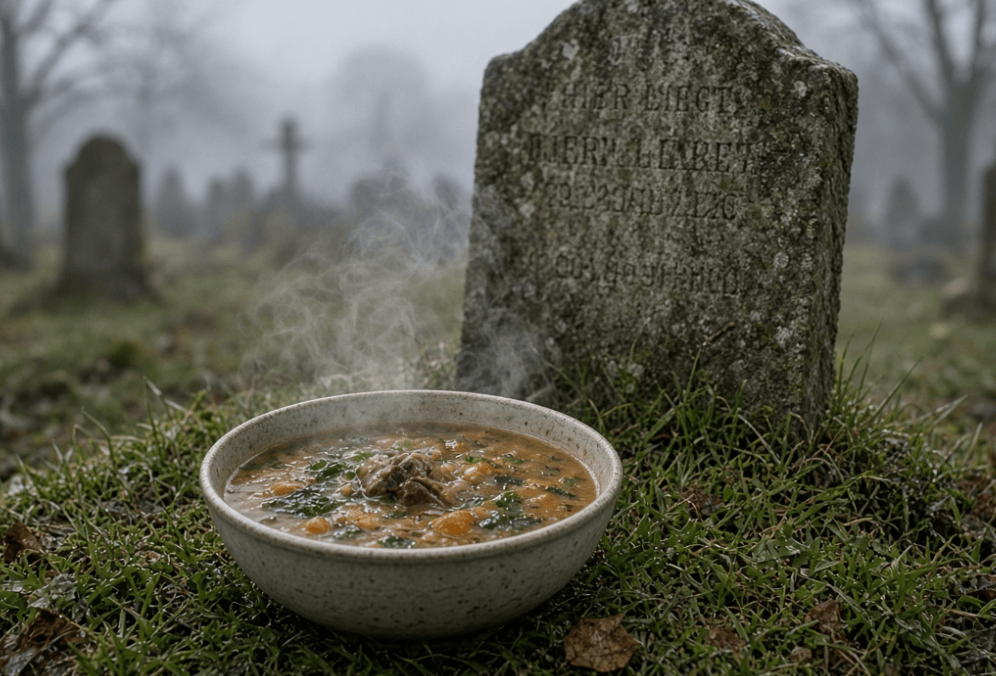
Among the many interesting little oddities in Dante is one found in Canto XXXIII of the Purgatorio, in lines 34 to 36. In Mr. Ciardi’s translation, these verses read:
The cart the dragon broke was, and is not;
Let him whose fault that is believe God’s wrath
Will not be calmed by soup, however hot.
The central focus of the Canto is to describe Dante’s final purification in preparation for his ascension to Paradise. Mr. Ciardi’s commentary on these lines explains the richness and diversity of the allusions they contain. There is first a play on the words of Revelation (17.8), “The beast thou sawest was, and is not.” The reference to soup, however, leads us down fascinating passageways.
Ciardi explains that there existed a superstition “in parts of ancient Greece” that a murderer could avoid detection for his crime if he managed to consume soup for nine consecutive days over the grave of his victim. Furthermore, we are told, it was a Florentine practice to post guards near the grave of a homicide victim for nine days to prevent anyone from eating soup over it. Dante’s mentioning of this folk custom is his way of telling his readers that mythic rituals and incantations can never thwart divine justice.
This may be all well and good. But where could this strange superstition possibly have come from? No one seems to know with certainty. Commentators have found its origins in the “vengeance culture” of medieval Florence, in old Germanic rituals, and in general Mediterranean burial and mourning customs. This seems to me logical, but one would like to have more information. I do not know if the scholars of Dante (of which there are a great many) have suggested a Roman cultural origin for the “nine-day soup-eating” folk tale. But this to me seems the most likely, in one form or another. We know that in ancient Rome there existed a festival called the novendiale, a word formed from the Latin words for nine (novem) and day (dies). It was essentially a dinner held after the nine days of mourning following someone’s death. References appear in Tacitus’s Annals (VI.5) and in Petronius’s Satyricon (55), where we find the line,
Scissa was holding an elegant funeral dinner [novendiale] for her slave, whom she had freed as he neared death.
The fact that Dante’s soup-eating grave ritual involved nine days, and the old Roman novendiale also involved nine days, causes one to be suspicious. I suppose it could be a coincidence. But perhaps it is something else. Religious rituals can, over time, evolve into folk habits, superstitions, or customs that have little or nothing to do with the original purpose of the ritual. Divergence proceeds with evolution. We recall that modern Halloween is an outgrowth of the Christian “All Saints’ Day,” celebrated on November 1. The remembrance of a 4th century bishop named St. Nicholas evolved into a modern icon named Santa Claus.
In olden times, during the Christian holiday of All Souls’ Day (celebrated on November 2), the devout would knock on doors and ask for something in exchange for “prayers for the departed.” Such prayers for the dead, it was believed, assisted souls in Purgatory by deducting years from their “sentences,” so to speak. Yet with the passage of centuries, the original context and purpose of going door-to-door to ask strangers for trifles became lost. What remained was a whimsical parody of the original rite. The evolution of culture and ceremony is much like biological evolution: new environments and conditions generate stimuli or stresses, which in turn create opportunities for adaptation. Everything in this world is subject to evolution and change; the flux of time leaves nothing untouched.
.
.
.
Read more in the essay collection Centuries.

