
The following story is found in the memoirs of the French traveler and gemstone trader Jean-Baptiste Tavernier. He lived from 1605 to about 1689, although the exact date of his death is not known with certainty.
Tavernier was born of a Huguenot family, and was infected with the urge to travel at an early age. By a remarkable series of journeys, he was able to establish himself as a jeweler in the Near East, particularly in Persia and the Mogul regions of what is now northern India. His name is mostly forgotten today, but he does retain the distinction of having sold the “Blue Diamond of the French Crown” to Louis XIV in 1668. This spectacular stone was later renamed the “Hope Diamond” after its theft and recutting in the wake of the French Revolution.
Around 1652, Tavernier found himself in the city of Surat, in the Indian state of Gujarat. The region was at that time ruled by Shaista Khan (Mirza Abu Talib), the maternal uncle of the noted Mogul emperor Aurangzeb. Tavernier had by this time made a respectable reputation for himself; but as every businessman knows, his acumen was frequently tested by both his customers and by the holders of the local reins of power. Using his suppliers and various contacts, he had sold Shaista Khan merchandise worth 96,000 rupees. When the time to pay arrived, Tavernier presented himself respectfully before the Khan, and reminded the Mogul of the balance owed. The Khan asked our merchant whether he would prefer to receive payment in gold or silver coin. “Sire, I am willing to leave that matter to your discretion,” was the Frenchman’s tactful reply. The Khan suggested gold rupees; Tavernier gratefully accepted.
However, when payment was made, the Khan had used the exchange rate of 14.5 silver rupees per gold rupee. Tavernier was well aware—and of course the Khan was also aware—that the current exchange rate was, in fact, 14 silver rupees per gold rupee. By overvaluing the gold coinage by one-half rupee per gold coin, the Khan was intending slyly to reduce his bill: the payment Tavernier actually received would be worth less, at current market rates, than the 96,000 rupee balance owed. Tavernier understood the game that was unfolding, but, as an experienced businessman, he was willing to “eat” this loss as a temporary cost of doing business with a powerful figure who might become a lucrative client.
The Frenchman had his own way of negotiating, however. Several days later, he again appeared before the Khan, and told the irritated potentate that he could find no money-changer willing to give him 14.5 silver rupees for one gold rupee. The going rate, he said, was 14, not 14.5. By his calculations, the Frenchman continued, he would lose around 3,428 rupees on the 96,000 payment he had been given. The Khan exploded in anger, accusing a Dutch currency trader of bad faith dealings; he threatened to have the man whipped with as many lashes as constituted the supposed numeric shortfall. Tavernier let the Khan rage, knowing that it was better to stand silent in the face of such a tempest. When the Khan had collected himself, the Frenchman asked him whether he should return the gold rupees or, he politely suggested, whether the Khan might be willing to compensate him in some other manner.
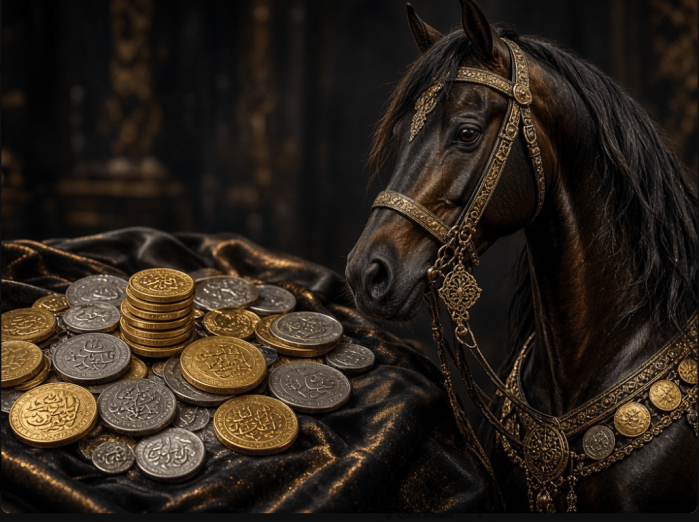
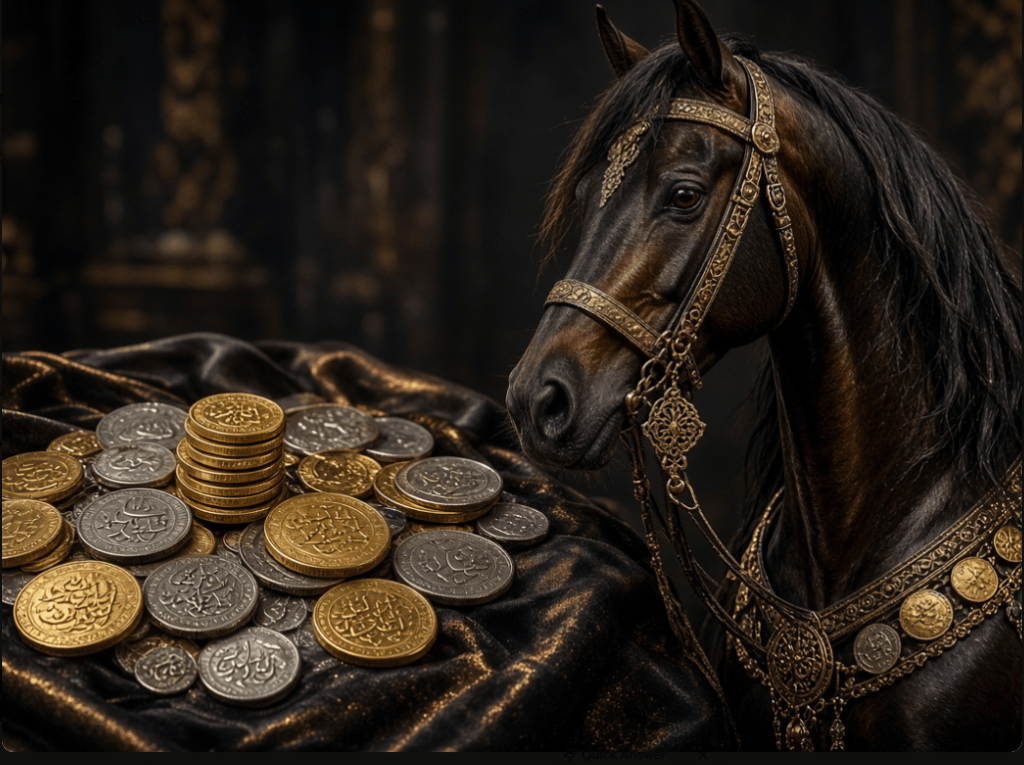
The Khan stared at Tavernier for a time, then slowly asked if the Frenchman still had a certain large pearl that had once attracted his attention. Our merchant replied in the affirmative. The Khan, his calm now restored, asked him what the price was. “Seven thousand rupees,” was the reply. The Mogul offered him five, pointing out that this would compensate him for the loss on the earlier transaction. For good measure, the Khan said he would add a formal robe and a horse to the bargain, because he “wish[ed] [Tavernier] to depart contented.” The offer was accepted, and Tavernier asked that the horse be a sturdy animal, one suited for arduous journeys.
He then took his leave, and appeared before the Khan the next day to complete the agreement. The horse was a beautiful animal, outfitted in green velvet with silver fringe. The horse was later found to be ill-tempered and unruly. When Tavernier informed the Khan of this, the Mogul laughed heartily, and replaced the mount with a fine Persian steed, one that had been owned by his father. The Mogul’s largesse did not end there; he added a basket of Kashmiri apples and a Persian melon, a fruit which, we are told, was then extremely valuable.
This amusing anecdote reminds us that, in many instances, continuing a dialogue, and avoiding hostile confrontations, can yield profitable results. Tavernier’s extensive dealings with Persians and Mogul officials had taught him the value of tactful diplomacy with the commercially-minded peoples of the Near East. Had he sullenly badgered the Khan over his monetary grievances, had he met the Khan’s feigned anger with anger of his own, he would have destroyed his relationship with him. No one responds to the language of threats and humiliation. By retaining his composure, by behaving as a gentleman and providing the Khan with a face-saving way out of the impasse, he found himself in an even better position than the one he had originally contemplated.
.
.
.
Be sure to take a look at the new, fully annotated translation of the Roman soldier Frontinus’s masterpiece of military strategy, Stratagems.

